Have you ever felt your heart race every time you deploy a new feature, or felt anxious that your service might crash?
This "deployment phobia," experienced by almost every developer, isn't just a psychological phenomenon. The process of "redeployment"—modifying code and pushing it back to the server—itself places a burden on the system, and unexpected bugs can cause immediate damage to the entire user base.
Particularly in recent times, as the speed at which AI agents generate and deploy code has accelerated, code is being pushed into production at a pace that is difficult for humans to review individually. In this era of chaos, what we need is not just a simple deployment tool, but a sophisticated "safety mechanism" that can toggle features on and off in real-time.
Today, we will conduct an in-depth analysis of Cloudflare Flagship, which has emerged to fundamentally solve this problem, focusing on how it differs from existing feature flag methods and why it could become the next-generation standard.
Current Dilemma: Feature Flags—Why are they still heavy and unreliable?
We are already well-acquainted with the concept of "Feature Flags." It is a feature that allows you to show specific functions only to certain users even after the code has been deployed, or to immediately disable them if problems arise. However, when attempting to implement this in a professional setting, several major hurdles appear.
The first problem is Latency. Most feature flag services ask, "Can this user see this feature?" via an external API. Since a communication round-trip with an external server must occur every time a user makes a request, a decrease in service response speed was an unavoidable destiny. This essentially undermines the core value of "low latency," which is the essence of edge computing.
The second is Management Complexity. When there are only a few flags, it can be solved with hardcoding, but as a service grows and dozens or hundreds of flags are created, it becomes impossible to track who changed which flag and when. Without a centralized management system, it eventually turns into spaghetti code.
Lastly, there is the Discord with Serverless Environments. Serverless environments like Cloudflare Workers execute in an independent environment for every request. Many existing SDKs were designed to cache flag values in memory, but in a serverless environment, the memory disappears once the request ends, making it impossible to enjoy the benefits of caching.

Comparison of Alternatives: Traditional Methods vs. External SaaS vs. Cloudflare Flagship
So, what options do we have? Let's compare the three main methods currently used in the industry.
1. Hardcoding and DIY Approach
The most primitive yet intuitive method. This involves directly inserting logic like if (feature_enabled) { ... } into the code.
- Pros: No additional cost and extremely fast due to no external dependencies.
- Cons: As the number of flags increases, code management becomes a disaster. Since you must modify and redeploy code to turn off a feature, you cannot achieve the fundamental purpose of feature flags: "separating deployment from release."
2. Traditional Third-party SaaS Solutions
This method involves using services from specialized companies like LaunchDarkly.
- Pros: Provides a very powerful UI and granular targeting features, with well-equipped management tools.
- Cons: It is very expensive. Furthermore, it is not free from the aforementioned "network latency" issue. Since an HTTP request must be sent to an external server every time it operates in an edge environment, it can be a fatal poison for high-performance services.
3. Cloudflare Flagship (The Edge-Native Solution)
A next-generation solution built directly by Cloudflare at the infrastructure level.
- Pros:
- Zero-Latency: Flag evaluation is performed locally at the Edge. This is because the data is already near the execution environment, removing the need to ask an external server.
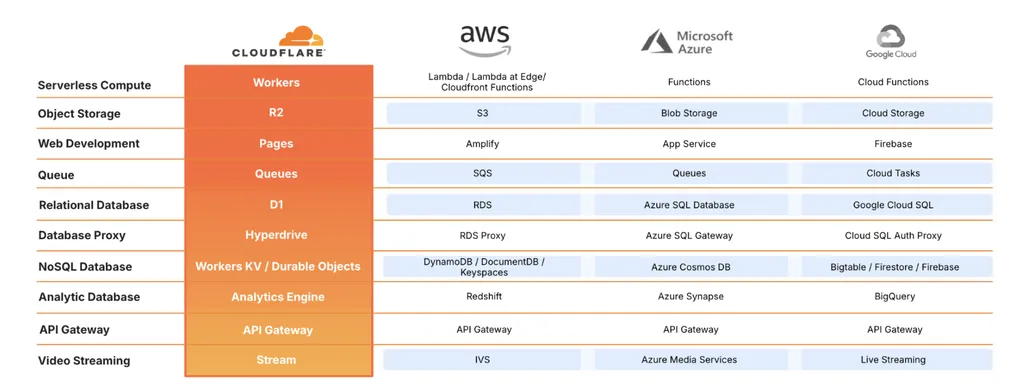
- Infrastructure Integration: It achieves both data consistency and speed by utilizing Workers, KV, and Durable Objects.
- OpenFeature Compliance: Since it follows an open standard that is not tied to a specific vendor, you won't need to overhaul your code even if you change tools later.
- Cons: The only barrier is that it is currently in Closed Beta, so not all users can use it immediately.
Why Cloudflare Flagship is Technically Superior: "The Power of the Edge"
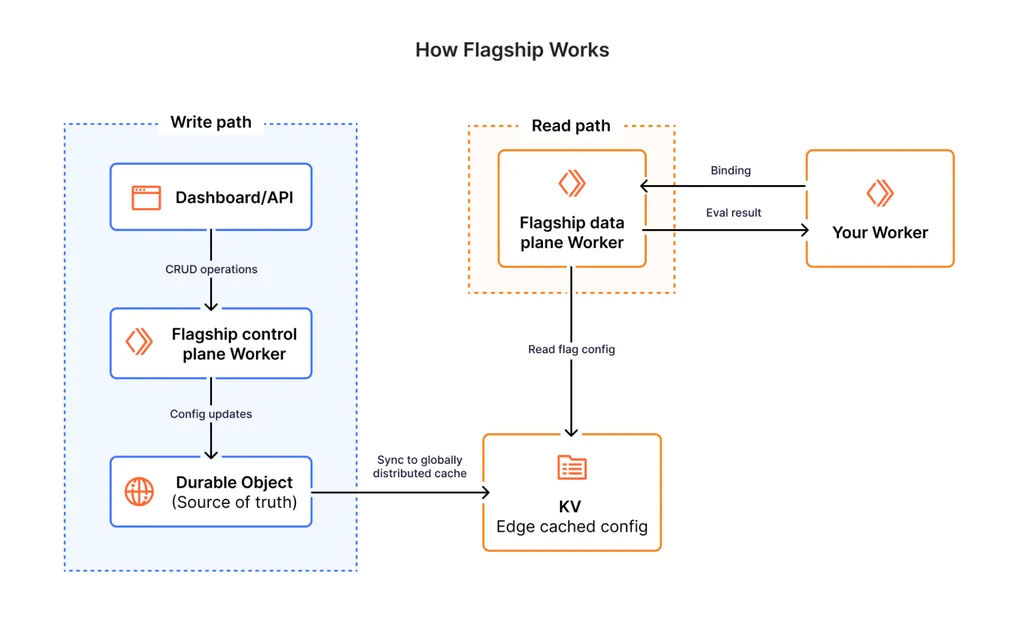
Why is Flagship overwhelmingly faster than other services? The secret lies in its architecture that leverages the entire Cloudflare stack.
If traditional methods are "going to a central server to get permission," Flagship is "keeping the permission slip in your pocket."
Flagship manages the "Single Source of Truth" for flag configurations through Durable Objects. When a configuration changes here, it is immediately synchronized to Workers KV distributed across the globe. At the exact moment a developer executes code, the flag value is already stored in the KV at that specific edge location.
As a result, there is no need to travel to a distant server via the external network. This is why flags can be determined with sub-millisecond latency. This becomes a massive competitive advantage in modern workflows where AI agents must generate and execute code in real-time.
Additionally, the support for the OpenFeature SDK should not be overlooked. This is a key element in preventing vendor lock-in. In other words, while using Cloudflare's technology, you secure the flexibility to maintain your code structure when moving to another platform later.
Practical Application: How Can You Get Started?
Flagship is designed to support various environments. Depending on your development environment, you can approach it as follows:
-
Cloudflare Workers Environment: The most powerful mode. By using
FlagshipBinding, you can access flags very easily and safely, such as throughenv.FLAGS, without separate authentication tokens or HTTP calls. This is the most perfect form in terms of performance. -
Node.js and General Server Environments: You can use the
@cloudflare/flagshipTypeScript SDK. However, in this case, you must configure authentication information such asappId,accountId, andauthTokenbecause it uses HTTP evaluation mode. -
Browser Environment: Flags are evaluated in the user's browser through the
FlagshipClientProvider. Because all flags are pre-fetched and cached in memory, you can control features in real-time without compromising the user experience.
An SDK for Python users is also provided, allowing for flexible integration in server-side Python applications.
Conclusion: The Paradigm of Deployment is Changing
To summarize, Cloudflare Flagship is not just a simple tool for toggling features. It is an Edge-native safety mechanism designed to completely separate Deployment from Release and fit into the era of ultra-fast, AI-driven development.
- Traditional methods had to pay the price of latency and management complexity,
- External SaaS had limitations such as high costs and network overhead,
- Flagship solves both of these problems simultaneously by utilizing edge infrastructure and secures flexibility through open standards.
Now, instead of the anxiety of "Will this code run?", developers can focus on more productive questions like "Which users should see this feature first?" Although it is currently in closed beta, it is clearly a technology that teams using the Cloudflare ecosystem must pay attention to.
Which method makes you feel most anxious when deploying new features? Or what is your biggest complaint with the feature flag services you currently use? Please share your experiences in the comments!
What do you think?
References
- Overview · Cloudflare Flagship docs · developers.cloudflare.com
- Introducing Flagship: feature flags built for the age of AI · blog.cloudflare.com
- 플래그십 소개: AI 시대에 맞춰 구축된 기능 플래그 - The Cloudflare Blog · blog.cloudflare.com
- OpenFeature SDK · Cloudflare Flagship docs · developers.cloudflare.com