Have you ever looked at a chart and asked yourself, "How will this pattern move next?"
Losing your way amidst countless technical indicators and complex formulas, or feeling your heart sink during sudden volatility, is a fate shared by all traders. Until now, AI has been a genius at understanding text, but it remained powerless against the subtle movements of candlesticks (K-lines) that we face every day.
However, in 2026, a game-changer has emerged: Kronos, the first open-source foundation model that has directly learned the language of financial markets. Today, we will dive deep into why this revolutionary model is being called the 'GPT Moment' of financial AI, going far beyond a mere prediction tool.
Why was traditional AI powerless in front of charts?
We often believe that Large Language Models (LLMs) will solve everything. However, financial data possesses an ecosystem entirely different from language.
The biggest problem faced by existing Time-Series Foundation Models (TSFMs) was their inability to handle the high-noise characteristics unique to financial data. Stock price data is not just a simple sequence of numbers. It is a multi-dimensional flow created by the complex interplay of Open, High, Low, Close, and Volume (OHLCV).
General time-series models often made the mistake of ignoring these complex correlations or mistaking noise for signals. It is similar to someone who doesn't know grammar attempting to interpret a foreign sentence based solely on the statistical frequency of individual words. Consequently, existing models failed to keep up with the actual dynamics of the financial market when predicting volatility or generating synthetic data.
Kronos: Rewriting the 'Grammar' of Finance
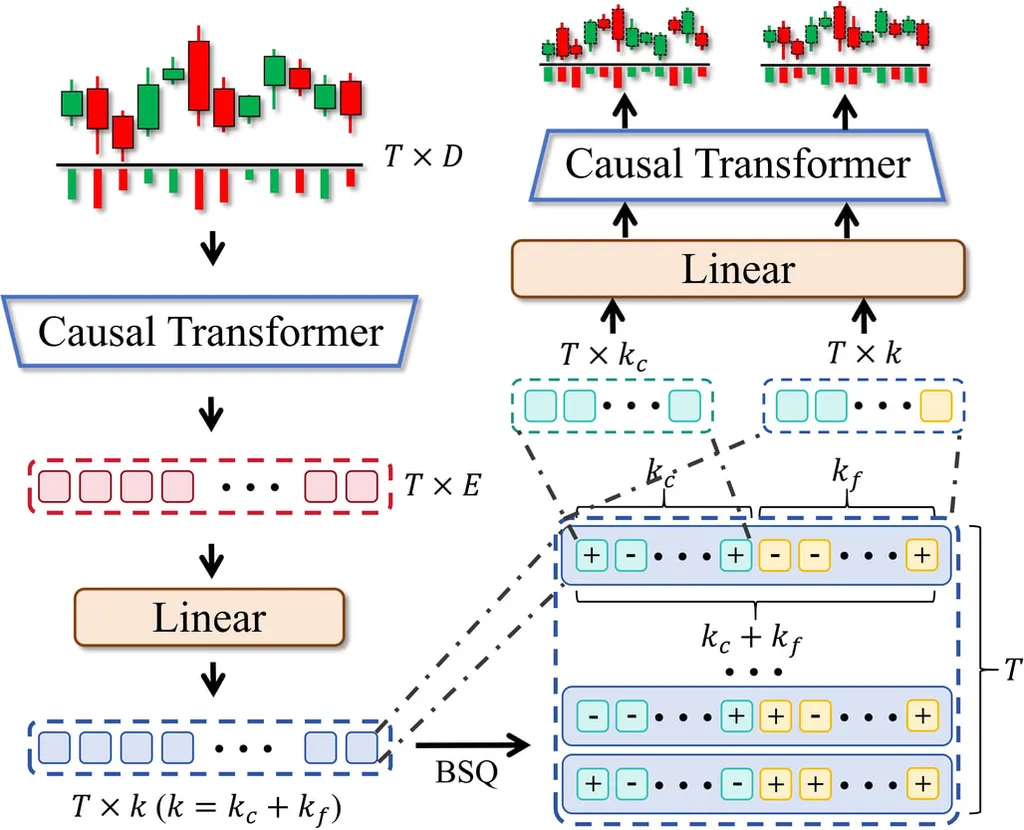
To solve this problem, Kronos approaches the challenge from a completely different perspective. This model treats financial data not as simple numbers, but as a "language."
The core of Kronos lies in its innovative two-stage framework.
- Specialized Tokenizer: It converts continuous candlestick data into hierarchical discrete tokens. This process is similar to converting words in a sentence into numbers, but it is a highly advanced technique that quantizes data into a form easy for the model to understand while preserving price movements and volume patterns.
- Autoregressive Transformer: It learns these converted tokens to predict the next pattern. Just as GPT predicts the next word, Kronos predicts the shape of the next candlestick.
What is even more astounding is the scale of the data. Kronos has learned from a massive dataset of over 12 billion entries collected from more than 45 global exchanges. Thanks to this, the model is not confined to specific assets but possesses a universal "financial intelligence" that functions across diverse market conditions.
In fact, according to benchmark results, Kronos showed a 93% improvement in RankIC (a price prediction metric) compared to existing top-tier models. This implies that its Zero-shot capability—the ability to analyze entirely new assets immediately without additional training—is incredibly powerful.
Examining Kronos's Predictive Power with Real-World Data
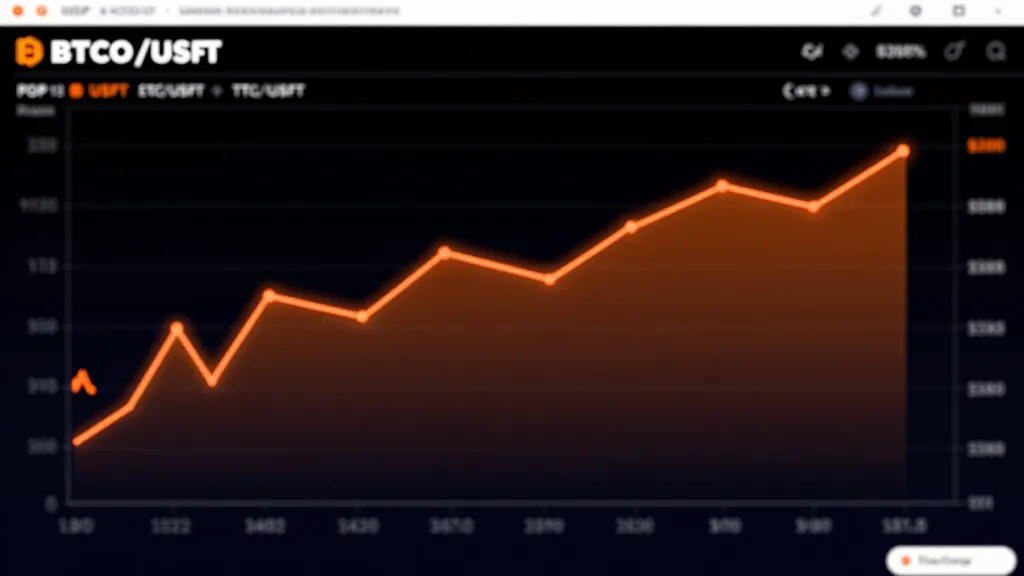
Theory alone is not enough. Let's see how Kronos operates in the actual market.
As of May 27, 2026, looking at the direction of Bitcoin (BTC/USDT) through a real-time demo of Kronos reveals an interesting point. Based on prediction results using 1-hour candle data from Binance, the probability of the Bitcoin price rising more than its current level over the next 24 hours is 46.7%.
What should be noted here is not just the simple "up/down" figure. Rather than predicting a single point, Kronos uses Monte Carlo Sampling to simulate tens of thousands of possible future paths.
On the chart, the solid orange line represents the average predicted path, while the surrounding shaded area indicates the possible range of prices. According to the demo results, the probability that volatility will exceed recent historical volatility within the next 24 hours is 63.3%, which can be interpreted as a strong warning signal that the market will exhibit highly dynamic movements.
Users can control the sophistication of the prediction by adjusting parameters such as temperature (T) or top_p through an intuitive tool called KronosPredictor. Much like an experienced trader adjusting their intuition, one can finely manage the probabilistic prediction range of the AI.
A Powerful Tool for Everyone: Model Lineup and Limitations
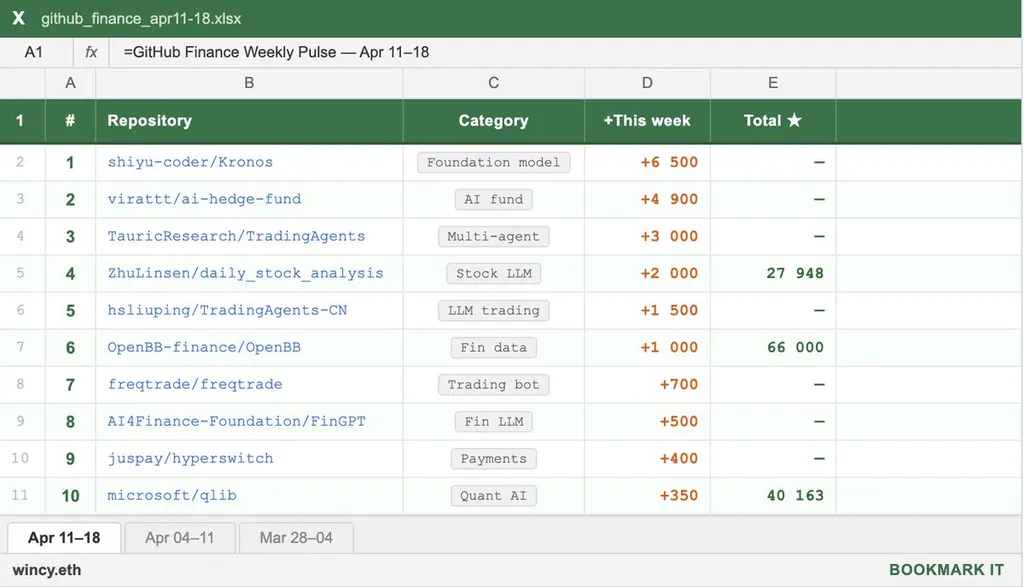
The greatest charm of Kronos is that it is open-source. It provides various model sizes through the Hugging Face Hub so that anyone can download the model and integrate it into their own strategies.
- Kronos-mini (4.1M): An ultra-small model that operates quickly even in light computing environments.
- Kronos-small (24.7M): A model that balances performance and speed.
- Kronos-base (102.3M): The main model with the most powerful analytical capabilities.
However, every technology has clear boundaries. The currently released small and base models are limited to a maximum Context Length of 512. This means if too much historical data is fed in at once, the model may forget the beginning or fail to process it properly. When applying it in practice, a strategic approach to appropriately adjusting the data length is essential.
Additionally, discussions are ongoing within the community regarding potential overfitting issues that may arise when applying the model to specific markets, such as the Korean market. It is important to note that the patterns in the global data the model learned may conflict with the specific characteristics of the Korean market.
Conclusion: Will it become the new standard for Financial AI?
Kronos is not just a simple prediction engine. It is a milestone for Financial AI that has expanded the horizons of artificial intelligence—previously limited to text—into the realm of complex financial data.
By understanding candlestick patterns like a language based on vast global data and presenting the future through probabilistic distributions, this model has handed a powerful weapon to quantitative investors. Of course, its robustness in extreme market conditions, such as a "Black Swan," remains a task to be verified, but the innovation in pattern recognition shown by Kronos is an undeniable fact.
We have now entered an era where we must move beyond simply believing the "numbers" provided by AI and instead contemplate how to interpret the "market flow" that the AI reads.
To what extent can you trust and reflect the probabilistic predictions of AI in your trading strategy? Let us know your thoughts in the comments!
References
- Kronos Live Forecast | BTC/USDT · shiyu-coder.github.io
- Kronos: A Foundation Model for the Language of Financial Markets · huggingface.co
- shiyu-coder - GitHub · github.com
- Heptone CEO Munk Seo Joins K-DACS Advisory Board ... · instagram.com
- Kronos: 45개 이상의 글로벌 거래소 데이터로 학습한, 금융 시계열 ... · discuss.pytorch.kr
- 금융 시장의 언어를 학습한 AI가 등장했다 - Threads · threads.com