It feels like just yesterday we were debating all night in online communities, asking, "Is an AI-generated image mine to copyright?" But today, in 2026, we live in an era where, instead of such vague questions, we must discuss practical rights and responsibilities within the massive legal framework known as the 'AI Basic Act.'
The storm unleashed by generative AI over the past few years has gone beyond mere technological wonder, shaking the very foundations of our society: the values of copyright and fairness. The AI Basic Act, which has just entered its first year, is in the process of organizing that chaos and finding answers to how technology and humans can coexist.
Today, I want to talk about what we are learning amidst this massive wave of change and how we should prepare for the future.
The Tears of a Creator and the Birth of New Rules

I am reminded of a story shared by an illustrator friend of mine not long ago. She spoke of the sense of helplessness she felt watching her unique artistic style, built over many years, being used as AI training data without permission, resulting in an endless flood of images that felt exactly like her own. "It felt like my soul-infused style was being cloned with just a few clicks," she said, a sentiment that perfectly captures the fear many creators felt at the time.
These conflicts moved beyond emotional issues into legal battles. AI developers argued that "data training is 'Fair Use' for analyzing new patterns," while creators countered that "unauthorized data scraping is a clear violation of copyright."
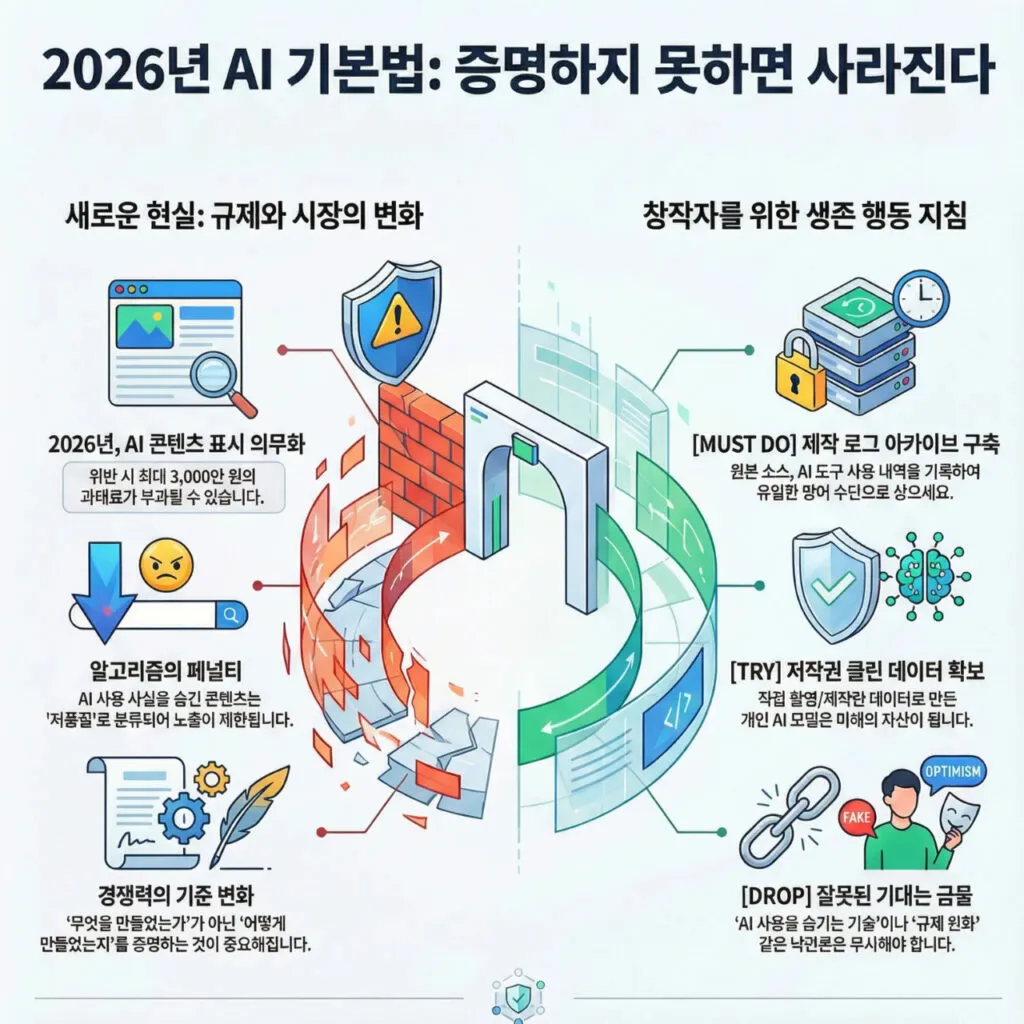
Finally, on January 22, 2026, the AI Basic Act officially went into effect in South Korea, setting a new milestone in this debate. Now, companies must bear legal responsibility for the source and permission status of the data used for AI training, and they face strong sanctions for illegal data collection practices such as unauthorized scraping. For creators, a minimal shield has finally been established to protect their rights.
Opening the Algorithm's 'Black Box': Transparency and the Right to Explanation
However, the law delves not only into copyright but also into how decisions are made in our lives. Everyone, imagine if you applied for a bank loan and an AI judged you as "ineligible." If you were rejected without even knowing why, how could you resolve that unfairness?
This is exactly why regulation for High-Impact AI is necessary. We call AI that operates in areas significantly affecting human life or fundamental rights—such as recruitment, loans, healthcare, and finance—'High-Impact AI.' One of the most notable changes brought by this law is the introduction of the Right to Explanation.
We now have the right to demand, "Tell me the basis for this result" regarding decisions made by an AI. This is an attempt to solve the 'Black Box' problem of AI (the characteristic where the decision-making process is unknown). Instead of simply saying, "The AI judged so," companies now bear the heavy responsibility of proving the logic behind the algorithm's judgment.
Of course, there is no shortage of concern from the industry. Voices are high claiming that overly strict transparency requirements could hinder technological innovation. Consequently, the government has designated the year 2026 as a grace period, focusing on education and guidance to help the industry adapt to the new rules rather than immediate punishment.
Invisible Discrimination: The War Against Algorithmic Bias
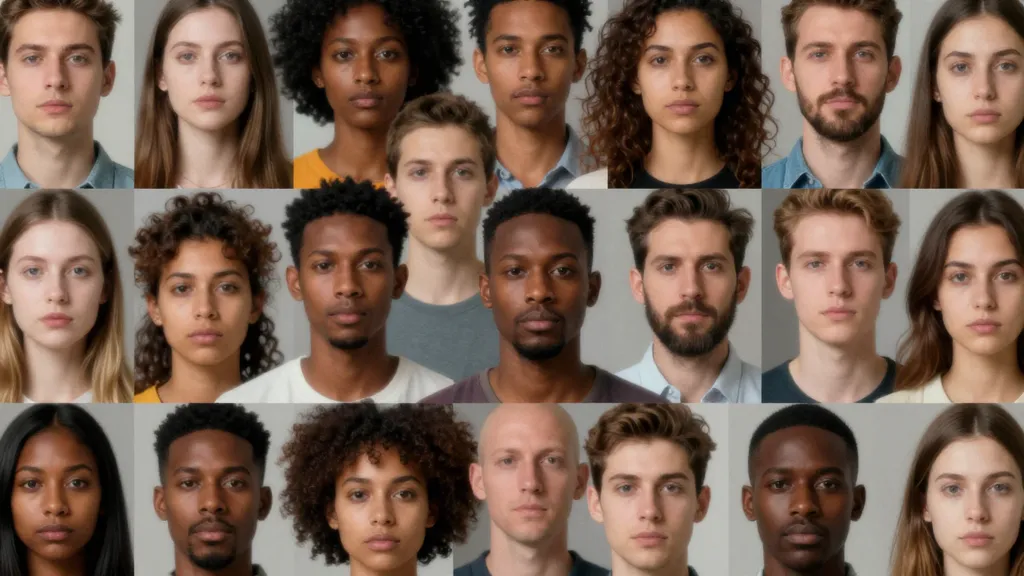
Another massive mountain we face is algorithmic bias. The belief that "AI is cold and objective" may actually be a dangerous illusion. This is because AI ultimately grows by consuming data created by humans.
Past instances, such as Amazon's AI recruitment tool discriminating against female applicants or medical AI failing to accurately recognize certain racial skin tones, demonstrated that AI can copy and amplify human bias. Social discrimination embedded in training data becomes systematically entrenched through algorithms.
To prevent this, the current law requires companies to prove fairness metrics beyond simple technical accuracy. Merely claiming "Our AI is fair" is not enough. They must present 'procedural evidence,' such as how they managed the gender and racial distribution in training data and what data curation processes they underwent to eliminate bias.
This goes beyond a technical issue into the realm of ethics and social consensus. The consensus among experts is that it is difficult for a perfectly unbiased AI to exist. Ultimately, our task is not to eliminate bias entirely, but to build a 'system' that can continuously monitor and minimize it.
Watermarks: Digital Fingerprints to Distinguish Fake from Real
In a world overflowing with deepfakes and sophisticated generative images, what should we believe? As of 2026, we live in an era where we must rely more on invisible technology than what is visible to the eye.
The AI Basic Act has imposed a disclosure obligation (watermarking) on content created by generative AI. Moving beyond merely writing "AI-generated" in the corner of a video, invisible watermark technology—which is invisible to the naked eye but detectable by algorithms—has now become essential.
Experts emphasize steganography technology, which hides encrypted data within the color information of an image, and compatibility with the global standard C2PA. This is akin to implanting a unique 'fingerprint' into digital content. Through this fingerprint, we can track when and by which AI this content was created.
Of course, this technology cannot be perfect. Attempts to abuse technology to erase watermarks will be incessant, and the gap between the speed of law and technology will persist. However, such regulations will serve as an important safety net to increase information transparency and reduce the social costs caused by fake news.
Corporate Survival Strategy: Turning Trust into Competitiveness
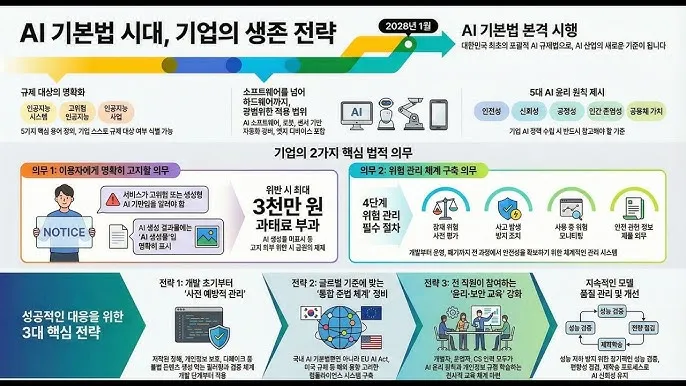
So, is the implementation of this law a disaster or an opportunity for companies?
In the past, regulation was thought to be the enemy of innovation. But the perspective in 2026 is slightly different. Now, 'Trust' itself becomes a powerful product competitiveness. Consumers and users will choose AI from companies that handle their data safely and provide unbiased, fair services.
Companies that preemptively obtain AI Reliability Certification and establish transparent data governance can go beyond merely following the law to gain an advantage in the global market. This directly translates to preferential points in public procurement or enhanced brand reliability.
Companies must now check the following list:
- Does our service fall under High-Impact AI?
- Is invisible watermark technology applied to our outputs?
- Is a Data Provenance system in place to prove the source and copyright status of training data?
- Have we secured XAI (Explainable AI) technology to explain the algorithm's decision-making process?
Closing: Can Human Values Keep Up with the Speed of Technology?

The implementation of the AI Basic Act in 2026 is not an end, but a new beginning. Technology is running at the speed of light, while law and ethics chase behind, struggling to maintain balance. We have witnessed algorithmic bias, experienced copyright conflicts, and now hold legal rights to demand technological transparency.
Ultimately, what matters is not the technology itself, but the question: "Is that technology oriented toward humans?" The law should not be a shackle to suppress technology, but a guideline to ensure technology does not infringe upon human dignity.
Can we truly preserve human-centered values amidst this massive technological transition?
What do you think about the fact that we now have the right to ask for reasons behind AI's decisions, and the mandatory watermarking of AI-generated content? Let us know your thoughts in the comments!
References
- ️ AI 기본법 시행 (2026년 1월 22일) - 창작자 입장에서 분석 (그림 ... · blog.naver.com
- 2026년 1월 22일, 'AI 기본법' 본격 시행 인공지능 산업의 발전과 ... · instagram.com
- [AI 변호사] AI 기본법상 생성형 AI와 고영향 AI - 법무법인 청출 · cheongchul.com
- [인사이트] AI 기본법 시행 D-2: 워터마크 의무화와 데이터 거버넌스 ... · thefromdata.com
- 생성형 인공지능 시대, 변호사가 알아야 할 저작권 쟁점 - 로웨이브 · lawwave.kr
- 인공지능시대를 위한 법률 개혁: 산업시대 법제도에서 지능정보사회 ... · blog.naver.com
- [2025 AI 윤리 세미나 EP.2] 편향을 넘어, 공정한 AI로의 여정 · lgresearch.ai
- AI시대 알고리즘 규제와 소송사례 | 인공지능ㆍ자율주행 - 네플라 · nepla.ai