In SK Hynix’s second-half 2026 recruitment, a notable design feature lies hidden within its newly introduced “Half-Day In-Depth Interview.” During their problem-solving presentations, candidates are free to use the company’s dedicated large language model (an AI tool) within their PC screen. However, evaluators do not assess "how well AI was used." They assess the thought process itself: how accurately candidates defined the problem and how logically they solved it. This case, designed to make human judgment even clearer in an AI-permitted environment, starkly illustrates the type of job preparation required in an era of “continuous recruitment,” where fixed open hiring seasons no longer exist.
The core of continuous recruitment is that the unit of preparation shifts from “first-half/second-half sprints (short, intense bursts of focus)” to “a single job experience you can always draw on.” The entire hiring process typically concludes within one to two months, leaving no room to wait for the next season. Furthermore, evaluation criteria have moved from academic pedigree to the depth of job performance capability. In this article, we will verify the extent of this change with numbers, examine what actual recruiters and current employees look for, and then specifically outline what to prepare now and how to maintain it.
Until when will open recruitment wait? The collapsed baseline

In the past, the two open recruitment periods held in early spring and midsummer were the benchmarks for job hunting. This was because companies willing to hire new graduates would open their doors all at once at those times. However, this baseline has already structurally collapsed. According to a sample survey of 100 large companies conducted by the Korea Labor Institute and reported by Yonhap News TV on April 1, 2024, the proportion of regular open recruitment among all hiring decreased from 39.9% in 2019 to 35.8% in 2023. Over the same period, the rate of ad hoc hiring increased from 45.6% to 48.3%. As of 2023, the share of ad hoc and continuous recruitment reached 1.8 times that of regular open recruitment1.
The numbers shift more sharply when looking at future intentions. When asked about future maintenance plans for the open recruitment system, among businesses that still maintain it, only 19.8% answered they would continue to do so1. This figure indicates that changes in large-company hiring practices are not a temporary adjustment but are solidifying in one direction. It is worth remembering, however, that this survey is limited to a sample of 100 large companies. This single number cannot fully represent the trends of the entire labor market, which includes small and medium-sized enterprises, but it is sufficient to conclude that the center of gravity for large-company recruitment has already shifted.
This change is not limited to the issue of the "timing" of job postings. The fact that timing has dispersed also means that evaluation criteria and the applicant experience have changed. In a blog post summarizing HR industry perspectives, Song Min-ho from Greeting explained that companies are increasingly handling new graduate recruitment on an ad hoc or continuous basis, rather than concentrating it in a specific season. As a result, companies have come to view the competencies and experience required for the job as the most critical factors in recruitment evaluation2. Companies have shifted from hiring large numbers twice a year to finding the right fit for the job when needed.
When are companies looking at applicants now?
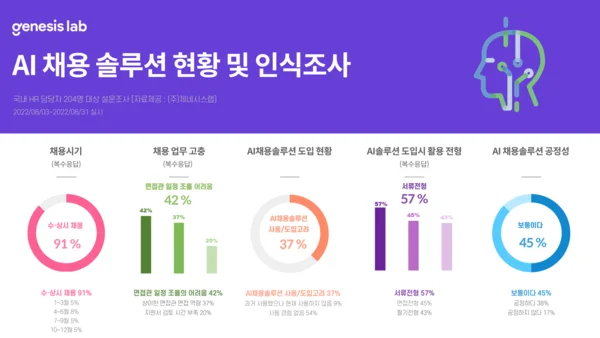
While job seekers ask, "When is the open recruitment season?" companies have already abandoned the question of timing. A Genesis Lab survey reported by Tech World News on September 15, 2022, involved 204 corporate HR personnel. Approximately 91% of respondents stated that they conduct ad hoc hiring without setting a specific period3. The proportion of companies adopting video/phone interviews or AI interviews as part of their hiring process reached 57%, leading analysts to conclude that non-face-to-face tools have influenced the spread of a continuous recruitment culture3.
A point worth noting is that HR personnel cited "applicant recruitment" as the greatest difficulty in continuous recruitment. In a multiple-choice survey, 76% responded that effective promotion of job postings and applicant recruitment was difficult3. From the companies' perspective, it is now more difficult to find people when they are needed. Consequently, they are responding by strengthening employer branding and managing the applicant experience. In a Greeting survey, 74% of job seekers said the existence of a company’s own recruitment site positively influenced their intention to apply, and a LinkedIn report stated that 75% of applicants conduct preliminary research on the company and role before applying2. Unlike the days when applicants would flock in when a single posting went live, companies are now in a position where they must persuade applicants.
Reading this trend from an applicant's perspective makes one thing clear. Applicants who are already in a state of readiness to apply, monitoring the market without gaps, stand out more often than those who hurriedly retrieve documents after a posting appears. From a corporate standpoint, “organic applicants”—those who find and apply on their own via search engines or company homepages—are rated as having lower dropout rates and a higher likelihood of organizational fit2. While companies move away from waiting for applicants toward managing relationships, applicants also have reason to maintain a state of continuous apply-readiness.
Why the unit of preparation has narrowed to "one role"
Continuous recruitment leaves no time. The experience of a YouTube channel called "Data Analyst Hui," which shared its journey to landing a job as a data scientist, clearly illustrates this. According to the uploader, open recruitment involves accepting applications followed by coding tests, aptitude tests, and technical/executive interviews, with gaps of about one to one and a half months between stages. In contrast, continuous recruitment involves submitting a resume and portfolio, leading to pre-assignments and interviews, concluding within a month and rarely exceeding two months4. In open recruitment, one can wait for results and find time to prepare for coding all at once, whereas in continuous recruitment, one must submit immediately upon a posting appearing and take tests and interviews just weeks later.
The core preparation materials for passing the continuous recruitment gates were not aptitude or coding problems, but the resume and portfolio. One must describe job-related experiences and projects in depth to pass the document screening4. The primary cause of failure in the first half of the year, identified by this uploader, was the ambiguity of the target role. By applying broadly from service planning to machine learning development, they had to virtually rewrite their personal statement every time they switched roles, leading to delayed applications and a lack of focus in preparation4. In the second half, however, they narrowed their focus to data analysis, created a standard personal statement tailored to that role, and submitted it to multiple places by simply changing the company name. They also compressed their resume and portfolio onto platforms like Wanted and LinkedIn, applying to every relevant posting they saw4. In IT and data fields, job fit and experience demonstrating "how good I am" are more important than loyalty to a company, so the explanation goes, one can standardize the base application and copy-paste it4.
This strategy is effective due to the speed of continuous recruitment. By narrowing preparation to "one role" and keeping the base application up to date at all times, there is no need to write from scratch when a posting appears. Data Analyst Hui also recommended a strategy of simultaneously pursuing startups and large companies. The reason is that gaining practical familiarity by taking coding tests and interviews first at fast-paced startups is advantageous when preparing for large company schedules. They mentioned an experience where startup coding test questions appeared verbatim in a large company exam, but it is difficult to assert this as a general guarantee rather than an isolated case4.
How to actually demonstrate "one point of depth"
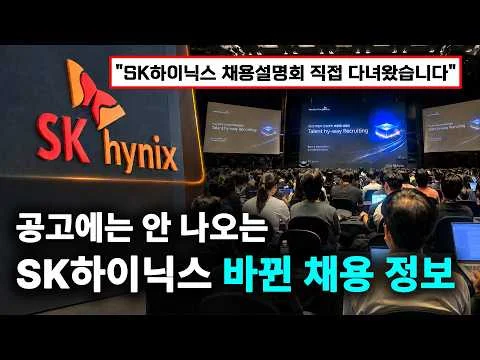
So, what constitutes the "deep experience" to keep in the base application? There are cases that can be verified through actual evaluation criteria and procedures, rather than general advice from recruiters. Content from the UCG Ultimate Career Group channel shared on August 19, 2026, details an on-site information session for SK Hynix’s second-half 2026 technical office recruitment. The session was held on August 14 of that year at E-Tower in Yangjae, Seoul, with application deadlines announced as strictly one week, from August 20 to 5:00 PM on August 265.
The first notable change in this recruitment is the abolition of academic requirements. SK Group had already removed academic criteria in its June 2026 ad hoc hiring and continued this stance in the second half. According to the channel interpreting the SK Hynix recruitment briefing, this means the basis for judgment has moved from school name to "what I have actually done"5.
The personal statement sections, the document screening gate, have been completely overhauled, compressed into two items: "job competency" and "AI utilization competency," replacing traditional questions. The character limit has reportedly been reduced. The job competency section is designed to assess processes taken to build professional expertise, such as majors, learning, projects, and research, but it places greater emphasis on a single experience and its authenticity rather than a list of various experiences. A current employee from the design sector at the event stated, "It is better to delve deeply into one thing than to do many things shallowly just because others are doing them," and the channel interpreting the video explained that this should be understood as the evaluation criteria itself, not just lip service5.
The AI interview has moved away from the previous format of being conducted from home and is now held in a separate space within the interview venue, where candidates answer on their own while watching videos5.
The same direction was confirmed during the current employee Q&A. To a question asking if qualifications like TOEIC were required, the answer was that language scores are considered as one of many competencies, not a deciding factor for acceptance. A current employee from the mass production technology sector said it was important to show adaptability and problem-solving skills over job knowledge, and that proposing specific solutions for how to resolve issues when they arose was effective5. The principle we can read from this case is clear. The "one experience you can always draw on" is not a list of various certifications, but a completed narrative of defining a problem, solving it, and producing results.
When a posting appears, what do you pull out?
The reasons and methods for changing job preparation at this juncture are as follows. Focusing only on specific periods while waiting for the open recruitment season does not suit continuous recruitment, where one must be ready for postings at any time. Instead, the approach shifts to maintaining three things at all times.
First, narrow your role and create a base application. As in Data Analyst Hui’s experience, if the application scope is set broadly, documents must be nearly rewritten every time the role changes, delaying applications4. Determine one role, keep the base personal statement and resume tailored to it updated, and submit quickly by changing only the company and posting details.
Second, always maintain one project with depth. Because evaluation has moved from school name to actual job experience, and from shallow listing to a single point of depth. As in the SK Hynix case, what is written in the personal statement becomes the interview question sheet as is, so it should be written from the outset based on the criterion of "can it withstand 30 minutes of digging?"5. Regarding experience using AI, rather than just stating "I used the tool," one must organize how the problem was defined and what results followed to be able to reproduce this during an interview.
Third, run multiple hiring processes simultaneously to build practical familiarity. Continuous recruitment concludes within one to two months, and startup processes proceed even faster. By paralleling startups and large companies, one can gain practical experience by repeating tests and interviews in the faster process first, and prepare for the remaining processes with the outcome of the first already decided4. Data Analyst Hui maintained routines such as document proofreading, daily coding problem solving, and video interview practice by utilizing online study groups. Checking the interview platform in advance and practicing the connection falls under the same category of preparation4.
In summary, in an environment where fixed open recruitment seasons have disappeared, job preparation is not a sprint for a specific period, but the work of maintaining a state of continuous apply-readiness. Determine one role, always refine the base application suited to it, keep one project as a completed narrative from problem definition to results, submit with only the name changed when postings appear, and maintain familiarity by going through multiple hiring processes simultaneously. When a current employee at the SK Hynix briefing said, "It is better to delve deeply into one thing than to do many things shallowly," this is ultimately read as a request to create that "one thing you can always draw on" starting now.
References
- 대기업, 공채 줄이고 수시·상시 채용 늘리는 추세 지속 / 연합뉴스TV (YonhapnewsTV) · youtube.com↩
- 2024년 채용 성과를 높여줄 3가지 경쟁력 - 그리팅 블로그 · blog.greetinghr.com↩
- ↩
- 비전공자 데이터사이언티스트 취업 준비와 성공 (대기업, 스타트업) · youtube.com↩
- ↩