
Many working professionals and job seekers are familiar with the experience of being so nervous during a presentation or interview that their pursuit of perfection instead led to rigid behavior. Psychological research suggests that humans experience laughter when they discover incongruities—gaps between expectations and reality—and find solutions to them 1. By understanding this cognitive mechanism, you can turn small mistakes or moments of tension in business communication into tools that soften the atmosphere and build trust. This article introduces three communication techniques based on the cognitive principles of laughter featured in Scientific American, designed to ease tension and facilitate smoother interactions in presentations and interviews.
Why Failures and Mistakes Make Us Laugh: Cognitive Mechanisms
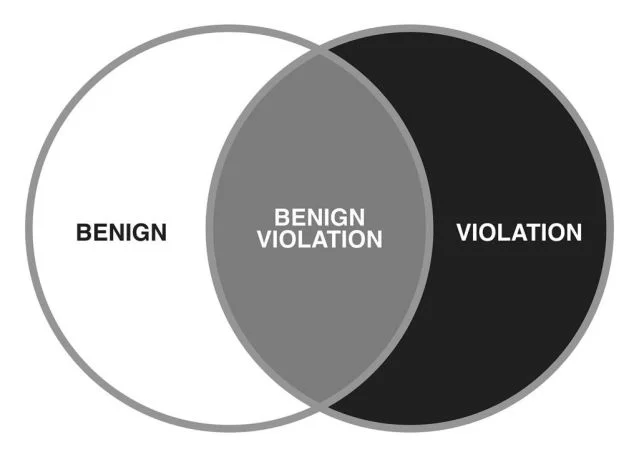
Among the various theories explaining the mechanics of laughter, Incongruity Theory is most closely related to professional communication. According to this theory, people laugh at the juxtaposition of incompatible concepts or discrepancies between expectations and reality. From the perspective of "Resolution of Incongruity," laughter occurs when an unexpected interpretation or solution is found for an awkward or unforeseen situation (the incongruity) 1. A classic example is the burst of laughter when hearing a double-meaning sentence and grasping its hidden implication.
However, not all incongruities function as humor. The Benign Violation Theory, proposed by A. Peter McGraw and Caleb Warren in 2010, more clearly defines the conditions for eliciting laughter. They argue that humor works only when a violation of ethical, social, or physical norms is simultaneously perceived as non-aggressive or non-offensive to the other party 1. The key factor here is "distance." McGraw et al. presented experimental results showing that tragic events feel funnier after time has passed or when sufficient psychological distance is established, thereby proposing the existence of an "optimal comic point"—a balanced point between the severity of the violation and psychological distance 1.
Furthermore, from an evolutionary perspective, laughter is interpreted as connected to the process of correcting cognitive errors. Matthew Hurley, Daniel Dennett, and others proposed that humans receive emotional rewards when they detect and correct mistakes in their thoughts or actions, and that laughter results from resolving such cognitive incongruities (mistakes) 1. This suggests that laughing together over a minor mistake during a report is related to the cognitive reward of self-confirming that the speaker has recognized and resolved the issue.
Three Communication Techniques to Ease Tension
To apply these theoretical principles in actual business situations, you need communication techniques that induce a "benign violation"—one that remains within non-threatening limits for the audience—and thereby trigger a cognitive resolution process. The following three methods are concrete approaches that reflect these mechanisms.
1. Acknowledging 'Minor Flaws' at the Start to Establish Distance
At the beginning of a presentation or interview, it is essential to break the ice. Acknowledging a trivial mistake made during your preparation process first can present the audience with a "non-threatening violation," thereby securing psychological distance. This preemptively softens any rigid image that might arise from insisting on perfection and helps the audience adopt a more open-minded attitude toward the speaker's subsequent content.
- Example of Applied Technique: "It seems nervousness got the better of me during preparation, and there's a typo on the first slide. Whoever spots it has effectively gained a little leverage over me. (smiles)"
- Effect: By transparently revealing awareness of their own minor mistake, the speaker allows the audience to perceive it as a "benign violation," lowering tension and narrowing the psychological distance between themselves and the speaker.
2. Sharing the 'Correction Process' When Discovering Mistakes During a Report to Build Rapport
According to the theory by Hurley and Dennett, the act of discovering and correcting a mistake itself triggers cognitive reward 1. Transparently sharing this cognitive resolution process can be interpreted as appealing to honesty; however, it is more appropriate to view this as a strategic effect of communication techniques rather than relying on the original evolutionary "bonding" theory (Wilson & Gervais).
- Example of Applied Technique: "One moment, please. The figure I just mentioned was momentarily confused by me. Upon double-checking, the accurate figure is a 15% growth rate for the third quarter. Thank you for helping me correct the error."
- Effect: Rather than trying to cover up a mistake, immediately recognizing and correcting it acts as a "cognitive resolution signal," demonstrating the speaker's honesty and problem-solving skills, which can earn the audience's trust.
3. Resolving Incongruity in Pressure Question Situations with an 'Unexpected Interpretation'
Pressure questions from interviewers or unexpected surprise questions create strong cognitive incongruity between the audience and the speaker. By reinterpreting this incongruity from an unexpected positive or rational perspective to induce a "resolution of incongruity," you can smoothly transition the tense atmosphere.
- Example of Applied Technique: "Regarding the project delay, I initially thought this might be perceived as a lack of competence on my part. However, through this process, the entire team was able to identify weaknesses in risk management early on. Therefore, I interpret this delay not as a simple failure, but as an essential learning process for future projects."
- Effect: By resolving the violation of social norms (tension) caused by a pressure question with an unexpected positive interpretation, you can change the atmosphere and demonstrate flexible responsiveness through a non-aggressive yet logical "benign violation."
Precautions for Practical Application

These communication techniques are grounded in Scientific American's research findings that laughter serves as a signal for resolving cognitive incongruity and a tool for social bonding 1. However, the same effects are not guaranteed in every situation. As shown by McGraw and Warren's research, for something to be accepted as humor, the violation must remain at a "benign" level, meaning sufficient psychological distance must be maintained so it is not offensive to the other party 1.
Therefore, when applying these techniques, consider the following points:
- Gauge the Other Party's Psychological Distance: Just as church members and non-members interpreted a church SUV raffle event differently, the threshold for a "benign violation" can vary depending on the audience's disposition and the situation 1. You must assess whether the other party might perceive it not as humor, but as discomfort or lack of seriousness.
- Avoid Excessive Self-Deprecation: Excessively aggressive or unreasonable self-deprecation may fall outside the scope of a "benign" violation, leaving it in a state of incongruity. It is crucial to strike a balanced attitude: treat mistakes lightly but emphasize that you seriously recognized and resolved them.
Ultimately, the purpose of utilizing humor or mistake-acceptance strategies in presentations or interviews is not merely to elicit laughter, but to form cognitive and social bonds with the audience in tense situations and to build trust. By understanding and appropriately applying these cognitive mechanisms, you can transform trivial incongruities and tensions in the workplace into opportunities for smooth communication.
References
- What's So Funny? The Science of Why We Laugh | Scientific American · scientificamerican.com↩