
When preparing for a job search, you may encounter personality assessment results stating that, because you are extroverted, you would be well suited to sales or counseling roles. However, when you look closely at the actual work processes involved in those roles, you often find yourself facing unexpected uncertainty. What if, in a role you imagined would involve meeting many people, the tasks that consume the most of your time are organizing paperwork, entering data, verifying compliance with regulations, and setting emotional boundaries? In such cases, many applicants doubt themselves, asking, "Why did I receive this result on the test?" or "Was I simply not suited for this role in the first place?"
You do not need to automatically exclude a role simply because your personality assessment results differ from it. Psychological assessments are not diagnostic certificates that determine final competence for a job. You must shift the criteria for choosing a role from "Does the job title or assessment label fit my personality?" to "Can I handle the daily repeated behaviors and performance conditions of this role?" You must set aside abstract frameworks like job titles and assessment results, and base your assessment of role fit on concrete evidence from actual tasks and performance standards.
Personality assessments show 'personality', not 'competence'
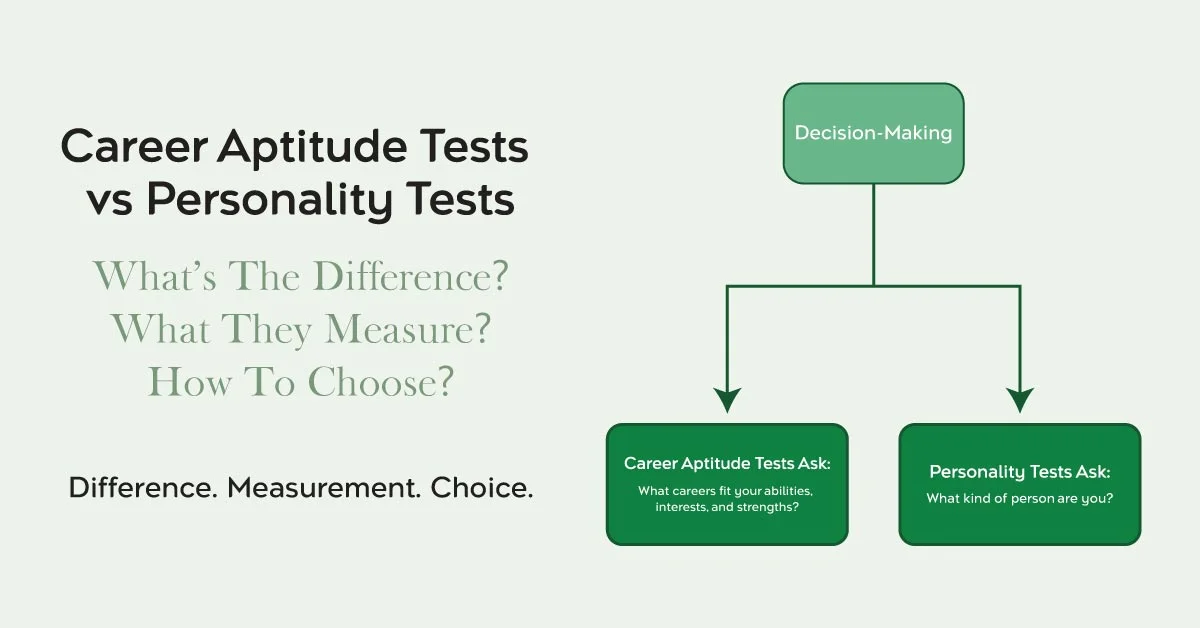
It is easy to believe that psychological assessment results guarantee success in a specific job, but there are clear limits to what assessments actually measure. According to the Cano blog, personality tests are tools that evaluate an individual’s personality traits, behavioral tendencies, and emotional patterns. Aptitude tests, on the other hand, measure specific abilities or potential, representing a different domain 1.
In other words, a personality test is merely a tendency indicator showing what kind of traits you possess. Therefore, a simple equation like "I am extroverted, so I will succeed in sales" does not hold. The assessment does not determine the competence to handle the daily repeated work processes of the role through to completion.
Moreover, even when psychological assessments are conducted with established reliability and validity, contextual interpretation by an expert is essential 1. Byolgyeol’s career choice guide also points out that vocational psychology tests and personality tests are closer to 'question tools' that help us discover preferences we have not yet articulated in words 2. Therefore, when the role recommended by your assessment differs from the role you intend to apply for, instead of being flustered, you should first adopt the perspective of asking, "What are the actual work conditions of the role that the assessment missed?"
Decomposing roles into 'Tasks, Performance, Environment, and Entry' instead of job titles

The primary cause of vague anxiety in choosing a role is using only massive job titles like 'HR', 'Sales', or 'Development' as the benchmark. Even with the same job title, the actual work varies significantly depending on the organization’s size, customer characteristics, manager style, and career stage 2. The job title alone provides insufficient information to judge whether you can cope with that environment.
To judge fit accurately, you must remove the job title and decompose the role into units of 'actual tasks'. The Byolgyeol guide advises checking the following four areas specifically for job analysis 2.
- Actual Tasks: Identify specifically what work consumes the most time in a typical work week and which tasks are felt to be the most difficult.
- Performance Criteria: Define the specific, physical outputs (deliverables) by which the organization will judge that "the employee is doing well" six months after joining.
- Work Environment: Review the actual ratios and controllability of individual focused work, collaboration, face-to-face contact, overtime, and business trips.
- Entry & Growth: Verify what certifications are strictly required and what competencies must be recognized for one's first career role.
By decomposing the role in this detailed manner, strengths that did not seem to overlap with your personality assessment results may be discovered in a different form within specific areas of the work.
Two cases where 'being good with people' and 'documentation' clash
This mechanism can be understood through cases where the image associated with the job title and the fit of the actual tasks are diametrically opposed. Among the cases introduced in the Byolgyeol guide, there was a person who chose a counseling role because they 'liked people'. However, once assigned to actual practice, they faced significant difficulties with record writing, organizing case data, and setting boundaries. Although the role of counseling appears to involve smooth connection with others, the core of the actual work was documentation and maintaining boundaries.
Conversely, there was also a person who thought they would not fit a people-facing role because they had a quiet personality. However, this person showed distinct strengths in one-on-one questioning and documentation work 2.
Looking only at the macro unit of the job title, it may appear that one's personality and the work do not match. But when decomposed into the micro unit of tasks, facets of strengths that suit you become clearly visible. Even if your assessment results indicate 'unsuitability for counseling', if you are good at 'questioning and documentation', it means you can have sufficient competitiveness in specific areas of that role.
Stereotypes applied to roles also hinder judgment

Not only assessment labels, but also social stereotypes applied to job titles themselves cause applicants to narrow their own choices. The CatchTV channel points out that images commonly associated with sales roles, such as 'excessive field work', 'high performance pressure', and 'always being cheerful on the go', can obscure the actual work content and lead to judgment errors 3.
In reality, because sales departments bring direct revenue to companies, they often have large recruitment scales and relatively relaxed restrictions on majors or certifications compared to other roles 3. A case of a pharmaceutical company sales employee introduced in a CatchTV video shows instances where employees achieve their annual performance goals by around November and then enjoy a autonomous work environment from December 3. Concluding "it won't fit my personality" based solely on the image of the role, without examining the actual daily routine and conditions, is equivalent to blocking your own opportunities.
Checking if you can endure and improve upon repeated tasks through 'small tests'
If you have recognized that you do not need to exclude a role even if your personality assessment differs, it is now time to objectively verify actual fit. The Byolgyeol guide emphasizes conducting practical 'small tests' alongside decomposing tasks 2. Systematically verify job fit through the following steps.
- Research the daily routine of the role of interest and write down the 'five core tasks' on paper.
- For each task, evaluate it across four axes: 'Enjoyment (interest)', 'Proficiency (current ability)', 'Willingness to learn (ease of learning)', and 'Burnout level (energy consumption)'.
- Do not stop at searching or imagination; create short deliverables with deadlines and feedback yourself, or speak with current incumbents to fill in the information.
- Rather than one enjoyable experience, record whether your efficiency improves naturally as you repeat the task without burnout 2.
If multiple tests point to the same trait, use it as a 'test hypothesis' to be verified, but make the final choice based on real-world evidence such as experience, qualifications, and living conditions 2.
Conclusion: Tests are just reference material; the decision lies in the 'daily tasks'
When personality assessment results do not match the role you are applying for, we often easily doubt ourselves. However, psychological assessments only show macro-level personality tendencies; they do not determine how efficiently you can handle the tasks of that role 1.
Therefore, the criteria for choosing a role should not be the job title or assessment label, but the role’s 'five core tasks repeated daily' and the 'actual conditions for producing performance' 2. Even if the test does not recommend sales, if you have strengths in data entry or documentation tasks included in the actual role, you can find areas where you can shine through small tests. Do not exclude the role itself just because the personality assessment differs. When you check what behaviors fill the actual day of that role, and verify directly how your strengths apply in the repeated work, you can make a job choice that is much more accurate and secure than a single line on a test result sheet.
References
- 1. 심리 검사의 정의와 종류: 인간의 마음을 측정하는 방법 · m.blog.naver.com↩
- 인사 직무가 맞는 사람과 실제 업무 | 별결 · byeolgyeol.product-pack.com↩
- 대기업 합격자가 말해주는 직무 선택 국룰 · youtube.com↩