When searching for restaurants on travel apps, you may have experienced a restaurant ranked number one on one app not appearing or dropping significantly in ranking on another. This discrepancy is not an error caused by specific platforms collecting data incorrectly. It happens because, even within the same app, the leading restaurant changes completely when you switch between criteria such as 'saved,' 'reserved,' and 'revisited.'
CatchTable’s year-end 2024 popular restaurant ranking illustrates this phenomenon well. The platform published the most popular restaurants based on five distinct criteria: reservations, waitlist registrations, saves, revisits, and real-time interest. When the criteria changed, the restaurants appearing on the ranking list changed completely. In the reservation category, ‘Mongtan Jeju Branch’ in Jeju took the top spot; for waitlist registrations, branches of ‘London Bagel Museum’ in Jeju and Jamsil led the way; for saves, ‘Via Toledo Pastabar,’ run by a chef who appeared on the Netflix variety show Culinary Class Wars, ranked first; and for revisits, Jeju’s long-established ‘Namchunsikdang’ took the lead 1.
Even within a single platform, the leading restaurant changes completely when the measurement metric changes. The reason restaurant rankings differ across travel apps is that, even if a list is labeled ‘No. 1,’ the questions each list is answering are different.
Different Decisions Implied by the Same Action
The rankings diverge because each action users take toward a restaurant records a different level of commitment. In the CatchTable ranking, restaurants operated by chefs from Culinary Class Wars—including Via Toledo Pastabar, Restaurant Neo, Doryang, Jogwang 201, and Tianmimi Hongdae—dominated the upper ranks for saves in 2024 1. These restaurants also appeared in the rankings for real-time interest 1. Restaurants featured on television instantly cause a spike in ‘save’ actions, where users bookmark them in the app with the intention to visit later.
However, during the same period, long-established local restaurants unrelated to the broadcast or specific trending spots took the top spots in other categories. In waitlist registrations, ‘London Bagel Museum,’ ‘Sukseongdo Jungmun Branch,’ and ‘Tonsho Busan Daehakro Main Branch’ ranked high. In revisits, ‘Namchunsikdang’ in Jeju, ‘Common Mansion’ in Gwanghwamun, and ‘Hakuten’ in Yeonnam-dong were listed 1. This indicates that while the TV effect is immediately reflected in ‘saves,’ it is not immediately evident in the action of ‘going out of one’s way to return and eat there.’
Reservations imply the decision to ‘secure an actual seat,’ waitlist registrations imply the decision to ‘agree to eat at that restaurant and wait,’ and revisits imply the decision to ‘return because the taste was good.’ While all restaurants ranked first in saves, reservations, or revisits can be called popular spots, the questions answered by each list are different.
Metrics Each Platform Prioritizes
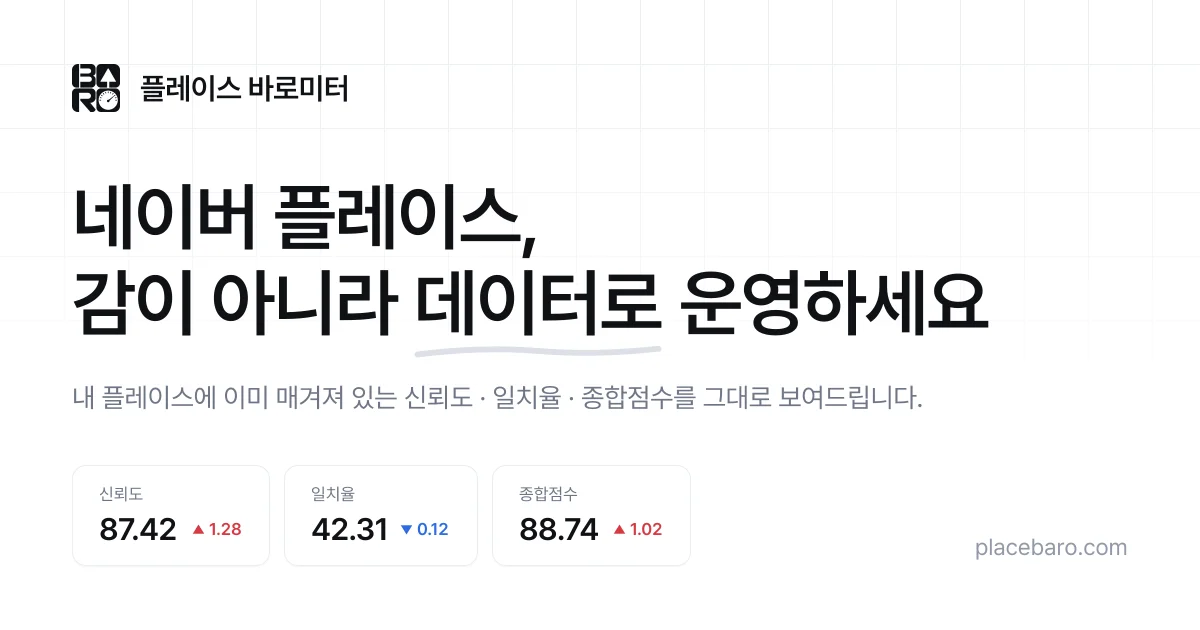
Other platforms also prioritize entirely different metrics suited to their service structures. According to ‘Place Barometer,’ a third-party tool that analyzes Naver Place exposure rankings, Naver internally evaluates credibility and relevance. Credibility is a score accumulated from actual user responses such as visitor traffic, reviews, saves, and dwell time. Relevance is the association between the business name, category, main keywords, and target search terms 2. The service interprets that the order of this ‘comprehensive score,’ which adds variables like distance and filters to these two metrics, directly determines actual exposure rankings 2.
According to seven years of operational observation by PineAdd, a search exposure specialist agency, Naver’s rankings are heavily influenced by ‘popularity,’ which is an accumulation of signals from actual user search, click, save, navigation, and review activities 3. Having directly operated Places for seven years, PineAdd identifies three key axes: relevance, distance, and popularity. It explains that popularity only rises as actual customer behavior signals accumulate, and rankings improve only when a natural flow from search to click, save, visit, and review is established 3.
In contrast, the travel review platform TripAdvisor looks at entirely different factors. TripAdvisor’s rankings reflect not just the quantity of reviews, but also their quality, recency, and the business’s feedback response rate 4. For example, ‘Desert Adventures,’ a company in Utah, USA, moved from the third page to the first page in search results within three months by doubling its monthly review count and responding quickly to user feedback 4. While Naver looks at map-based search and dwell time, TripAdvisor looks at the recency of reviews and the business’s attitude toward communication. The criteria for judging ‘popularity’ are fundamentally different depending on the nature of the service.
Criteria to Verify When Reviewing Rankings

Instead of viewing differing rankings across platforms with distrust, it is useful to use them as tools to identify the questions each ranking answers. Understanding that Naver Map ranks locations using a comprehensive score that combines the relevance of search terms to business names and categories with distance allows users to understand that the number one restaurant is not an ‘absolute best restaurant,’ but rather ‘a highly relevant and active location from my search position’ 2. If you see a restaurant ranked first on TripAdvisor, you should interpret this to mean that the restaurant is not just popular, but also consistently receives recent reviews and that the business owner is diligent in communication 4.
Ultimately, when viewing a ‘No. 1 Popular Restaurant’ on any app, it is important to develop the habit of first checking the criteria behind the list. Titles like ‘Nearest First,’ ‘Most Saved,’ ‘Real-Time Interest,’ and ‘Most Revisited’ reveal which user actions the list is based on. Rankings differing across platforms is not because the value of restaurants is unclear, but because each app measures entirely different behavioral signals from users, such as ‘saves,’ ‘reservations,’ ‘return visits,’ and ‘search activity.’
References
- “몽탄·나폴리맛피아 등”…2024년 최고 인기 맛집 순위는 · economist.co.kr↩
- 플레이스 바로미터 | 네이버 플레이스 상위노출 · 순위 · 지수 분석 · placebaro.com↩
- 플레이스 상위노출이란? 네이버 지도 1위의 원리와 알고리즘 총정리 | 파인애드 · pinead.co.kr↩
- How to Get More Reviews on TripAdvisor | Peek Pro · peekpro.com↩