"Is it actually helpful for the baby if I leave Tinymobile running while I eat, even if I feel a bit guilty about it?" This is a question many parents have when choosing birth preparations. The answer is clear. It is not automatically beneficial for all newborns. It can only be used as a stimulus tool after three months of age, when the baby starts tracking moving objects with their eyes, and only if the installation distance and settings match the baby's age in months. Conversely, hanging it directly above their eyes or extending usage time indefinitely can lead to results opposite to expectations.
The author of the blog "Wise Green's Home," in a parenting guide published in July 2026, described the Tiny Love mobile (hereinafter "Tinymobile") not as a passive toy, but as a developmental tool that stimulates visual, auditory, cognitive, and motor nerves1. However, this benefit does not arise automatically from the product itself. The baby's age in months, installation location, usage time, and the reactions the baby displays must all align. This article, based on the blog and the public guidelines cited by the author, carefully organizes when and how Tinymobile is meaningful, and when it should be stopped.
Before 3 weeks of age: Black-and-white focus books come before mobiles
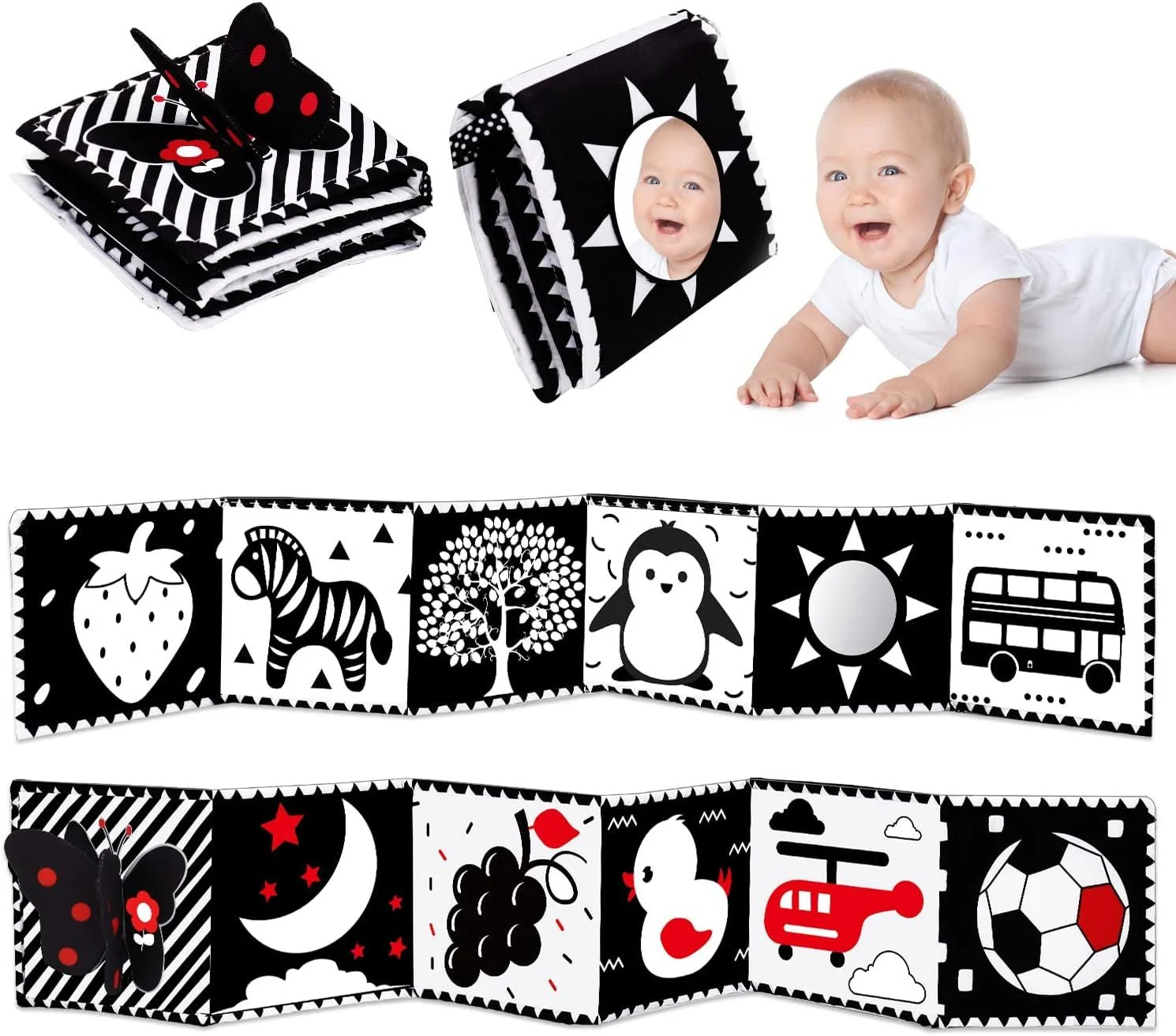
The world of a newborn is not sharp. The blog author explained that a newborn's focal distance stays around 15~25 cm, similar to the distance at which their mother's face is visible during breastfeeding, and that it is difficult for them to track moving objects in the early stages1. The Seoul Childcare Portal Service guide, cited by the blog, also describes 15~25 cm as the visible range from the newborn period up to before 4 months of age.
Following this explanation, the idea that "you should show babies as many mobiles as possible when they are young" may be putting things the wrong way around. The author advises that before 3 weeks of age, placing a black-and-white focus book 20~30 cm from where the baby's gaze falls is developmentally more effective than a moving mobile1. The rationale is that since the ability to track moving objects with the eyes has not fully developed yet, a stationary stimulus with high contrast is easier for holding attention while reducing burden on the baby, compared to slowly rotating plush toys.
Therefore, there is no need to run Tinymobile indiscriminately from the start. Before 3 weeks, it aligns more with the guidelines to first have ample time for face-to-face interaction and eye contact using focus books, and to avoid forcing the mobile into operation. Even if you included a mobile on your birth preparation list, this is why you need to separately check "when to start."
Installation position after 3 weeks: Diagonal from belly and chest, not directly above eyes

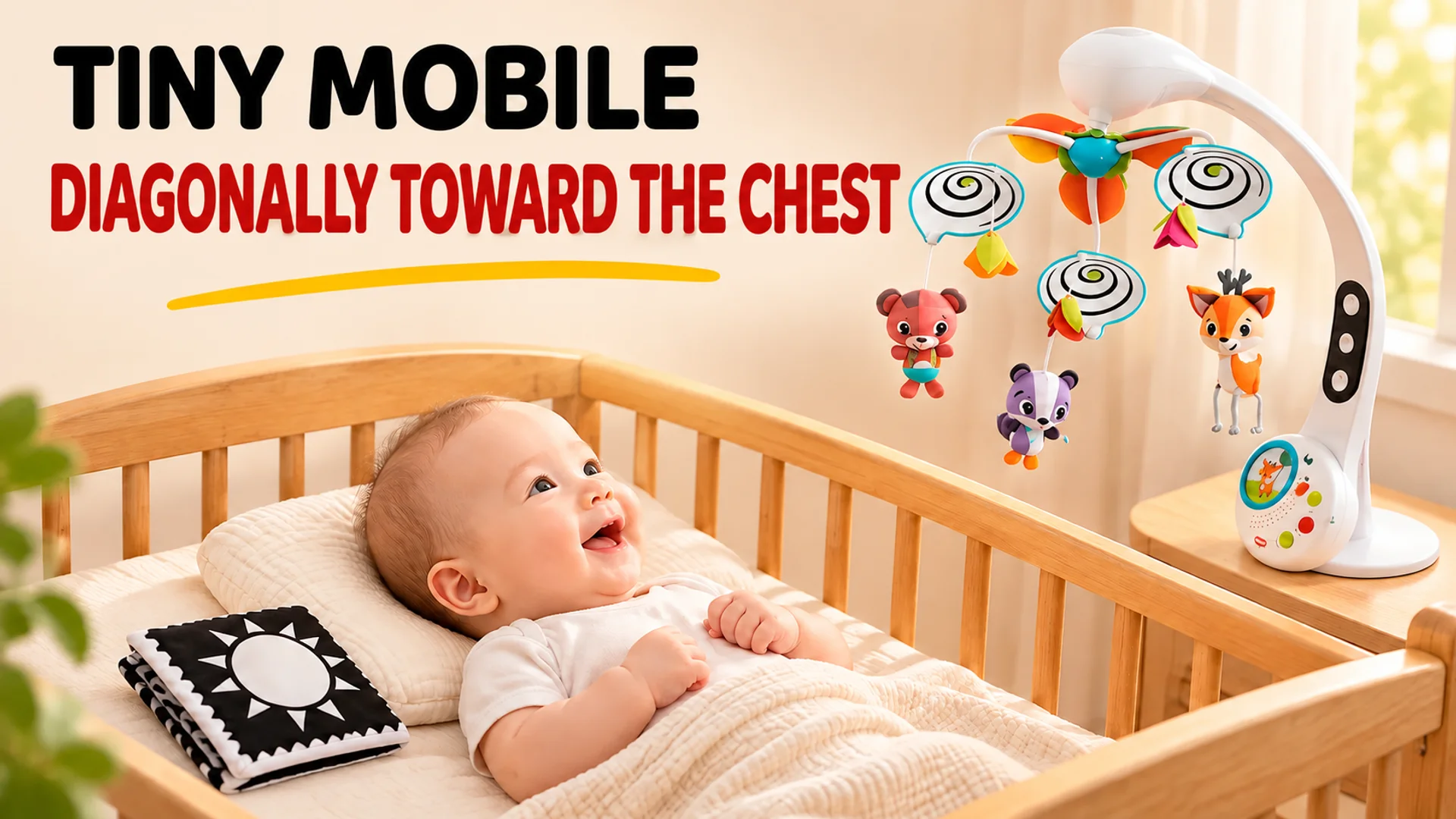
From 3 weeks to 2 months of age is guided as the period when babies begin to recognize light and shadow, that is, differences in contrast1. At this stage, the blog author recommends attaching black-and-white plush toys to the Tinymobile and installing it at a diagonal 45-degree angle from the baby's belly or chest position, at a distance of about 30 cm. This position is described as the "standard" because it allows the baby to look at the mobile comfortably without putting excessive strain on the neck1.
What is important here is the angle, not the distance. If hung vertically directly above the forehead, the baby has to twist their neck as if tilting their head back, and their eyes must maintain fixation on nearby objects inwardly for long periods. The blog guides that in this case, eyes may turn inward, so positions directly above the eyes or too close should be avoided[2](https://green8rise.com/tinylove-mobile-newborn-development-guide/]. While cross-eye is a medical diagnosis and cannot be determined solely by a mobile, the safe and comfortable installation standard recommended by this guide is at least "belly~chest position, about 30~40 cm"[2](https://green8rise.com/tinylove-mobile-newborn-development-guide/].
To put it concretely: When a baby around one month old is lying down, set the mobile axis slightly below the baby's eye level, slanting it across the chest line. The baby looks at the moving black-and-white plush toys by turning their head slightly or naturally shifting their gaze from the front. It is not the common sense of "closer is better"; first, it is the angle that reduces burden on the optic nerve and neck muscles together.
Time when gaze tracking and limb movement happen together

From 1~2 months of age, the blog author explains that tracking ability—the ability to follow objects in front of the eyes with eyes—begins to develop[2](https://green8rise.com/tinylove-mobile-newborn-development-guide/]. When Tinymobile rotates at a constant speed, the baby moves their eye muscles by following the plush toys to the end, and plush toys moving three-dimensionally from various directions can serve as stimuli for learning depth perception and binocular vision, according to the blog's interpretation.
If the term "tracking ability" is unfamiliar, think of the moment you track a signboard outside a car window without turning your head, only with your eyes. The baby's eyes are still in the stage of learning that ability, and the mobile is a visual stimulus that can help with this practice. However, this explanation is an interpretation provided by the blog based on public developmental guides and parenting experiences, and should not be accepted as clinical results claiming that all babies' vision improves consistently just by looking at Tinymobile.
An interesting point is that visual stimulation does not end in the hands and body. The blog explains that in the process of moving limbs strongly while fixing gaze on the mobile, back, abdominal, and leg muscles are used, and from 3~4 months of age onward, attempts to reach hands toward the plush toys can become a stage for practicing hand-eye coordination[2](https://green8rise.com/tinylove-mobile-newborn-development-guide/]. In other words, the mobile's help is not just training eyes, but can connect to the chain of behaviors of seeing, moving, and trying to grasp.
You need to change the plush toys and sounds according to age in months
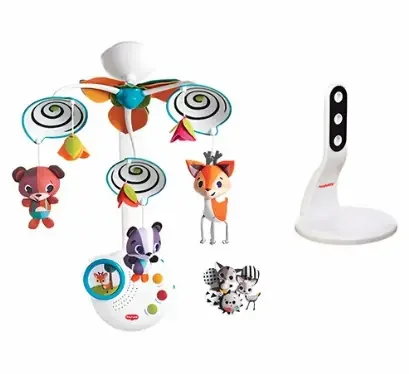
At 3~5 months of age, the blog author describes the stage where babies distinguish primary colors like red or green and see shapes more clearly, advising to replace with colorful plush toys and switch melodies to bright music or natural sounds at this stage1. When the baby starts reaching out and touching the plush toys, the mobile height must be raised slightly to prevent safety accidents in advance1.
After 6 months of age, the role of a mobile viewed while lying down effectively ends, and a use method is introduced where the main body alone is detached from the mount and changed into a sound toy pressed while sitting[2](https://green8rise.com/tinylove-mobile-newborn-development-guide/]. This is a way to help the baby confirm the cause-and-effect relationship of "if you press the button, sound comes." At this stage, rather than continuing to keep the mobile plush toys in front of the eyes, the purpose should shift to play that uses the baby's hands and ears.
Monthly replacement is not merely a product expansion feature but a measure to align the types of stimuli given to the brain with the baby's abilities. The blog notes that excessive stimuli that do not match the baby's developmental speed can actually become stress.
15~20 minutes is the baseline, stop immediately if gaze turns away

Even if installation is perfect, time cannot be extended infinitely. The blog guides that newborn brains fatigue quickly from sensory stimuli, so mobile use should be limited to about 15~20 minutes per session1. More important here is the baby's reaction. If the baby looks away or fusses while looking at the mobile, it means the stimulus is excessive and should be turned off immediately to let them rest, as explained[2](https://green8rise.com/tinylove-mobile-newborn-development-guide/].
The point where parents feel guilty is also at this moment. Rather than the scene of the baby lying alone in front of the mobile itself, whether the baby is reacting sufficiently and when to stop become the actual judgment criteria. The blog introduces that white noise and gentle music can lower heart rate through brainwave stabilization and autonomic nervous system responses, potentially providing comfort similar to that in the womb, but this effect is only valid while the baby shows comfort. Continuing to play it for a baby who turns their gaze away, thinking "they might calm down more," does not match the guidelines.
An actual usage example is as follows. After preparing to put a one-month-old baby to sleep, place the mobile with black-and-white plush toys at a diagonal 45-degree angle from the belly~chest line, about 30 cm away, and set a timer for 15 minutes. If the baby moves their eyes following the plush toys, leave it as is, but if they turn their head or make unpleasant sounds, immediately turn off the power and hold them. This process is not an experiment to prove product performance, but a way to actually apply the reaction observation and usage limits presented by the blog.
The answer is ultimately not about 'time left on' but about 'criteria for observing'
If asked whether Tinymobile helps newborns, based on the blog guides, it can be summarized as: "Before 3 weeks, black-and-white focus books come first, and after 3 weeks, follow the order of black-and-white, color, and sound toys matching the age in months, and it has value as a stimulus tool when used for only 15~20 minutes at a diagonal 45-degree angle from belly~chest, about 30~40 cm, not directly above the eyes"[2](https://green8rise.com/tinylove-mobile-newborn-development-guide/].
There is an important boundary in this answer. The blog itself stated that it is a guide based on parenting experiences and public data, and does not replace medical diagnoses[2](https://green8rise.com/tinylove-mobile-newborn-development-guide/]. It is difficult to assert that a specific product guarantees consistent developmental effects for all newborns, and if there are concerns about the baby's visual or emotional development, it is safer to consult a pediatric ophthalmologist or pediatrician. For the mobile to be a useful tool, more than the degree to which parents believe in the product, a gaze that observes whether my baby is currently handling that stimulus is more necessary.