
“AI-Generated Images Have Six Fingers” or “Sign Text Is Blurred” has spread as a meme across the internet. People trust this rule to determine the authenticity of photos or videos, but an academic study published in January 2026 confirmed with data that this common belief does not align with the facts. Yao Xiao’s team, who conducted the X-AIGD research, found that existing detectors rely little on the perceptual flaws humans identify visually 1.
Then, what do machines base their decision on to label something as “AI-generated”? The answer is statistical patterns that are imperceptible to the naked eye. This article explains which signals detectors actually respond to and examines, through specific experimental examples, where the gap between human and machine judgment originates.
Detectors See Very Few Visible Flaws
Yao Xiao’s research team constructed the ‘X-AIGD’ benchmark, which meticulously classifies flaws in AI-generated images. The team labeled both the location and type of errors, ranging from low-level distortions such as finger deformities or abnormal shadows to high-level semantic errors involving context mismatches, down to the pixel level 1.
The results showed that existing detectors have a negligible level of dependence on these perceptual artifacts, even at the most basic distortion stage. Even when models were trained specifically to detect particular flaws, a substantial portion of their decisions still relied on uninterpretable features 1. In other words, detectors are not looking for ‘characteristic visual mistakes’ but are reading the unique statistical patterns that generative models leave in the data.
Statistical Discrimination Impossible for the Human Eye
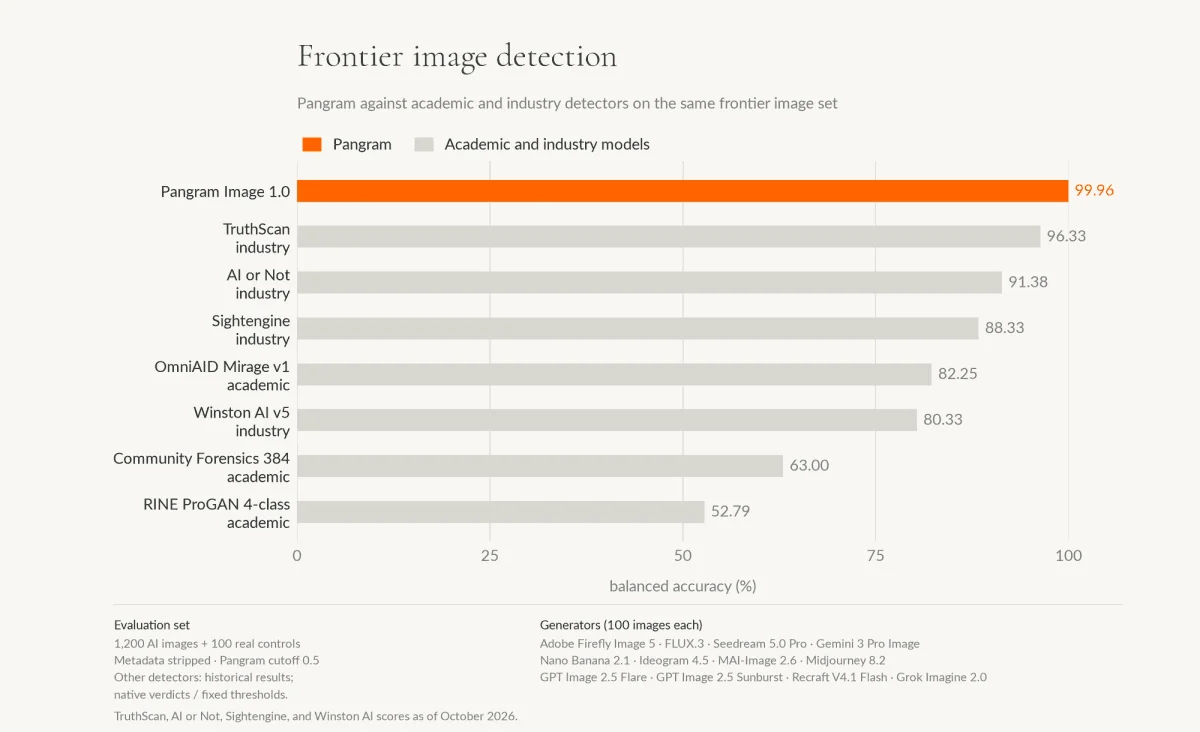
The gap in judgment between detectors and humans is starkly revealed in the results of the academic DF26 benchmark. This test involves distinguishing between real videos of a person speaking and AI-generated videos 2, 3. In November 2026, Pangram released its video detection model, Image Flash 1.0, via its company blog, citing the DF26 benchmark as a basis for evaluation 2, 3.
According to Pangram, in this experiment, human judgment accuracy was only slightly better than a coin toss, and existing detectors did not perform much better. In contrast, Pangram’s Flash 1.0 recorded 98.7% accuracy on this benchmark, showing a performance 29 percentage points higher than the next-best detector 2, 3.
| Detection Target | Judgment Accuracy |
|---|---|
| Human (distinguishing real vs. AI videos) | Slightly better than random choice 2 |
| Next-best AI detector | Approximately 69.7% (estimated calculation based on the 29 pp difference from the 98.7% benchmark) |
| Pangram Image Flash 1.0 | 98.7% 2, 3 |
Pangram’s image detection model, Image 1.0, recorded 99.96% accuracy on its own benchmark, which consisted of a total of 1,300 images: 100 real photos and 1,200 synthetic images created by 12 of the latest AI generation models 2, 3. This result aligns with the general finding of the X-AIGD research that existing detectors’ dependence on perceptual artifacts is negligible 1. However, Pangram did not specifically explain the mechanism behind Image 1.0’s 99.96% accuracy as the interpretation of visually uninterpretable signals.
Practical Tools and Experimental Designs for Bias Removal
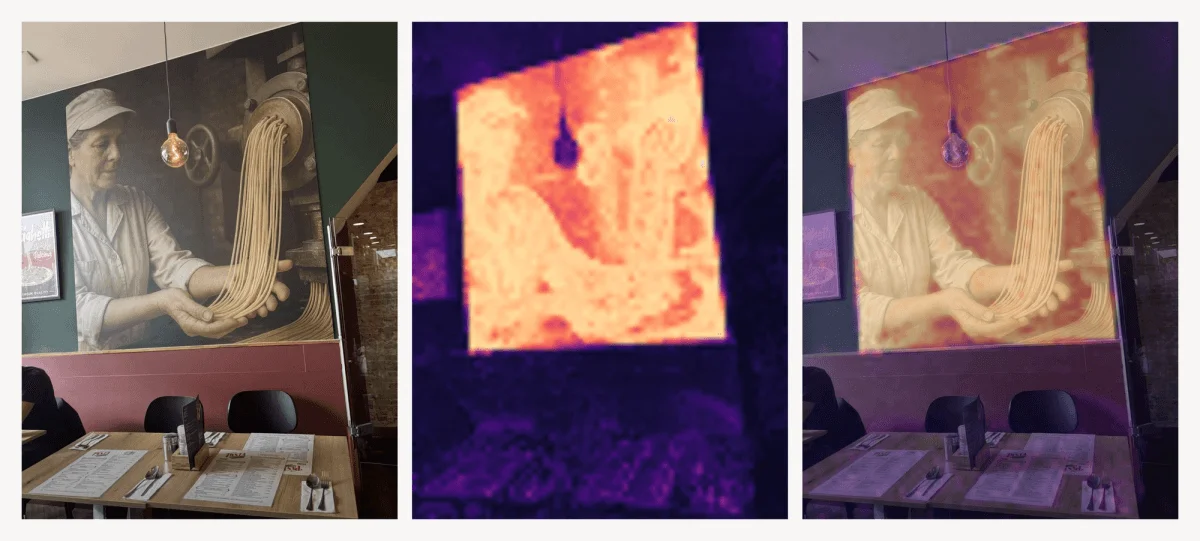
Pangram has implemented this technical principle into a tool that is easy for general users to understand. Provided as a Chrome extension, Image 1.0 overlays a heatmap on images while users browse social media, shopping sites, or rental listings, visually highlighting AI-generated areas and their locations 2, 3.
The tool was trained to be robust against compression, resizing, blurring, and noise processing commonly occurring in social media environments. It provides guidance on reduced reliability when input resolution falls below 512×512 pixels, but supports attempts to discriminate even on low-resolution images as small as 256×256 pixels 2.
(Pangram blog: An experiment designed to reduce judgment bias toward specific content by configuring real videos and synthetic mirror videos to share the same scene and subjects) 3
Experimental designs aimed at enhancing the reliability of detection performance are also noteworthy. Pangram used the first frames of 129 real social media videos as initial inputs and injected video descriptions generated by a Vision-Language Model (VLM) as prompts, instructing 14 video generation models to create ‘synthetic mirror’ videos 3. Because real and synthetic videos share the same scenes and subjects, the detector’s capabilities can be fairly measured without bias from misidentifying specific content types as AI-generated 3.
When Decisions Cannot Explain Their Basis, Provenance Technologies Help

Even when detectors make decisions based on statistical patterns, it is difficult to explain the reasons in visually understandable language for humans 1. To complement this limitation, technologies and regulations that mandate both ‘judgment’ and ‘provenance labeling’ simultaneously are being discussed.
Failure to comply with the transparency obligations specified in Article 50 of the EU AI Act can result in fines of up to 15 million euros or 3% of global annual revenue 4.
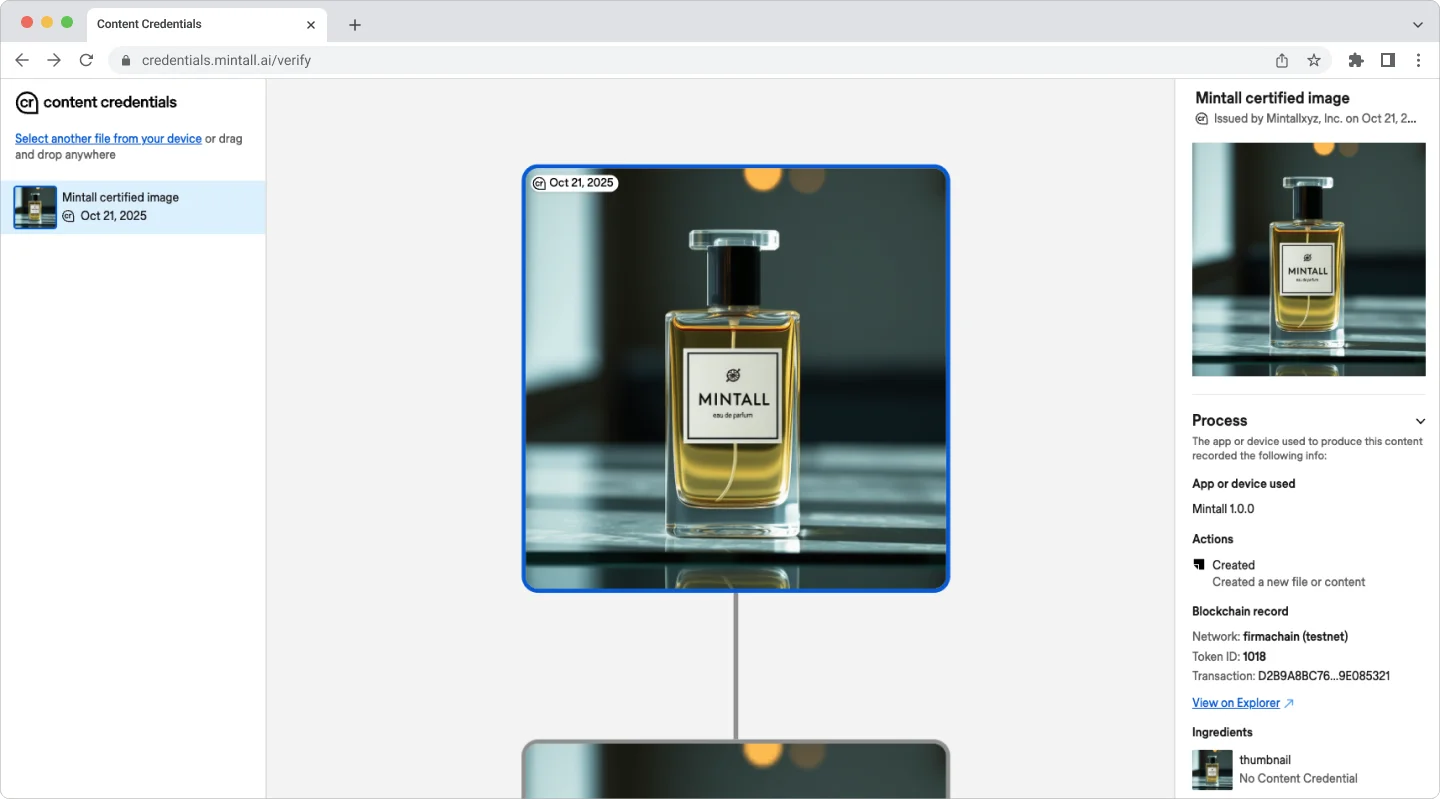
C2PA (Content Credentials) is a standard that records the provenance and editing history of content in encrypted metadata. To support compliance with such regulations, Luxembourg’s Ministry of Digitalization initiated the procurement of an AI detection platform called ‘TAID.LU’ in May 2026 5, 6. This public system requires that when detecting deepfakes, it provides not just a simple score but also ‘auditable evidence and explanations’ 6.
| Category | AI Detection Technology (e.g., Pangram) | C2PA and Watermarking (e.g., Rezolve) |
|---|---|---|
| Discrimination Method | Analysis of statistical and visual patterns invisible to the naked eye 2, 1 | Reading digital signatures embedded at the time of creation and data within color channels 5, 4 |
| Pros and Cons | Catches high-quality fake videos using clues imperceptible to humans | While C2PA metadata risks losing its signal if removed or edited, Rezolve’s patented watermark, embedded within the image’s color channels, remains even if metadata is removed 4 |
Why Cross-Verification Is Needed Instead of Visual Cues
Ultimately, AI image detectors are not tools that look for ‘six fingers’ or ‘blurred text’ 1. A machine making an ‘AI decision’ essentially means it has discovered statistical patterns in pixels that humans fail to notice.
Even when facing videos of people speaking, the human eye remains at the level of random guessing, whereas detectors achieving 98.7% accuracy read intangible statistical patterns 2, 3.
References
- Unveiling Perceptual Artifacts: A Fine-Grained Benchmark for Interpretable AI-Generated Image Detection · arxiv.org↩
- Pangram Image 1.0 공개 - 사진과 영상에서 AI로 만든 부분을 탐지 | GeekNews · news.hada.io↩
- Introducing Pangram Image 1.0 · pangram.com↩
- Rezolve Ai Unveils Patent-Backed AI Provenance Platform as Watermarking Becomes Global Infrastructure · globenewswire.com↩
- ↩
- Luxembourg opens tender for AI-generated content detection tool | Biometric Update · biometricupdate.com↩