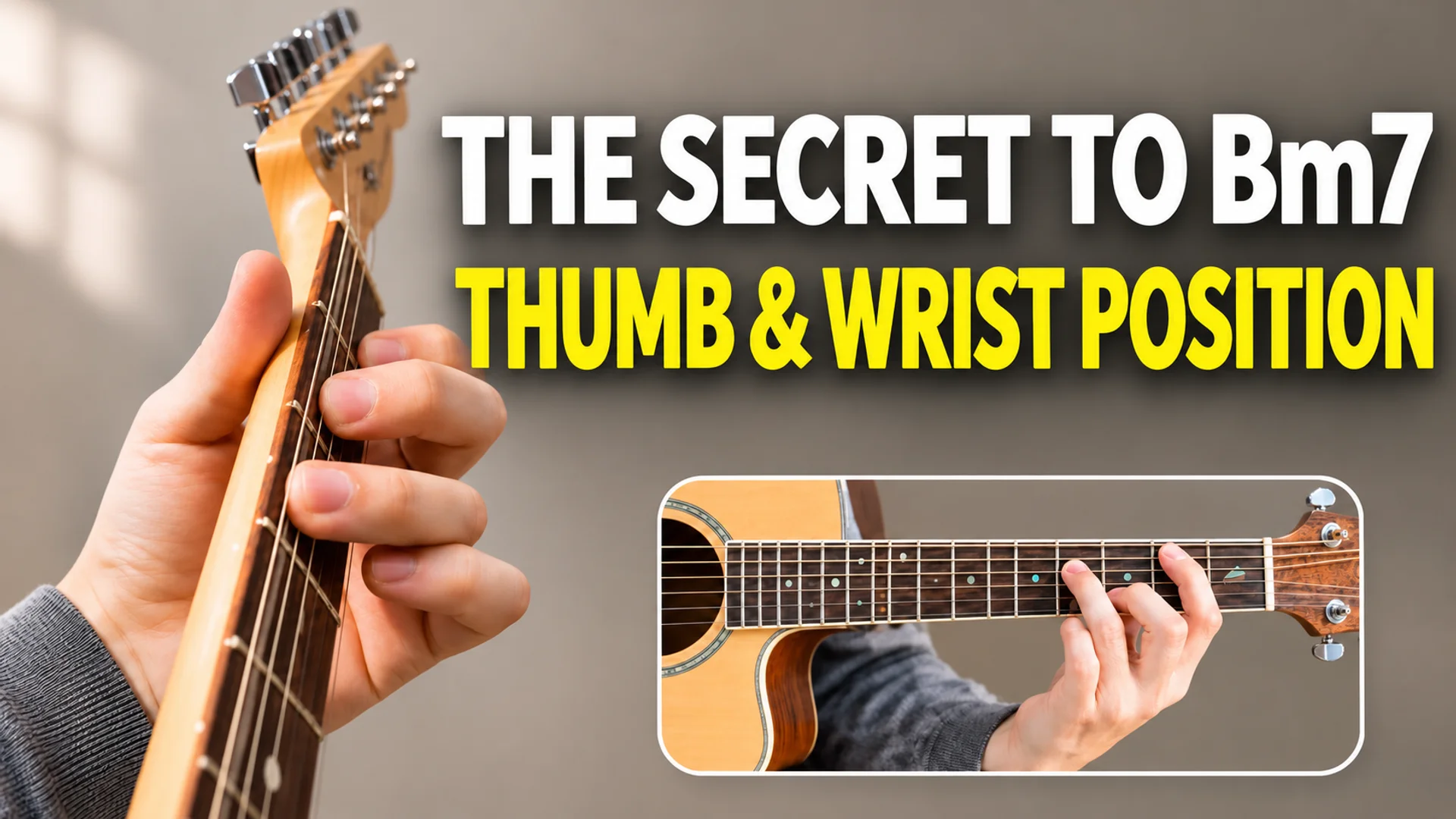
Guitar instructor Gita Soldier explains the role of the thumb in barre chords, using the analogy that the thumb should push the strings from behind, much like a capo 1. While we know a capo works by clamping the strings from above and below to produce sound, we often fail to realize that our thumb must act as the "lower jaw" of that capo. Consequently, the sound remains muffled.
The Code Requires Simultaneously Reversing Three Open Chord Habits
The real reason Bm7 fails to sound clearly is that we must reverse all three habits ingrained in our bodies from playing open chords. It is not simply a matter of applying more force; we must change the geometric structure of our hand.
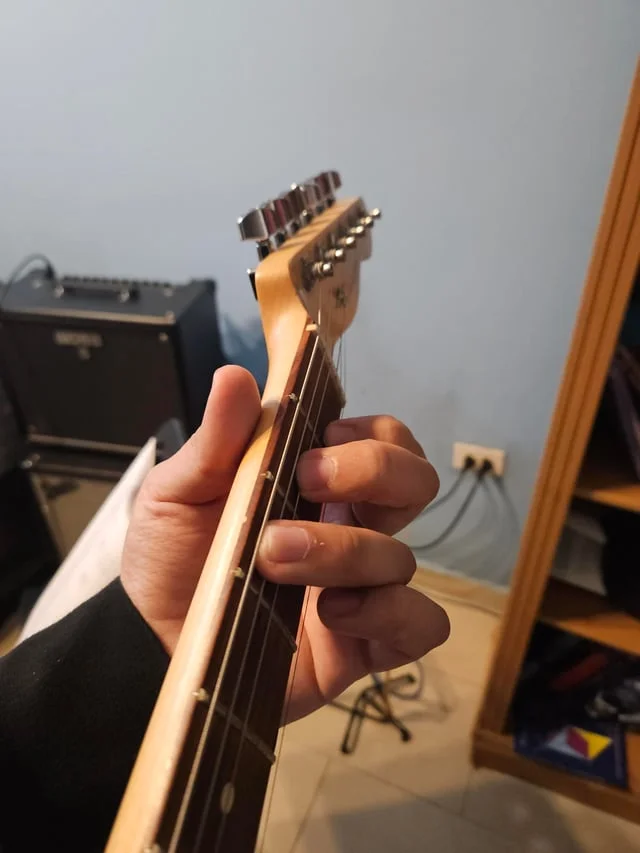
First, the position of the thumb must change. When playing open chords, it is common to hook or wrap the thumb over the top of the neck. However, for Bm7, the thumb must move to the exact center of the back of the neck. Instructor Gita Soldier explains that this position is an essential condition for supporting the pressure of the index finger 1. The sound rings out clearly only when the downward pressing force of the thumb and the forward pushing support from behind the neck are in balance.
Second, the angle of the wrist must be adjusted. Placing the thumb in the center of the back of the neck naturally causes the wrist to bend outward. This specific angle is required for the fingers to press the strings nearly perpendicular to the fretboard, producing a clear sound 1. With the wrist straight, it is difficult to properly contact the strings with the sides of the fingers. Kim Kyung-hoon Guitar School also emphasizes that the arrangement of the fingers must align parallel to the strings for efficiency, noting that a diagonal approach is inefficient 2.
Third, the contact surface of the index finger must shift to its side. As emphasized in the Simple Woody guide, flattening the finger causes it to touch adjacent strings, resulting in a muffled sound, so the arch (curve) of the finger must be maintained 3. At this time, the index finger should press the strings with its "side" rather than the pad of the fingertip. Kirin Musical Instruments Mall and eferrit lessons specifically instruct slightly curling the index finger and rolling it back so that the side near the thumb makes more contact with the strings, noting that this generates force more effectively 4, 5. They also add that pulling the guitar body toward the body with the picking arm helps in pressing down barre chords 5.
The Trap of Muffling the 6th String Without Breaking the Pitch
Even with corrected posture, certain pitches often get distorted when playing Bm7. When forming Bm7 as a barre chord, the 6th string is muted (not allowed to sound), while the 5th through 1st strings must be fretted. The most common mistake beginners make in this process is "forcing the 6th string down and inadvertently touching the 5th string."
The Gita Soldier video warns against pushing the finger upward forcefully when muting the 6th string. Doing so causes a bend (an increase in pitch) on the adjacent 5th string 1. In the Bm7 chord, the 5th string at the 2nd fret (where the barre is formed) is the bass note 'B'. If pressing down on the 6th string with the index finger lifts the 5th string upward, the bass note changes to 'C', a semitone higher, and the harmony of the entire chord becomes misaligned.
Therefore, when muting the 6th string, precise touch is required: lightly resting the lower part of the finger to stop the vibration without affecting the pitch of the 5th string. The fretting position is also important. Since more force is required the further away from the fret bar (the metal strip on the fretboard) the string is pressed, fingers should be placed as close to the fret bar as possible. This allows the string to sound clearly with less effort 3.
Why 'It Looks Easy' Is a Trap and the Bm11 Alternative

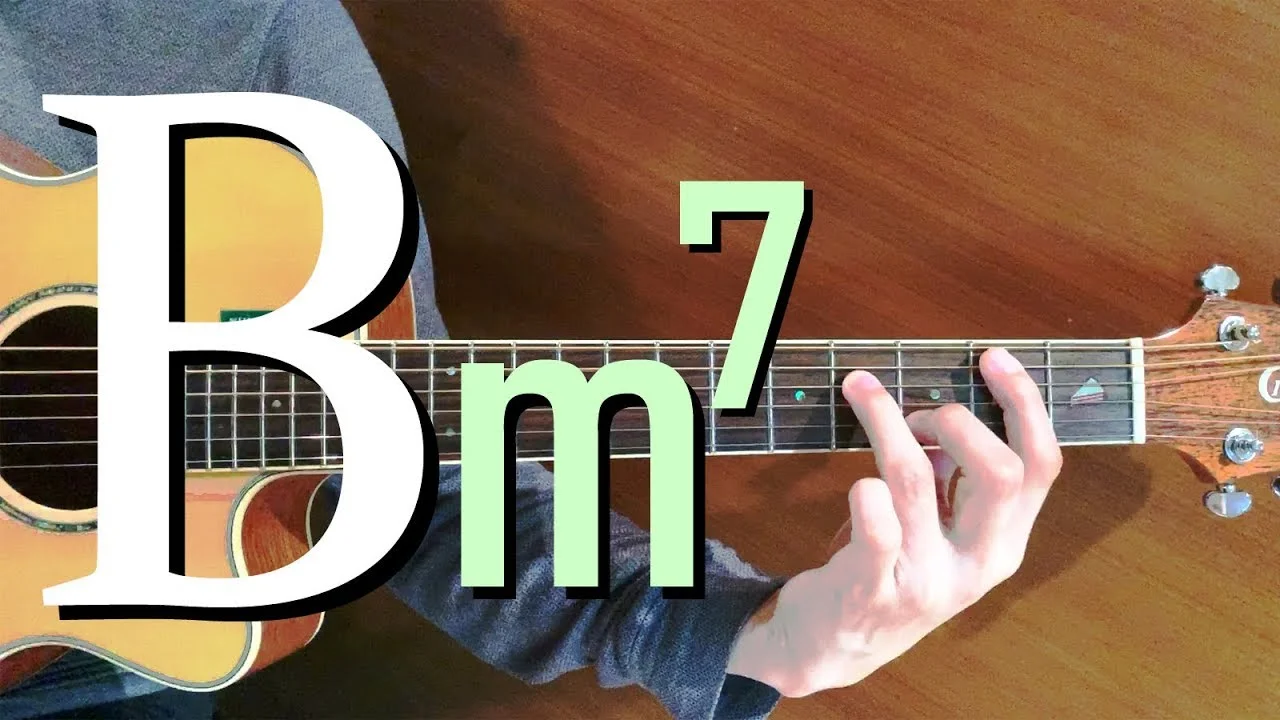
In guitar theory, Bm7 is formed by removing the pinky finger from a Bm chord. It might seem easier with one less finger, but in reality, it is not. The Kirin Musical Instruments Mall blog points out that removing a finger does not make it easier; in fact, it makes it more difficult 4.
Because the index finger must now replace the pinky on the 3rd string, greater finger dispersion and precision are required. This constitutes a high-difficulty segment of barre chords: fretting the 5th and 1st strings (while lightly muting the 6th) and accurately pressing the middle notes with the remaining fingers.
If barre chords are not yet manageable, it is wiser to practice by substituting similar chord progressions rather than forcing the issue. The instructor who runs Kirin Musical Instruments Mall stated that when teaching beginners, they tend to recommend the Bm11 chord, which requires no barre, when Bm or Bm7 appears in a piece 4. Bm11 allows the thumb to wrap over the neck, reducing the burden regarding capo mechanics and wrist angles, while still maintaining the harmonic progression. This instructor advises using the easiest possible method to form chords when the primary goal is not specifically barre chord practice 4. They also mentioned that many players intentionally use Bm11 because of its pleasing sound 4.
Ultimately, the reason Bm7 sounds muffled is not a lack of muscle strength, but the fact that the "simultaneous posture shift"—pulling the thumb to the back of the neck, bending the wrist, and using the side of the index finger—has not yet become second nature. If all these conditions are not met immediately, mastering song progressions using Bm11 while separately internalizing the capo principles of barre chords is a practical path to improving skills without stopping guitar practice.
References
- ↩
- ↩
- 🎸 기타 코드 운지법(Logic) 가이드 | 심플우디 · simplewoody.com↩
- 기타 Bm, Bm7, Bm11 코드 정리해드림 · m.blog.naver.com↩
- 기타의 기본 바레 코드 배우기 · ko.eferrit.com↩