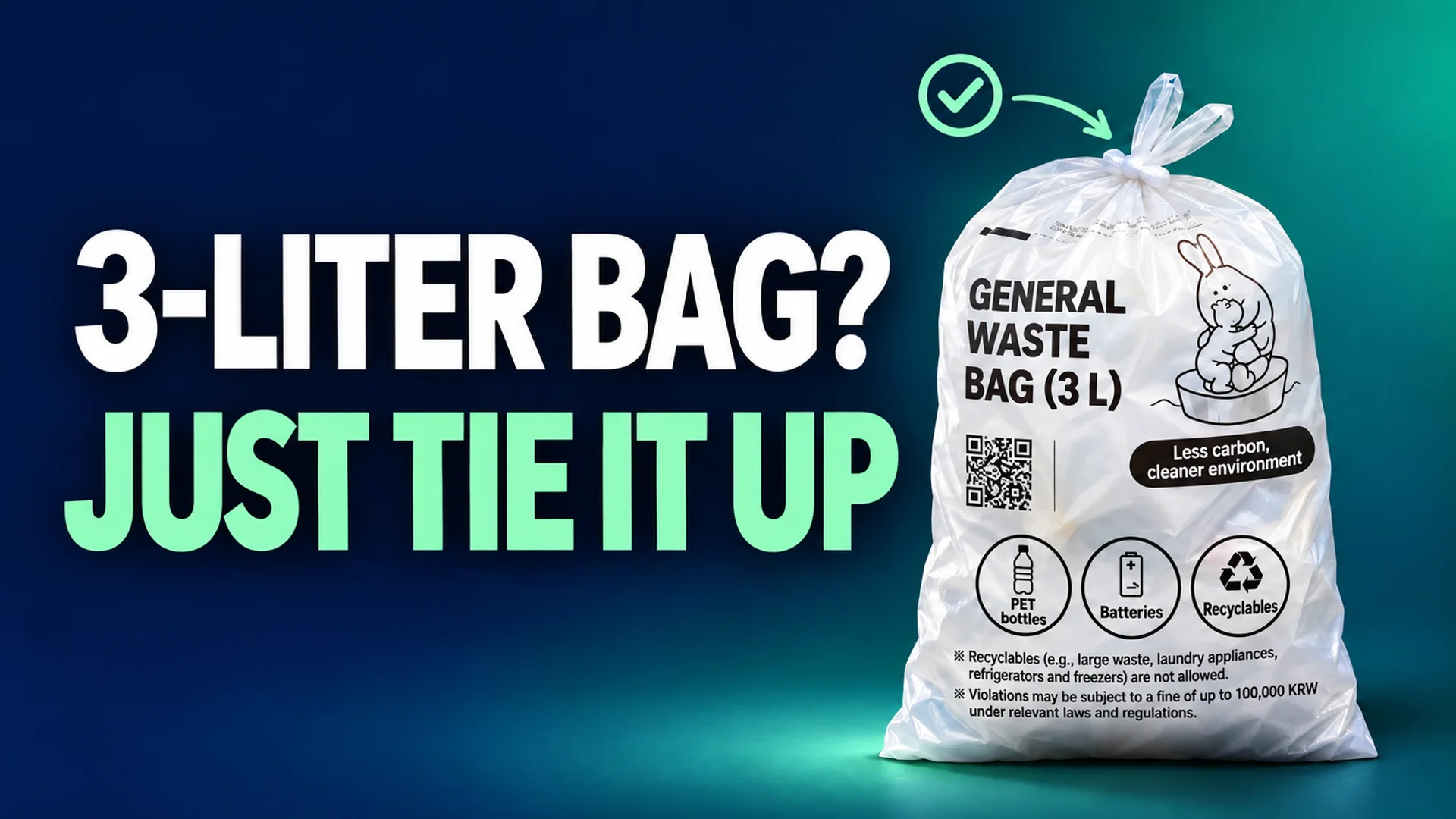
Sales of 3-liter (L) waste bags began in Bucheon on November 5 1. Seeing the number ‘3 liters’ newly displayed on shelves in convenience stores or community centers, it may not be immediately clear whether the contents of your usual trash bin will fit completely into this single bag.
The key question is whether you can tie the opening closed. “3 liters” is a unit of volume, not a standard box size with pre-determined dimensions in centimeters. Therefore, whether the bag can be tied shut after filling is the practical criterion that determines whether waste can be disposed of as general trash. Items such as sofas, refrigerators, and furniture that cannot fit into a bag should not be disposed of in standard waste bags but require separate reporting as large waste items 2.
Actual Capacity and Size of 3-Liter Bags
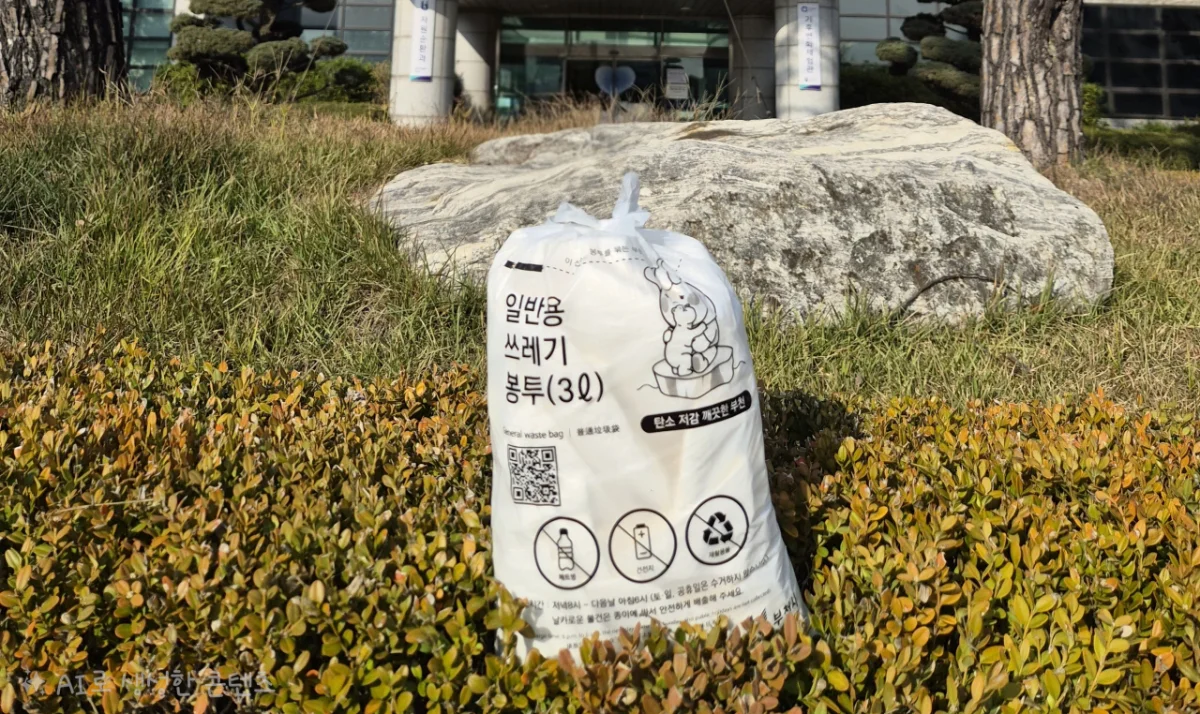
Bucheon offers a selection of waste bag sizes from 1L, 2L, 3L, 5L, 10L, 20L, 50L, 75L, and 100L. The newly introduced 3-liter bag falls between the 2L and 5L sizes, offering an intermediate option that households generating small amounts of waste can use without burden 2.
For a single-person household, this bag can comfortably hold daily waste such as instant noodle containers or food peels. However, placing PET bottles in with caps on, or stuffing unfolded cardboard boxes whole, can make it difficult to tie the bag closed. It is important to ensure enough room to tie the bag rather than forcefully compressing contents beyond the bag’s rated capacity 3.
Because the bags are stretchable, they can hold slightly more than their calculated volume. However, if the bottom tears or the top cannot be tied shut, collection may be refused. Rather than forcing items in, it is advisable to first check whether you will have enough room to tie the bag after filling it 3.
Items too large for bagging are subject to large waste reporting requirements
Items too large to tie within a bag must be disposed of through a completely different channel. Large waste items are not placed in bags but require online reporting and affixing a sticker. When doing so, local governments set reporting fees based on the exact dimensions of the item, such as the number of drawers or the width 4.
For example, Bucheon’s large waste reporting criteria set the fee for dressers at KRW 4,000 for four drawers or fewer, and KRW 6,000 for five or more. Sofas are charged KRW 3,000 for single-seaters and KRW 5,000 for two- or three-seaters. Wardrobes and closets with a width under 70 cm, including half-size wardrobes or narrow storage units, incur a fee of KRW 6,000 4. Items that cannot be tied when placed in a bag are classified as large waste under these detailed size-based standards and must be reported regardless of liter capacity.
Tips for Buying Bags and Policy Trends for Single-Person Households
Community centers with weekday operating hours generally have the most stable stock 2.
In April 2026, to address fluctuations in international oil and raw material prices, Bucheon implemented a supply quota system (allocation) per vendor and joint on-site inspections to prevent shortages at specific retailers 5. Therefore, it is recommended to purchase only the necessary quantity when needed rather than hoarding.
Cases from other local governments help infer the reasons for introducing ultra-small sizes like 3 liters. Busan Saha-gu introduced 3-liter waste bags (KRW 120 each) in response to the increase in single-person households, decreased waste generation in smaller households, and demands for smaller sizes than the existing 5-liter bags 6. Using smaller sizes allows for more frequent emptying before waste overflows, which helps reduce odors 3.
In conclusion, to estimate whether your trash will fit in a 3-liter bag, you do not need to measure pre-determined dimensions in centimeters. Simply check whether you can tie the opening closed after filling. If the bag cannot be tied shut, or if the item falls under fixed size criteria such as Bucheon’s reporting standards, do not force it into a 3-liter bag; instead, separate it and report it via online large waste reporting to avoid collection refusal.
References
- 부천미래신문 · m.bcnews.co.kr↩
- 경기 부천시 종량제봉투 가격 — 종량제봉투 크기별 일반·음식물 가격표·파는곳 · life.mustarddata.com↩
- 종량제봉투 규격 확인 및 올바른 배출 방법 가이드 - 다모음 · damoum.net↩
- 부천시 대형폐기물 인터넷신고 · clean.bucheon.go.kr↩
- [데일리투데이] 부천시, 종량제봉투 안정 공급 유지…쿼터제·현장 점검으로 수급 관리 · dailytoday.co.kr↩
- ( 구정 ) 의 목록 | 사상소식지 · sasang.go.kr↩