It is not uncommon to put a book down after reading only thirty pages or halfway through, thinking, “I simply cannot understand what this person is saying.” KBS Senior Correspondent Esther Park, who has worked at the network for twenty-seven years, explains that this frustration is not due to a lack of reader effort, but rather a natural phenomenon resulting from the fact that the author’s logical structure has not yet reached its conclusion. In argumentative non-fiction, such as works in the social sciences, authors build their logic “like a tower,” from the bottom up. Consequently, even when a reader is halfway through, they are often still stuck in the “introduction” stage, where the author is still laying out premises and defining terms 1.
So, to prevent mid-book abandonment, should you look at the table of contents first? According to Park’s publicly shared reading method, the core is not scanning the table of contents itself. She recommends “front-loading”—intensively reading the first one-third to one-quarter of the book, where unfamiliar premises are clustered, within a short period 1. Unlike strategies that involve skimming the book’s overall outline, this approach focuses on lowering the cognitive barrier required to taste the insights in the latter half by first acclimatizing to the author’s rhythm.
Half of an Argumentative Book Is the “Premise-Building Zone”
According to Park, social science authors unfold one large framework from start to finish, stacking their logic meticulously like a tower. They begin by laying stones at the very bottom and eventually place a single stone of insight at the top. The problem arises when a reader stops halfway up this tower. Park notes that even after reading half the book, the reader may not have even reached the stage where the premises are fully laid. During the construction phase of the tower, the reader cannot yet look down from the top where the insight resides, leading inevitably to a sense of frustration, as if the book is floating in a void 1.
She explains that once you begin reading such books, you should aim to finish them in one go. Reading them over a long period breaks the logical rhythm, making completion difficult, much like holding your breath for months before exhaling 1.
Why You Should Concentrate on the First One-Third Rather Than Skimming the Table of Contents

Park’s proposed solution can be summarized in three elements: “rhythm,” “speed,” and “notes.” Among these, the key to preventing mid-book abandonment lies in the strategy of understanding the “rhythm” and getting through the beginning. She recommends reading at least the first one-third or one-quarter of the book in a short period 1.
By “the beginning,” Park does not mean a simple introduction. This is the section where the underlying premises of the book, the key terms the author emphasizes, and the context serving as the basis for the argument are presented in an unfamiliar way. Getting through the unfamiliarity of this section requires not only patience but also a process of becoming accustomed to the author’s rhythm. Reading this section in a short period leads to the following changes 1:
- Reading speed increases: As you understand the premises and terminology, it becomes easier to follow the more complex and important arguments as you move toward the middle and later parts of the book.
- The book becomes enjoyable: A sense of pace leads to interest. Once the author’s logical progression begins to make sense, the book shifts from a boring list of facts to a meaningful journey.
- Insight arrives all at once: You get to fully experience the “eureka” moment of catharsis that the author has prepared for the end.
On the other hand, if a book is already divided into “multiple short rhythms,” such as an essay collection, there is no need to apply this strategy. Reading it in one-rhythm units (one essay at a time) does not disrupt the overall structure. Therefore, it is important to first determine whether the book that has stalled in your hands is an “argumentative book with a single rhythm” or a “collection with short rhythms” 1.
| Book Rhythm Structure | Recommended Reading Approach |
|---|---|
| Argumentative books with a single overall rhythm | Intensively finish the first one-third to one-quarter in a short period, then read the rest with a sense of momentum |
| Books divided by chronology or theme (e.g., history books) | Reading in rhythm units (eras, chapters) does not significantly hinder structural understanding |
| Collections with short rhythms (e.g., essays) | Reading one piece at a time with breaks is more suitable |
How to Maintain the Benefits of the “Front-Loading” Strategy with “Careful Reading” and “Notes”
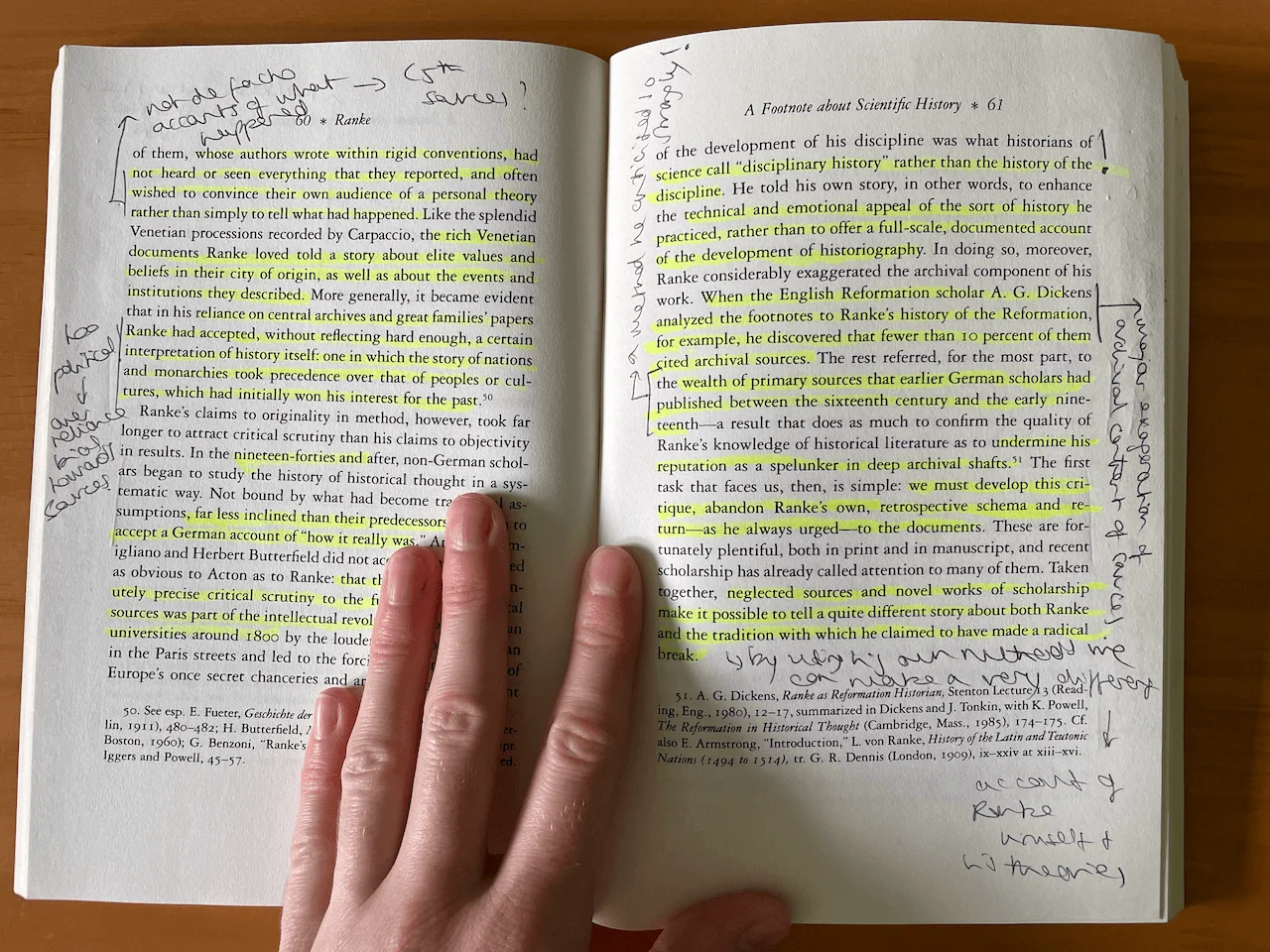
Even after learning the premises through front-loading, you need a “careful reading” attitude to understand the complex logic in the latter half. Park explains that speed reading involves skipping some content, making it unsuitable for books that require “deep reading”—where the author’s thoughts meet or clash with yours. She cites one of the most concisely written books she has read as an example, advising that such books require careful reading that even infers the parts the author did not explicitly write 1.
The “notes” strategy is not intended for memory retention after reading. For the reading notes Park has kept for over ten years, the role is to catch the flow of thought in the “present moment.” There comes a time in the middle of the book when a sentence you underlined earlier because it seemed unfamiliar suddenly clicks: “Ah, I underlined this because they were setting up that point.” Park defines this exact moment of connection as “the best reading experience.” This process is also how premises that felt foreign in the beginning dissolve into your own perspective 1.
Meanwhile, online communities often suggest tips to prevent mid-book abandonment, such as “choosing books in your area of interest” and “starting with shorter books.” Building a sense of completion by choosing books on familiar topics or with fewer pages can reduce the psychological pressure of tackling longer works 2. These tips do not conflict with the front-loading strategy. Applying front-loading to an argumentative book in a field you are already interested in can reduce the burden of its unfamiliar structure and help you more easily experience the sense of achievement that comes with finishing a book.
Ultimately, the feeling of stopping at page thirty is not a matter of willpower; it is a sign that you are currently passing through the foundation-laying phase, where the author has not yet revealed the top of the tower. At this point, rather than using the table of contents to get an overview, acclimatizing your body to the author’s rhythm by quickly learning the unfamiliar premises and terms in the beginning is a practical way to encounter the insights in the latter half. However, this method is limited to argumentative non-fiction where the entire book is woven into a single logical thread; for essays or collections, reading in breaks at your own pace is sufficient.
References
- 난 왜 책을 끝까지 못 읽을까? “이렇게 해보세요”[KBS 27년차 대기자의 비법 대공개] · youtube.com↩
- ↩