As soon as I turn on my smartphone, videos and articles I might like pour in. Algorithms that identify my tastes and suggest content in 0.1 seconds are incredibly convenient, but don't you sometimes wonder, "Is what I'm watching right now truly what I wanted, or is it just what the algorithm is spoon-feeding me?"
In 2026, we live in a paradoxical era. It is a hyper-connected age where AI predicts and recommends everything, yet paradoxically, people are struggling to escape the "touch of the algorithm" to find their own rhythm. Today, based on recently released reading data analysis, I want to explore the fascinating trend of why we should pay attention to analog detox and slow reading right now.
Changes Told by Data: 'My Daily Life' Over Grand Dreams
Looking at the 2026 reading trend analysis recently announced by KT Millie, an interesting point emerges. While grand discourses like "economic freedom" or "macro success" dominated the reading market in the past, the readers of 2026 are looking toward much more realistic and personal matters.
The most striking keyword is Nano-Fintech. Instead of learning how to become a billionaire, people are now more deeply concerned about how to generate an extra 100,000 KRW per month as an office worker, or how specific issues like exchange rates or virtual assets will impact their own wallets. In fact, the fact that the most-read book on the AI reading service 'AI Dokfarming' was Money Trend 2026 shows that reading has evolved from an abstract pastime into a practical tool for survival.
However, there is one thing we must not miss. The more we obsess over such realistic information, the more our brains paradoxically tire out. This is because the brain must incessantly process information amidst constantly changing economic indicators and news.
Finding 'Intentional Rest' Amidst the Flood of Dopamine
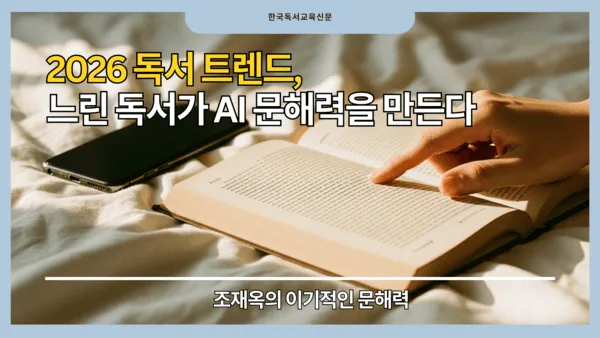
We are currently in a state of 'dopamine overload.' Three-second short-form videos, ten-second summary texts, and the constant ringing of app notifications. While this stimulating content provides immediate pleasure to our brains, it gradually erodes our power of deep thought—our capacity for reasoning.
This is why dopamine detox and intentional rest have emerged as core trends for 2026. Rest is not simply doing nothing. The key is the process of intentionally blocking digital signals that stimulate the brain, enduring 'boredom,' and restoring focus.
The increasing re-reading rates of books related to meditation, mindfulness, and 'digital minimalism' are highly significant. People are now redefining reading not merely as an act of filling up information, but as a means of emotional recovery to cool down an overheated brain.
There is a pitfall we must watch out for here. Many people claim to do a 'digital detox' by staying away from smartphones, but they end up feeling the same digital fatigue by reading e-books on a tablet PC. A true detox is only complete when it includes stepping away from the light of the screen to feel the texture of paper.
How to Not Become a Slave to the Algorithm: The Power of 'Slow Reading'

So, how can we ride the waves of this algorithm? Experts suggest media literacy combined with Slow Reading as the solution.
Algorithms only show us what we want to see. If this intensifies, we fall into 'confirmation bias,' believing only what we already believe. By moving only within the framework set by the algorithm, we lose diverse perspectives and become trapped in a closed structure of thought.
This is when what we need is selfish literacy. Here, 'selfish' does not mean being inconsiderate of others. It means a 'subjective attitude' of protecting one's own rhythm and seeking true wisdom without being swayed by platform algorithms or the pace of others.
Slow Reading is not just reading slowly.
- It is critically contemplating the context even when reading a single sentence.
- It is pondering why an author chose a specific word, rather than accepting the 10-second conclusion summarized by an AI.
- It is the process of facing the text deeply while feeling the texture of a paper book.
This process is the only way to cultivate 'critical thinking,' the unique and powerful weapon humans can possess in the age of AI. The reason why 2026 reading trends are returning to the 'power of story,' with genre fiction and series with solid world-building being loved, is ultimately due to the human instinct to immerse oneself deeply in powerful narratives that allow one to forget the anxieties of reality.
The Future of Reading Walking with AI
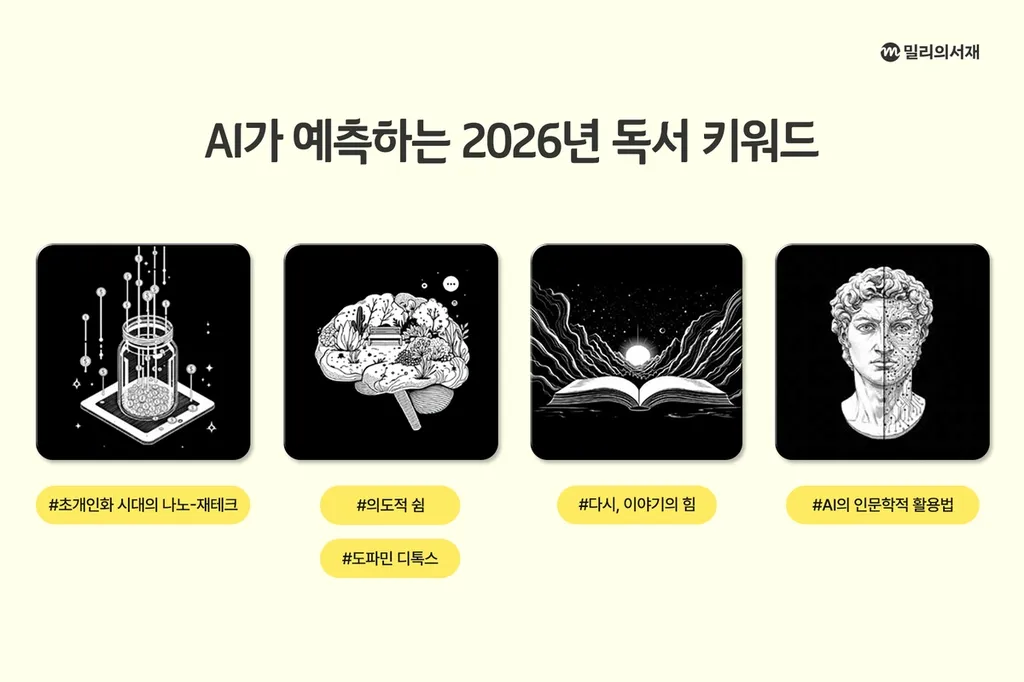
Of course, there is no need to unconditionally distance ourselves from AI. Rather, 2026 is the period when the humanistic application of AI begins in earnest. AI is not our enemy; it can be a smart assistant that helps us move toward a wider world.
Rather than simply learning how to use technology, general education books that explore how to critically accept the vast data provided by AI and how to use AI to expand uniquely human creativity are gaining attention. This is also why platforms like Millie are evolving from 'search-centric' models to AI-based services that 'discover' individual tastes.
Ultimately, the key lies in the balance between 'AI as a tool' and 'Human as a subject.' While AI can read and summarize books for us, the task of integrating that content into our life values and making judgments belongs solely to humans.
In Summary: What is Your Reading Rhythm?
The 2026 reading trends discussed so far can be summarized into three points:
- Practical Wisdom: Focusing on practical information like Nano-Fintech that can be immediately applied to life, rather than grand discourses.
- Emotional Stability: Intentional rest and dopamine detox become essential survival strategies to prevent dopamine overload.
- Subjective Thinking: Rather than relying on algorithmic recommendations, cultivating critical thinking and humanistic insight through slow reading.
We have entered an era where the question is no longer 'how much do you read' but 'how deeply do you read.' It is fine to follow the convenient path recommended by the algorithm, but how about occasionally stepping off the path intentionally, picking up an unfamiliar book, and feeling the cool yet warm touch of paper?
Today, instead of the video recommended by the algorithm, which book's first page would you like to turn?