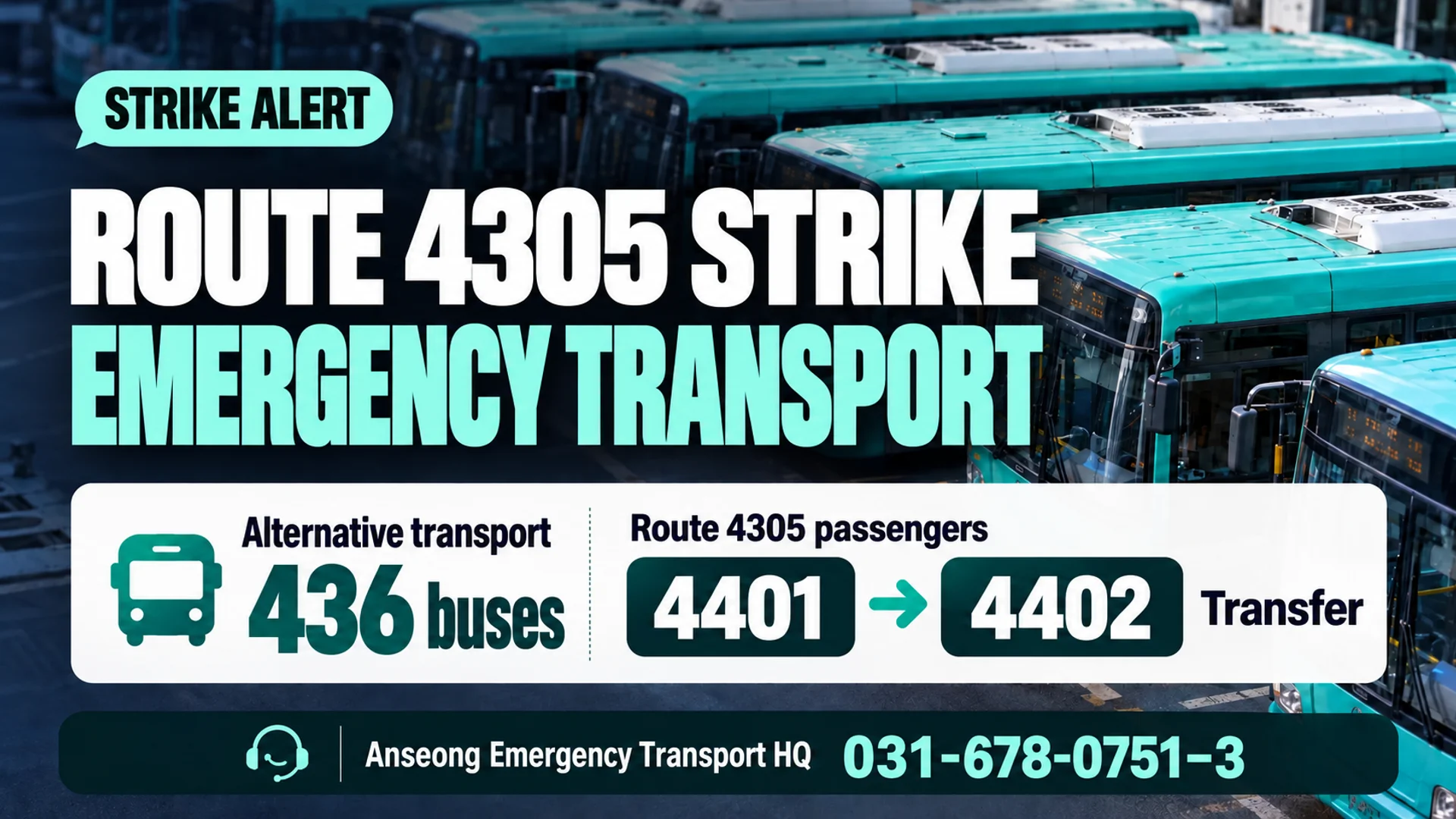
As the general strike by the Gyeonggi-do city bus labor union has been announced to begin with the first bus on October 30, 2026, Anseong City has activated emergency transportation measures to minimize inconvenience to citizens. With the strike expected to involve routes operated by Baeksung Transport, a major local transportation company, the operation of Express Bus No. 4305 is likely to be suspended. Accordingly, Anseong City is guiding alternative routes for No. 4305 passengers and deploying a total of 436 alternative transportation vehicles on-site. This article summarizes the anticipated impacts of the strike, the city's emergency transportation plan, and alternative transit options citizens should review in advance.
Expected Suspension of Route 4305 and Transfer Methods
Express intercity bus No. 4305, operated by Baeksung Transport, connects Anseong City and Songpa-gu in Seoul. It previously operated 24 daily trips with a headway of 40–50 minutes from Anseong Bus Terminal to Munjeong Station (Munjeong Rodeo Street) in Seoul, serving demand for travel from the Anseong area to southeastern Seoul following the discontinuation of existing intercity bus services[ 1]23.
If the strike proceeds as scheduled on October 30, 2026, Baeksung Transport's 87 routes (135 vehicles) are expected to suspend operations[ 1]2. Consequently, No. 4305 is likely to be suspended, and citizens who previously used this route will need to transfer to Routes 4401 or 4402, which are not part of the strike[ 1]2. These two routes are expected to operate normally regardless of the strike.
Emergency Vehicles Deployed and Operating Routes in Anseong City
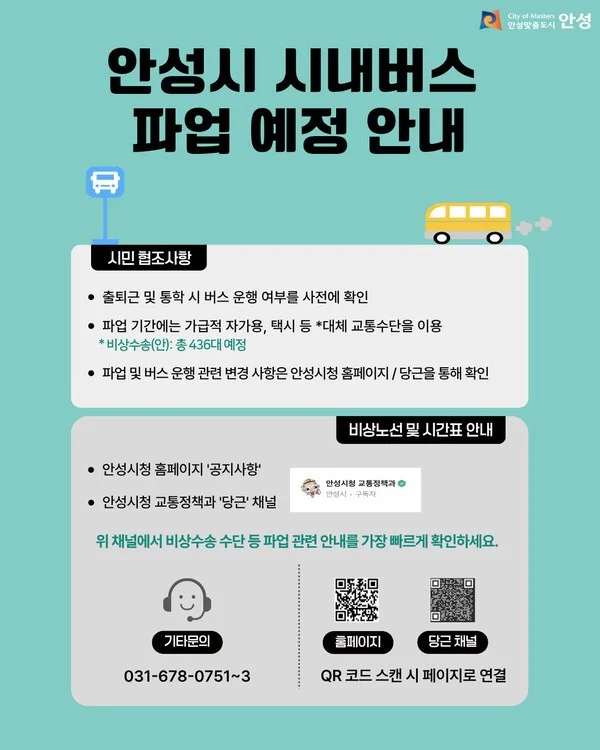
Anseong City has established emergency transportation measures deploying a total of 436 alternative vehicles during the strike period. The composition of deployed vehicles is as follows:
| Category | Number of Vehicles |
|---|---|
| Municipal Vehicles | 8–9 |
| Charter Buses | 11 |
| Annyeong Buses | 7 |
| Ttok Buses | 7 |
| Taxis | 403 |
| Total | 436 |
(Source: Anseong City Emergency Transportation Measures[ 1]2)
Emergency transport buses are concentrated on specific key segments. Municipal and charter buses will operate on the Anseong Terminal–Gongdo Terminal–Pyeongtaek Terminal segment. To ensure mobility for residents in township (eup) and myeon areas, they will also be deployed on the Anseong Terminal–Iljuk Terminal and Gongdo-eup–Wolgok-myeon/Yangseong-myeon segments. Additionally, routes connecting myeon areas such as Bogae, Gosam, Geumgwang, Miyang, and Seowun to terminals will operate to secure connections between the city outskirts and intercity hubs[ 1]2.
Distinguishing Between Strike-Affected and Normal-Operation Routes
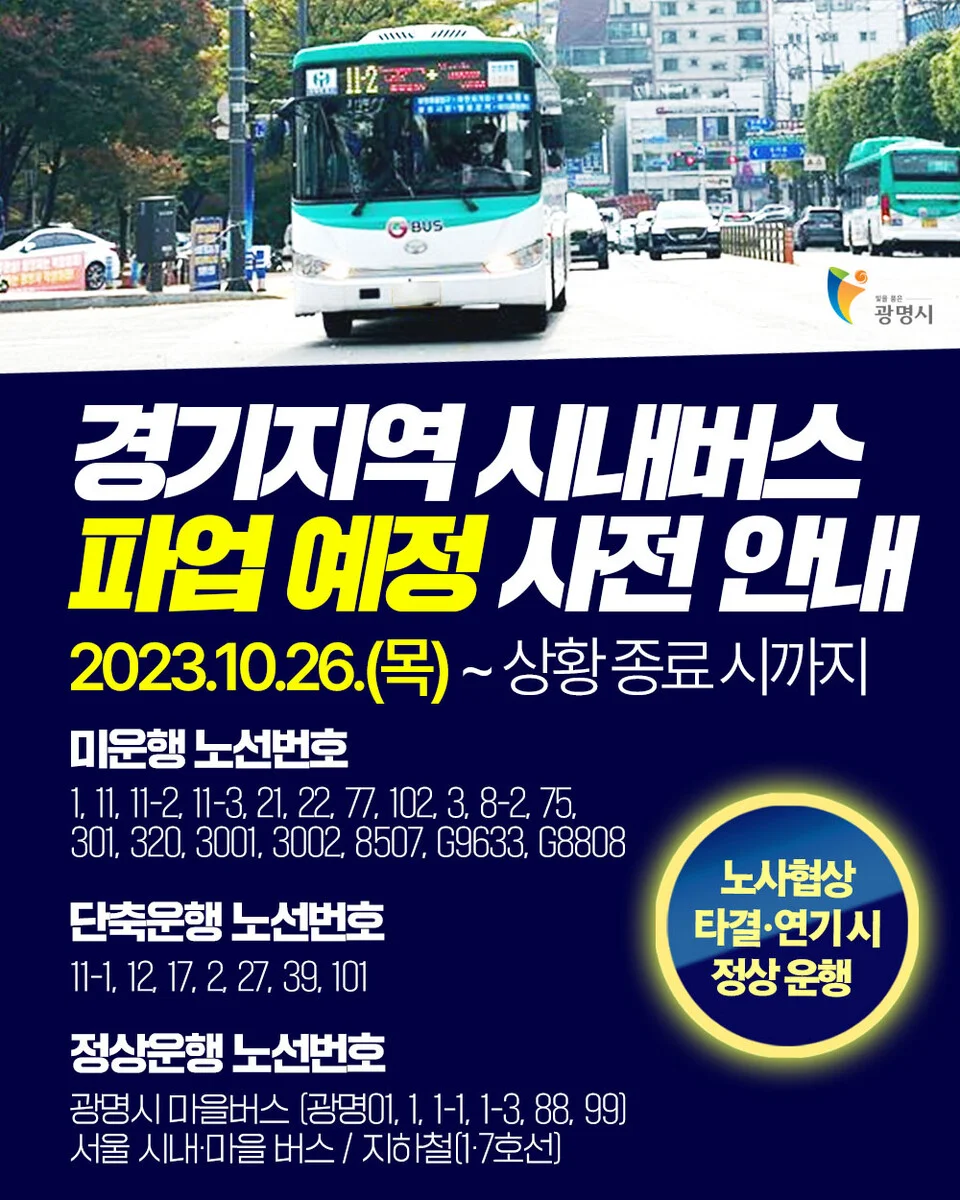
To reduce confusion among citizens, it is necessary to clearly distinguish between routes suspended due to the strike and those operating normally.
In Anseong City, the routes affected by the strike are the 87 routes operated by Baeksung Transport. In contrast, routes excluded from the strike and scheduled to operate normally include Nos. 8200–8204, 4401, 4402, Route 201 toward Cheonan, and the southern and eastern sections of the Ttok Bus service[ 1]2.
Anseong City urges citizens to check bus operating status in advance before commuting to work or school, and to actively utilize alternative transportation means such as carpooling or taxis. Detailed information on emergency transport routes and timetables is available on the Anseong City Hall website and municipal notification channels. Inquiries can be made to the Anseong City Call Center (031-678-2114) or the Anseong City Emergency Transportation Headquarters (031-678-0751~3)[ 1]2.
Key Issues of the Strike and Broader Regional Response
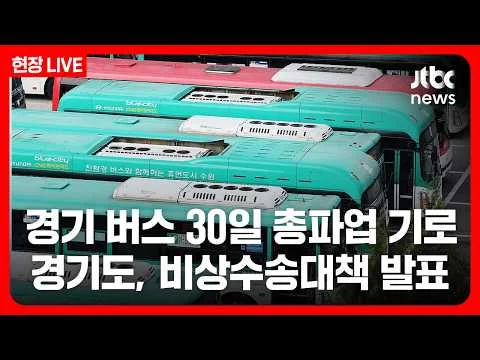
The central issue of this strike is the implementation of the agreement to reach wage parity with Seoul buses by January 1, 2026. Based on rulings in Seoul ordinary wage lawsuits, the union is demanding wage increases of 21.56% for semi-public system routes and 30% for private system routes[ 4]5. Meanwhile, management insists on freezing wages for private system routes due to worsening financial conditions in Gyeonggi Province[ 5].
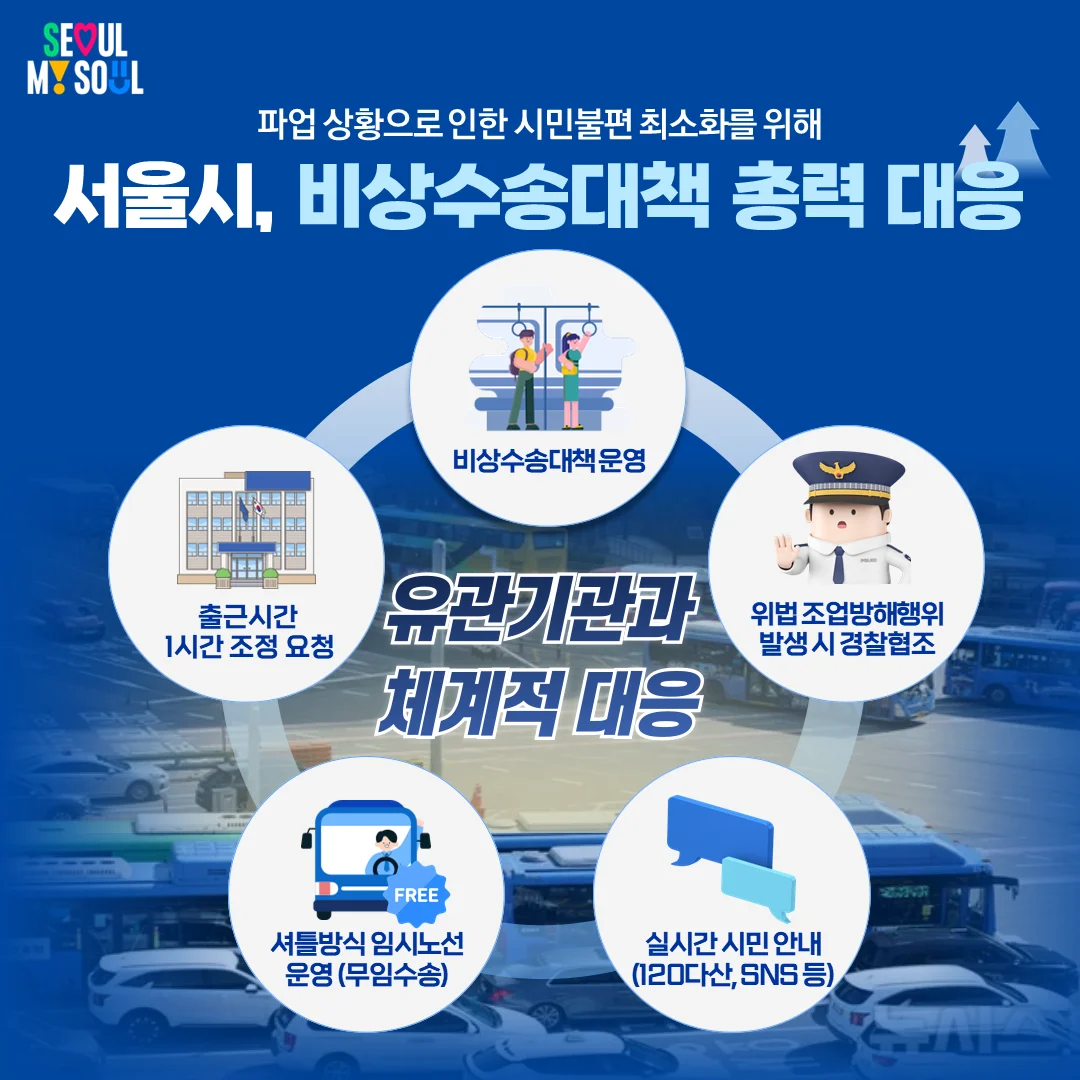
At the provincial level, including Anseong City, Gyeonggi Province has activated a large-scale emergency transportation headquarters since 9:00 AM on October 29. The province is operating around 200 charter and municipal buses on loop routes across 15 cities/counties and 160 key locations, and is encouraging maximum operation of over 2,300 non-striking buses and over 27,000 taxis[ 4]. Additionally, Seoul is coordinating with neighboring local governments to fill service gaps by extending peak-hour concentration scheduling for inbound city buses from Gyeonggi[ 6].
Gyeonggi Province has acknowledged a wage gap for transportation workers between Gyeonggi Province (5.25 million won) and Seoul (5.29 million won) and stated its principled position to apply identical wages starting January 2026[ 4]. However, the actual implementation and duration of the strike may vary depending on the outcome of final mediation.
Despite the sudden development of the strike notice, Anseong City is mobilizing all available resources, including municipal vehicles, charter buses, and taxis, to guarantee citizens' right to mobility. Checking in advance whether key routes like No. 4305 are suspended, utilizing alternative routes such as 4401 and 4402, and regularly verifying emergency transport information provided by the city are the most practical ways to reduce traffic disruptions during the strike period.
References
- 안성시, 시내버스 파업 대비 비상수송대책 가동…대체교통 436대 투입 · gwangjang-ilbo.com↩
- 안성시, 경기도 시내버스 총파업 대비 비상수송대책 구축 - 뉴스Q · newsq.kr↩
- 안성 버스 4305 - 나무위키 · namu.wiki↩
- ↩
- 경기 버스노사 오늘 최종 조정회의…결렬 시 내일 첫차부터 파업 · yna.co.kr↩
- 서울시, 철도노조파업(12월 23일) 대비 비상수송대책 시행 · newsin020.com↩