
"Lower your expectations and you'll get a job"—is there any advice more cruel to job seekers than this?
Despite the endless hours spent building specs and battling personal statements, the reality of the job market feels like a wall that is both incredibly high and impenetrable. What is the true nature of this overwhelming subsistence-type youth unemployment, which cannot be explained simply by saying "there are no jobs"?
Today, instead of being buried in mere employment rate statistics, we intend to delve into the fundamental causes of why young people cannot find jobs and why an unbridgeable gap exists between companies and job seekers.
Is it a matter of expectations, or a mismatch in job quality?
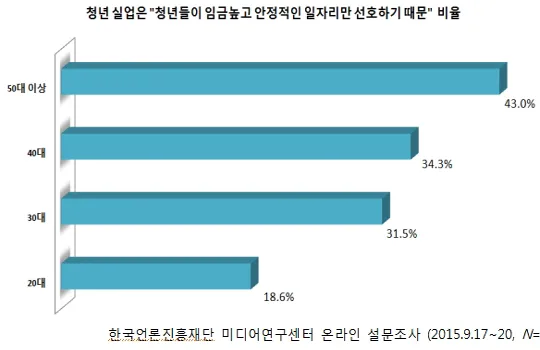
Many point to "high expectations of young people" as a cause of youth unemployment. However, the story changes slightly when looking at recent research published by Seoul National University.
It was revealed that the conditions job seekers desire are not merely limited to "high salaries." Job seekers tended to prioritize working environment, job security, aptitude and interest, and corporate vision over wages.
This means that young people are not simply looking for "easy jobs," but are searching for valuable workplaces that can make their careers sustainable. In other words, the problem is not "expectations" themselves, but a massive labor market mismatch between the values young people expect and the conditions companies provide.
The reason many college graduates avoid small and medium-sized enterprises (SMEs) is not just because of money. According to research by the Korea Research Institute for Vocational Education and Training, young people seriously consider not only the low wages of SMEs but also the lack of welfare benefits and unstructured human resource development systems. The absence of Perceived Organizational Support (POS)—environments that make one wonder, "Can I grow here?"—is a key factor driving young people away.
The tightly closed door to permanent positions and the trap of the dual structure
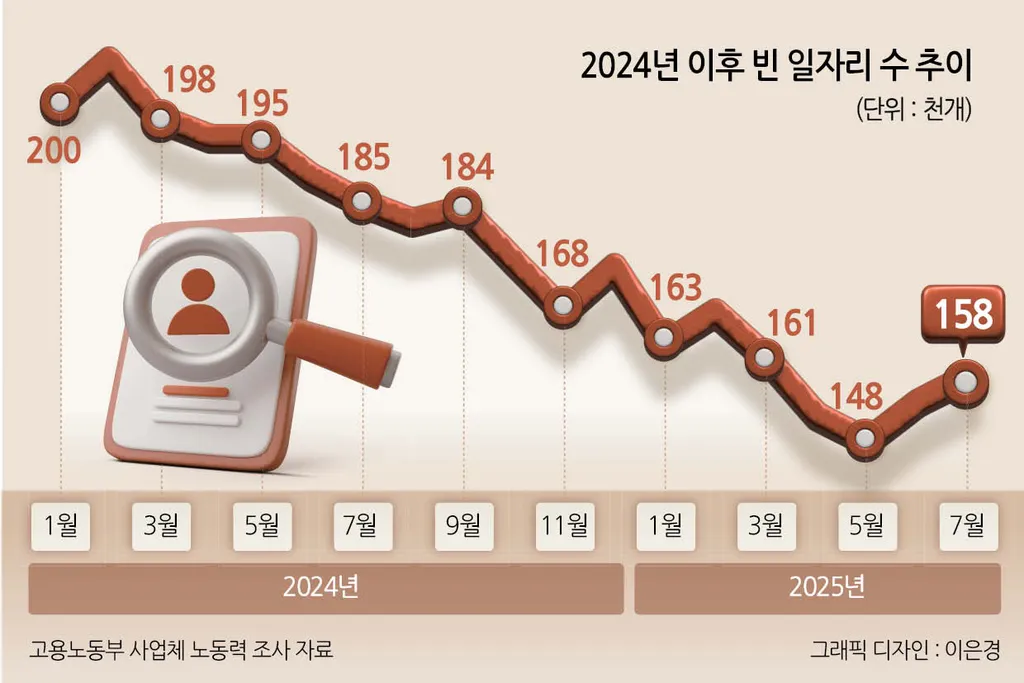
Then why has the threshold for large corporations or stable permanent positions become so high? Here, we encounter the dual structure problem, a chronic ailment of the Korean labor market.
Currently, the Korean labor market is sharply divided into a primary market centered on large corporations and permanent employees, and a secondary market centered on SMEs and non-regular workers. The labor flexibility accelerated after the IMF financial crisis has caused companies to extremely refrain from hiring permanent employees to avoid employment uncertainty.
Some argue that regulations should be relaxed by citing "overprotection of permanent workers," but this may be an argument that misses the essence. In reality, relaxing the protection of permanent workers does not necessarily pass those benefits down to non-regular workers or youth; rather, there is a risk that it could be exploited as a means for companies to cut costs, ultimately reducing the number of jobs available.
Ultimately, the unemployment faced by young people stems not from a lack of individual capability, but from a structural imbalance where high-quality jobs are concentrated within specific groups. Research showing that youth in certain fields, such as those majoring in arts or physical education, face much harsher environments in both wages and job security compared to other majors, demonstrates how multi-layered this inequality is.
Three keys to creating "decent jobs"
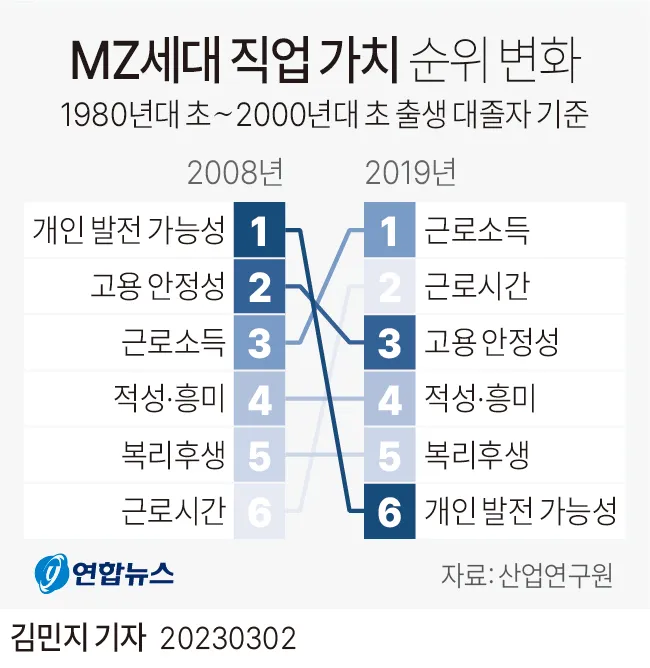
How can we solve this massive structural problem? Simply shouting "we will create more jobs" is not enough. We need an approach across the following three dimensions:
1. Building a 'Bridge of Trust' between companies and youth
For SMEs to become an attractive option for young people, increasing wages alone is insufficient. Companies must treat employees not as mere consumables, but as value co-creation partners. As research has shown, young people are sensitive to how much an organization will support them (Perceived Organizational Support). Standardizing systematic training programs and welfare systems will be a key factor in preventing talent drain from SMEs.
2. Harmonizing flexibility and stability: 'Flexicurity'
Looking at cases from OECD countries, it is evident that the Flexicurity model is more effective than unconditional employment protection. This involves opening entry points through flexible forms such as internships initially, while providing strong government incentives to companies so that young people who have gained practical experience can transition into permanent positions. This is why internships must serve as a stepping stone to permanent employment rather than just a tool to replace low-wage labor.
3. Tailored policies spanning regions and majors
As seen in the case of Seoul, vocational training linked to region-specific industries and digital competency reinforcement education must be carried out in parallel. Additionally, customized regional employment support policies must be established to resolve employment imbalances caused by regional disparities. It is also urgent to prepare institutional mechanisms to break the structure where certain majors are at a disadvantage.
Change begins with 'Quality' beyond the numbers
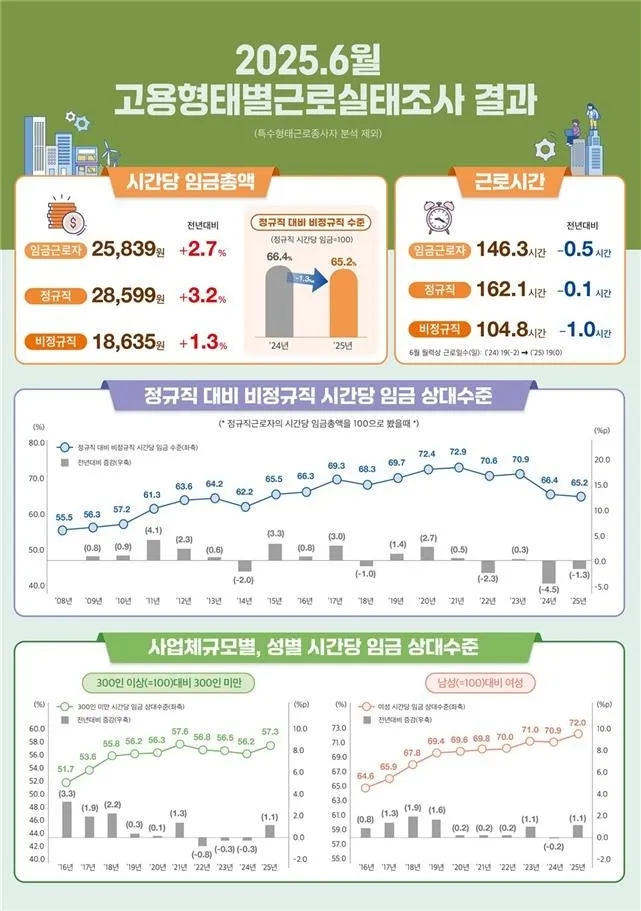
Ultimately, solving the youth unemployment problem in Korean society is not a game of simply lowering the unemployment rate figure. It is a process of raising the overall quality of jobs and creating a predictable environment where young people can design their futures.
Companies must view talent not as a 'cost' but as an 'investment,' and the government must design sophisticated policy packages that can break the dual structure of the labor market, going beyond short-term subsidies. Only when society can fill the gap with 'decent jobs' that match the expectations of young people, rather than asking the youth to lower their expectations, can this long-standing conflict finally come to an end.
We cheer for all the young people who are fighting against an uncertain future even at this very moment. Your struggles are by no means your fault.
What kind of job do you dream of? Is it simply a high salary, or an environment where you can grow? Please share your thoughts in the comments.
References
- 일자리 눈높이 차이가 대졸 청년의 노동시장 성과에 미치는 영향 · s-space.snu.ac.kr
- 청년 구직자의 중소기업 취업의향 영향 요인 연구 - 한국직업능력연구원 · krivet.re.kr
- 청년의 괜찮은 일자리 취업의 영향요인에 관한 지역 간 비교 연구 · oak.chosun.ac.kr
- 중소기업 이슈 포커스 · image.starrich.co.kr
- 노동시장 구조개혁, 정규직 과보호론의 틀에서 벗어나야 - 대학신문 · snunews.com
- OECD 국가의 유연안정성 및 유형별 적극적노동시장정책의 조합과 ... · kasp.re.kr
- 청년고용, 이렇게 풀자! 청년고용문제 해결을 위한 정책방안과 서울시 ... · labors.or.kr
- 한국경제 구조변화와 고용창출 - 연구 보고서 - KDI 한국개발연구원 · kdi.re.kr