"Assemble a development team for this project."
If you typed this single sentence into your terminal, would you believe it if the environment setup and team formation—tasks that used to take hours or even days—were completed in just 30 seconds? As of 2026, AI has evolved beyond being a simple coding assistant into the 'Meta' stage, where it organizes and operates teams on its own.
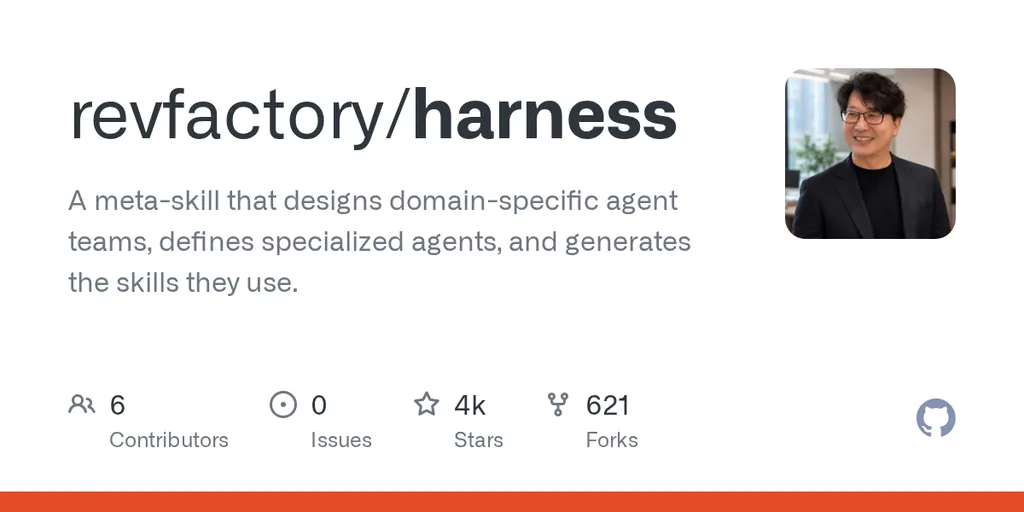
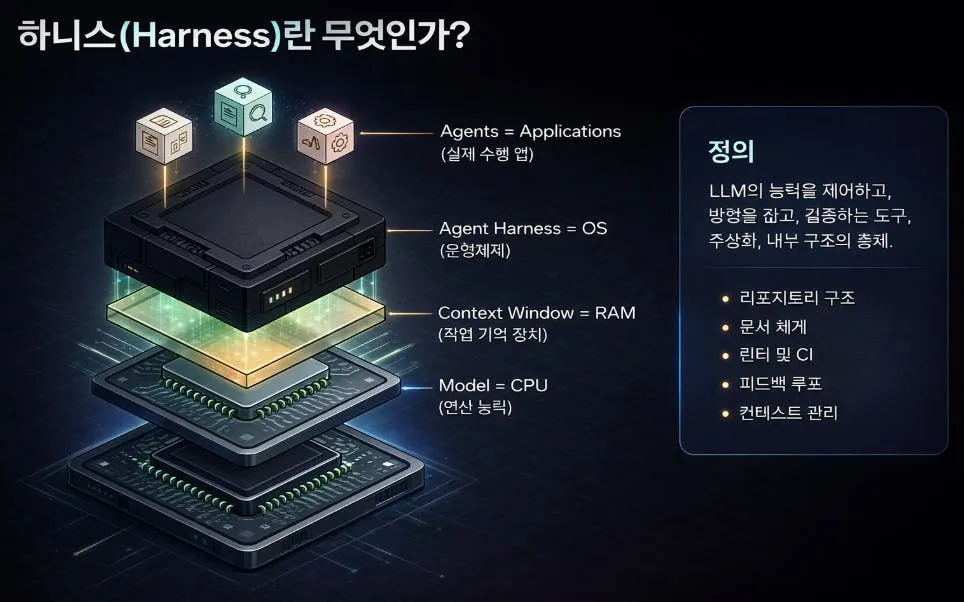
The revfactory/harness we are introducing today is a "Team Architecture Factory" within the Claude Code ecosystem. It goes beyond simple coding assistance to design the architecture of specialized agent teams to solve complex domain problems. Developers are now transforming from 'writers' who write code line by line into 'conductors' who direct AI teams.
Beyond the Limits of a Single Agent: Why 'Harness'?
What was the biggest frustration we felt when using AI until now? It was likely the realization that "AI is very smart, but it cannot manage an entire complex project on its own." Leaving everything to a single agent often resulted in tangled contexts or outputs lacking specialized expertise.
Harness starts from exactly this point. Instead of using one giant AI, this tool creates a 'team' consisting of 4 to 5 specialized agents tailored to specific fields. It implements a structure in the AI world similar to how planners, developers, and QA engineers collaborate in a startup.
6 Team Architecture Patterns: Designing the Right 'Org Chart' for the Situation
Harness doesn't just create teams; it proposes 6 optimized organizational structures (Patterns) based on the nature of the task.
- Pipeline: A structure where tasks flow sequentially like water.
- Fan-out/Fan-in: A method of processing multiple tasks in parallel and then consolidating them into one.
- Expert Pool: A form of calling upon experts suited to the situation.
- Producer-Reviewer: A quality-centric structure that creates and reviews outputs.
- Supervisor: A structure where a central manager dynamically allocates tasks.
- Hierarchical Delegation: A hierarchical structure where superiors delegate tasks to subordinates.
The ability to select a team architecture suited to the situation is the key that makes Harness more than just a simple plugin—it makes it a 'meta-skill.'
A Magical Workflow Completed in 30 Seconds
Using Harness is incredibly intuitive. There is no need to wrestle with complex configuration (Config) files. Users simply issue commands in natural language.
From Installation to Execution: Just Two Commands
Even the installation process is very smooth. Simply enter the command in the Claude Code marketplace.
- First, add Harness to the marketplace:
/plugin marketplace add revfactory/harness - Then, install the actual plugin:
/plugin install harness@harness
Once installation is complete, it's time for the real magic. For example, if you type "Build a harness for deep research," Harness analyzes the domain, defines the necessary agents, and even automatically generates the specialized skills they will use.
What is noteworthy here is the Progressive Disclosure technique. Instead of flooding the AI with all information at once and polluting its context, it maximizes efficiency by delivering only the necessary information to the agent at the required time. Thanks to this delicate design, the agent team can perform much clearer and error-free collaboration.
Harness 100: 100 'Pro-Grade' Teams Ready to Go
"Designing your own team is great, but what if there were already proven teams available?"
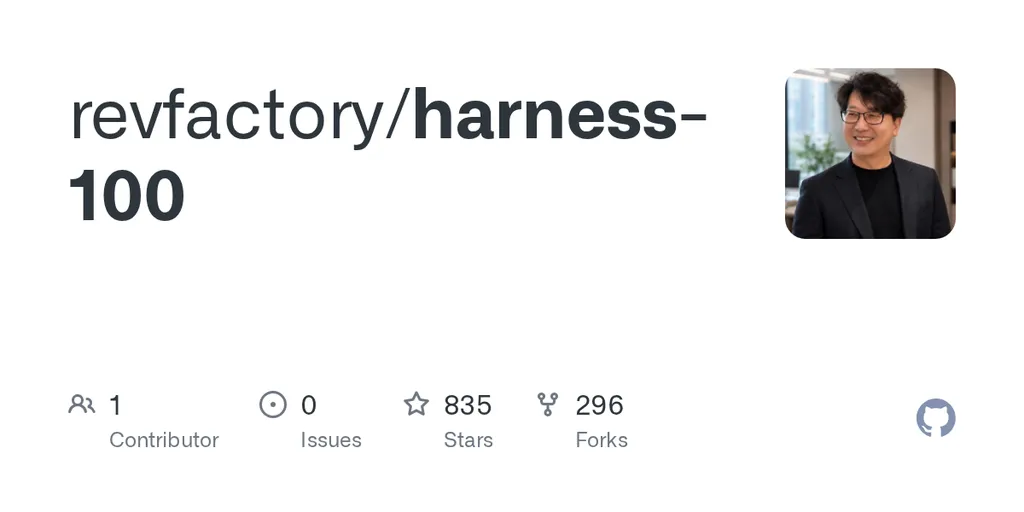
The answer to this question is the Harness 100 project. This is not just a collection of examples. It is a collection of 100 agent teams at a production-grade level that can be deployed immediately in real-world settings.
Vast Domain Coverage
Harness 100 covers 10 major categories and includes a staggering 978 agent definitions and 630 skills.
- Content Creation: The
youtube-productionteam, responsible for everything from YouTube video planning to SEO. - Software Development: Specialized teams for building full-stack web apps or mobile apps.
- Data & AI: Specialized teams for building LLM applications or performing data analysis.
- Business & Law: Specialized teams for market research, startup launching, and contract review.
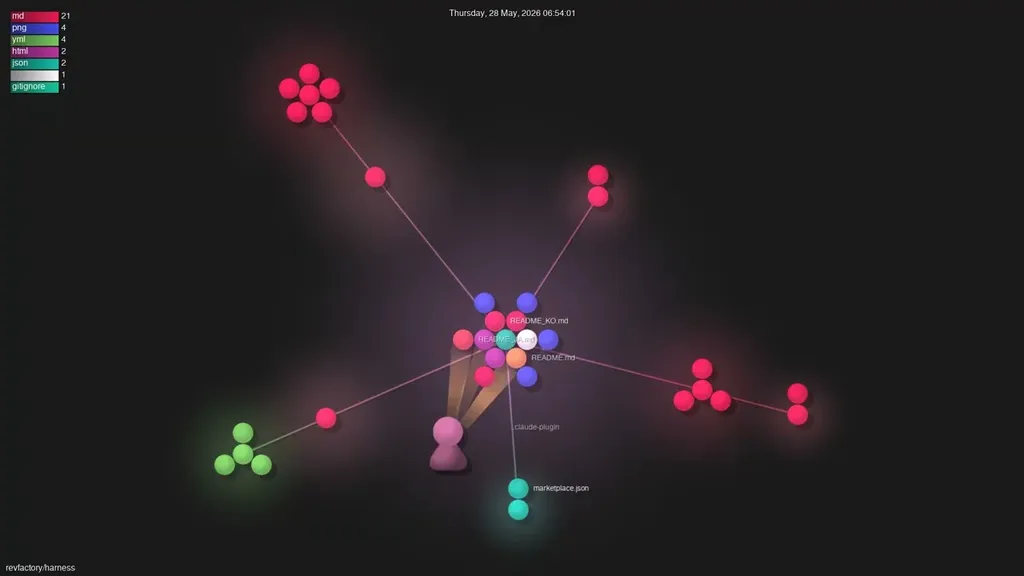
Users simply need to cp the desired harness into their project directory (.claude). It is like immediately recruiting a well-organized team of experts into your project.
Notably, all harnesses support Agent Team Mode, designed so that agents cross-validate each other's outputs. This serves as a powerful safety mechanism to prevent 'Hallucination,' a common issue with AI.
2026: How is the Developer's Role Changing?
We are standing at a massive turning point. If developers in the past were 'masons' who laid each brick of code by hand, they must now become 'architects' who design entire buildings by directing skilled AI workers.
Harness accelerates this change. As of 2026, AI coding tools are no longer an option but essential infrastructure. How well one can handle tools like Harness has become the core competitiveness determining the productivity of individuals and organizations.
Of course, AI agent teams are not omnipotent. Human intervention is still required if the designed architecture fails to reflect the characteristics of the domain or if the orchestration between agents becomes tangled. However, Harness's 'Harness Evolution Mechanism' shows something remarkable. It is designed to capture changes occurring during execution and feed them back to the factory, so that the next generation of harnesses is born even more perfect.
Summary and Closing
The Harness we looked at today is not just a tool. It is a 'team design factory' that decomposes complex problems into specialized agent teams and weaves them into an optimal architecture.
- Harness automatically designs optimal agent team structures through 6 patterns.
- Through Harness 100, you can immediately use expert teams from 100 already-proven fields.
- This allows developers to escape repetitive configuration tasks and focus on high-level architectural design.
Why not assemble an AI expert team for your project now? We invite you to experience this revolutionary change that begins with a single line of command.
What kind of AI team would you like to build first for your project? Please share your ideas in the comments!
References
- revfactory/harness-100 - GitHub · github.com
- I Asked AI to Build Me a Dev Team in 30 Seconds - Level Up Coding · levelup.gitconnected.com
- Harness — Agent Team & Skill Architect for Claude Code · revfactory.github.io
- harness - AI Agents on GitHub (3.5k ) | SkillsLLM · skillsllm.com
- Claude Code를 위한 팀 아키텍처 팩토리(Team-Architecture Factory ... · threads.com
- Harness 100 — 실전 에이전트 팀 하네스 컬렉션 - GitHub · github.com
- Harness — Claude Code를 위한 팀 아키텍처 팩토리 - GitHub · github.com