We all know how tedious those few seconds or minutes of waiting can be when you hit the rebuild button after fixing a single line of code.
For system programming developers in particular, "build time" is not just a simple waiting period; it is a painful moment where the flow of immersion is broken.
What if, as soon as you modified your code, the results were reflected in just 0.03 seconds (30ms), much like using JavaScript or Python?
In 2026, this unrealistic scenario is becoming a reality within the Zig language ecosystem.
The Magic of 0.03 Seconds: The Impact of the Zig ELF Linker

The news that has recently heated up Hacker News and the Zig community is the improvement to Zig's new ELF linker.
It is not merely a matter of being "a little faster." When testing Andrew's Tetris clone project, Zig developers revealed surprising data showing that the re-build time after code modification was a mere 30ms.
Even the compiler's own build process starts at 36 seconds for the initial build, but subsequent changes are reflected within 200–300ms. At this speed, developers can forget the very concept of "building" and work while interacting with their code in real-time.
What makes this incredible speed possible? The key lies in Incremental Compilation and structural innovations in the linker.
Many existing system languages consume massive amounts of time re-assembling giant binaries every time code is modified. However, Zig is designed through its new linker to handle only the changed parts extremely efficiently.
This update, led by Matthew Lugg, optimized the symbol table processing algorithm, resolving the bottlenecks that occur when handling complex dependency graphs. Whereas previously it had to inefficiently scan all data, it now eliminates duplicate symbols and traverses the graph in near-linear time.
As a result, even in large-scale projects, it has managed to catch two birds with one stone: reducing memory usage and maximizing speed.
Presence Beyond C: Reducing LLVM Dependency
Many have questioned, "Is all this change due to a recent specific community issue?"
However, developer kristoff_it drew a clear line. This technical breakthrough is not a reaction to a sudden issue, but the fruit of a long-term project that has been steadily prepared since 2020.
One of Zig's ambitious goals was to remove the heavy LLVM dependency from the debug build pipeline. While LLVM is a powerful tool, it can sometimes act as a massive barrier in controlling the overall compiler flow and optimizing speed.
Zig is now carving its own path by successfully supporting self-hosting compiler builds while still utilizing LLVM and LLD libraries.
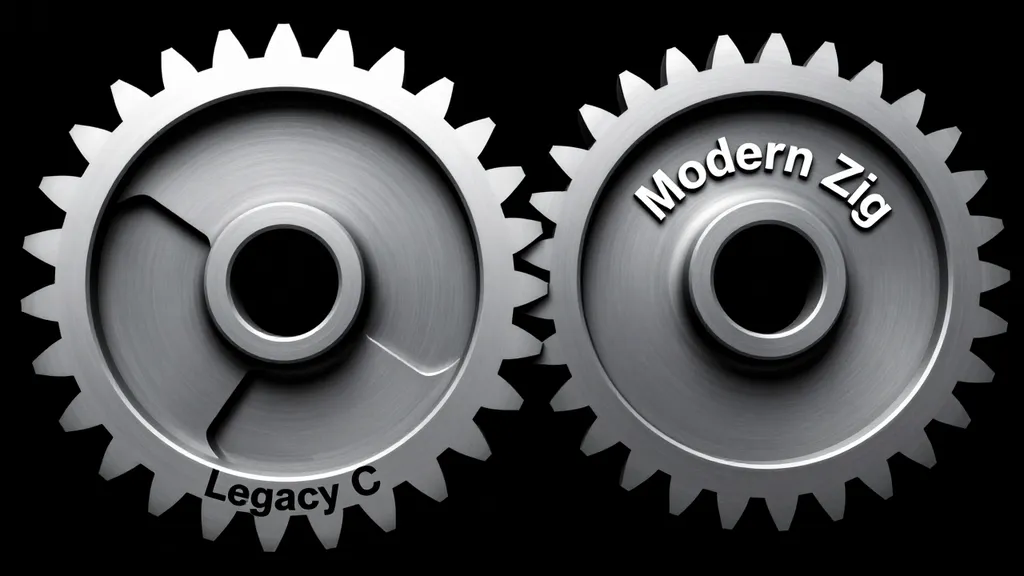
A fascinating analogy emerged here. One community user remarked, "If Rust is the new C++, then Zig is the new C."
While Rust attempts to solve the complexity of C++ based on its powerful type system and safety, Zig focuses on providing a modern developer experience (DX) while maintaining the low-level control and lightness of C.
In other words, the strategy is to maintain C/Rust-level performance while achieving development speeds similar to scripting languages (JS/Python). This becomes a powerful weapon that makes high-difficulty projects, such as the "uncompromising UX DAW (Digital Audio Workstation) development" that Andrew Kelley initially dreamed of, feasible.
However, all innovation comes with an opportunity cost. Currently, the new linker does not yet support DWARF debug information generation. In other words, the current technical limitation is that it may be less convenient than existing methods in situations requiring very precise debugging. But since this has been explicitly stated as a next-priority task, it is a problem that will be solved soon.
Fundamental Redesign of the Build System: Separation of Configuration and Execution
Beyond the evolution of the linker, the architecture of the build system itself has been completely overhauled.
The existing build.zig method required a massive process to run every time a build was performed to draw a complex build graph in memory. This made the build preparation stage itself heavy as the project grew larger.
The new structure announced by Andrew Kelley separates this process into a Configuration process and a Maker process.
- Configurator: Executes
build.zigto draw the blueprint (graph) required for the build, then serializes and saves this as a binary file. - Maker: Receives the saved blueprint and performs the actual compilation.
The core of this method is caching. If the logic of build.zig has not changed, the Maker can read the cached file and immediately start working without needing to redraw the blueprint every time.
This is like not redrawing the blueprint every time you build a house, but instead pulling out a well-drawn blueprint and starting construction immediately. As long as the Zig version does not change, the Maker process can drastically reduce recompilation time by utilizing a global cache.
This structural change demonstrates that Zig is evolving beyond being just a "new language" into a complete build system capable of supporting large-scale software engineering.
Summary and Future Outlook

The changes in Zig observed so far are not merely improvements in performance metrics. They represent a philosophical movement to change the way developers code itself.
- Ultra-fast Linking: Achieved a phenomenal re-build speed of 30ms through incremental compilation.
- Independent Ecosystem: Building a lighter and faster independent compilation pipeline by reducing LLVM dependency.
- Efficient Build Architecture: Fundamentally resolved build system overhead by separating the configuration and maker processes.
Of course, tasks still remain to be solved, such as the issue of debug information support and the relationship with LTO (Link Time Optimization) during release builds. However, as of 2026, Zig is rapidly solidifying its position as a powerful alternative to C.
If you are a system programmer who wants to write creative code within a fast feedback loop, it is now time to turn on the -fnew-linker flag on Zig's master branch and experience this magical speed for yourself.
How much of an impact do you think build speed has on development productivity? Or can Zig truly and completely replace C?
Please let us know your thoughts in the comments!
References
- Zig ELF Linker Improvements Devlog - Hacker News · news.ycombinator.com
- Devlog ELF Linker Improvements - Media - Ziggit · ziggit.dev
- Devlog - Zig Programming Language · ziglang.org
- Devlog - Zig Programming Language · ziglang.org