"MCP is dead." This provocative sentence circulating in the AI community recently is not just a simple buzzword. As of 2026, it is a technical warning siren indicating that the limitations faced by the Model Context Protocol (hereafter MCP) have reached a breaking point.
To get straight to the point: While the 'connection method' known as MCP is dying, the 'necessity' for AI to interact with the external world is stronger than ever. We are currently standing in a massive transitional period, moving past the era of simple Tool Calling toward a new architecture driven by intelligent Skills and Agent-to-Agent (A2A) collaboration.
Why are people talking about the end of MCP?
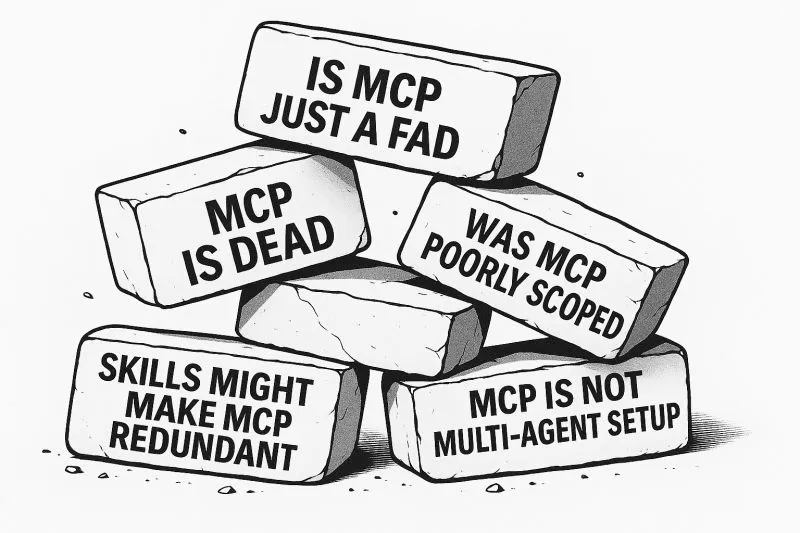
Why is criticism of MCP flooding Reddit and various tech blogs lately? It isn't simply because the technology is poor. It is because, upon actual implementation in the field, unexpected "costs" and "loads" have emerged.
The biggest issue is the model's cognitive load. Looking at the structure of MCP, every time a model connects to an external server, it must repeatedly read and understand the specifications and usage instructions of the numerous tools provided by that server. If there are 10 tools, there are 10 instances; if there are 100, there are 100 instances of a 'learning' process occurring during real-time responses. This inevitably causes latency, and as the number of tools increases, it raises the probability of the model making errors by selecting the wrong tool.
Furthermore, the barrier to practical implementation is high. In early 2026, many companies attempted to introduce MCP into enterprise environments, but they are pulling back due to compatibility issues with existing legacy systems, complex authentication (Auth) procedures, and security vulnerabilities that arise when data leaks externally. In particular, MCP servers running in local environments are being criticized for failing to match the intuition and speed of a CLI (Command Line Interface) rather than providing convenience.
Ultimately, voices arguing "I'd rather use a familiar, fast CLI, or just use a smarter method altogether" have grown louder, leading to extreme claims like "MCP is dead."
Beyond 'Tools' to the Era of 'Skills'
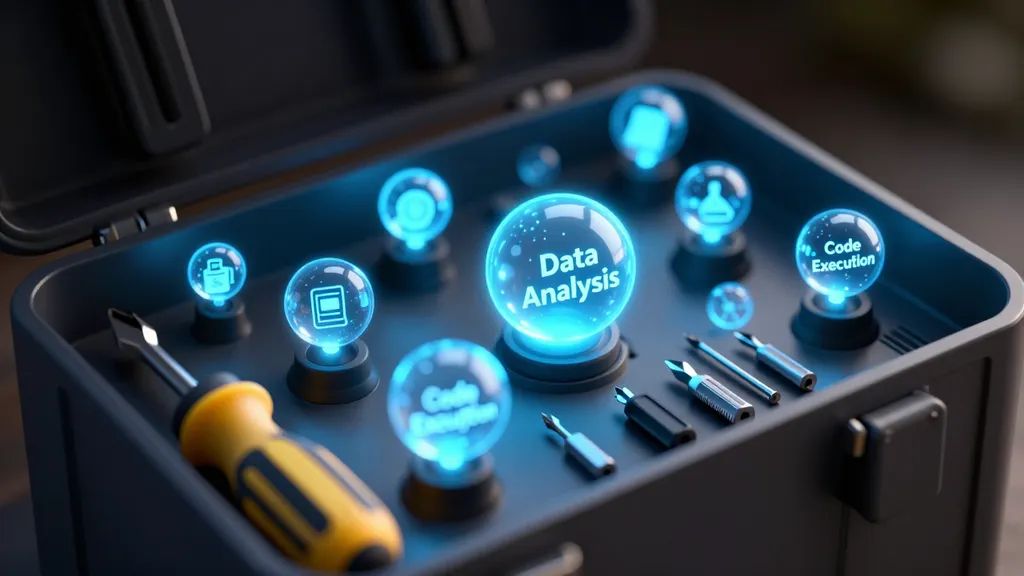
Then, what will fill the void left by MCP? Experts suggest that the answer lies in Skill-centric design, rather than simple "tool calling."
Let's use an analogy to make this difference easy to understand.
- The MCP approach is like handing a chef (AI) a manual every single time, explaining "how to hold this knife" or "how to adjust the heat on this pot." The chef's cooking speed slows down because they have to read the manual every time.
- The Skills approach is like internalizing the proficient skill of "grilling a steak" within the chef. The chef doesn't need to worry about the detailed specifications of the knife or the pot; they simply receive the command "grill a steak" and execute it immediately.
In other words, a Skill goes beyond a simple API-calling interface; it is an abstraction of knowledge, context, and execution logic into a single module for performing a specific task. If there is a "Data Analysis" skill, it already includes the usage of the Pandas library or SQL query optimization logic. Instead of spending energy learning the minute differences of individual tools, the model can focus on the user's final intent.
This method drastically reduces token consumption. In fact, companies like Cloudflare have replaced tool-calling mechanisms with code-generation methods, reducing token usage by a staggering 244 times. This can be seen as a case of overcoming the "explanation-centric overhead" of MCP with "execution-centric intelligence."
The Core of Enterprise AI: Building a Control Plane
However, simply transitioning to skills does not solve all problems. From a corporate perspective, the core reason MCP is criticized is the governance issue: "Who will manage and control this connection?"
Current AI architecture is evolving by being separated into three layers:
- Systems of Record: The bottom, robust database layer where data accuracy is paramount, such as ERP or CRM.
- AI Innovation Layer: The top, rapidly changing intelligence layer, such as GPT-5 or the latest agent frameworks.
- Control Plane: The core layer that connects these two layers.
This is where many companies make a mistake. They think of MCP merely as a "connection pipe" and overlook the security, auditing, permission management, and encapsulation of business logic occurring in between.
True enterprise-grade AI should not discard MCP, but rather utilize MCP as part of the 'Control Plane'. If business logic (e.g., refund processing, quote generation) is encapsulated as a skill and placed within the Control Plane, the core "operational capability" of the company can be maintained even if the top-level AI model changes. This is precisely why the 'tool' functions and 'prompt/resource' functions of MCP must be combined and elevated to an enterprise level.
MCP and A2A: The Collaboration Grammar of AI Agents
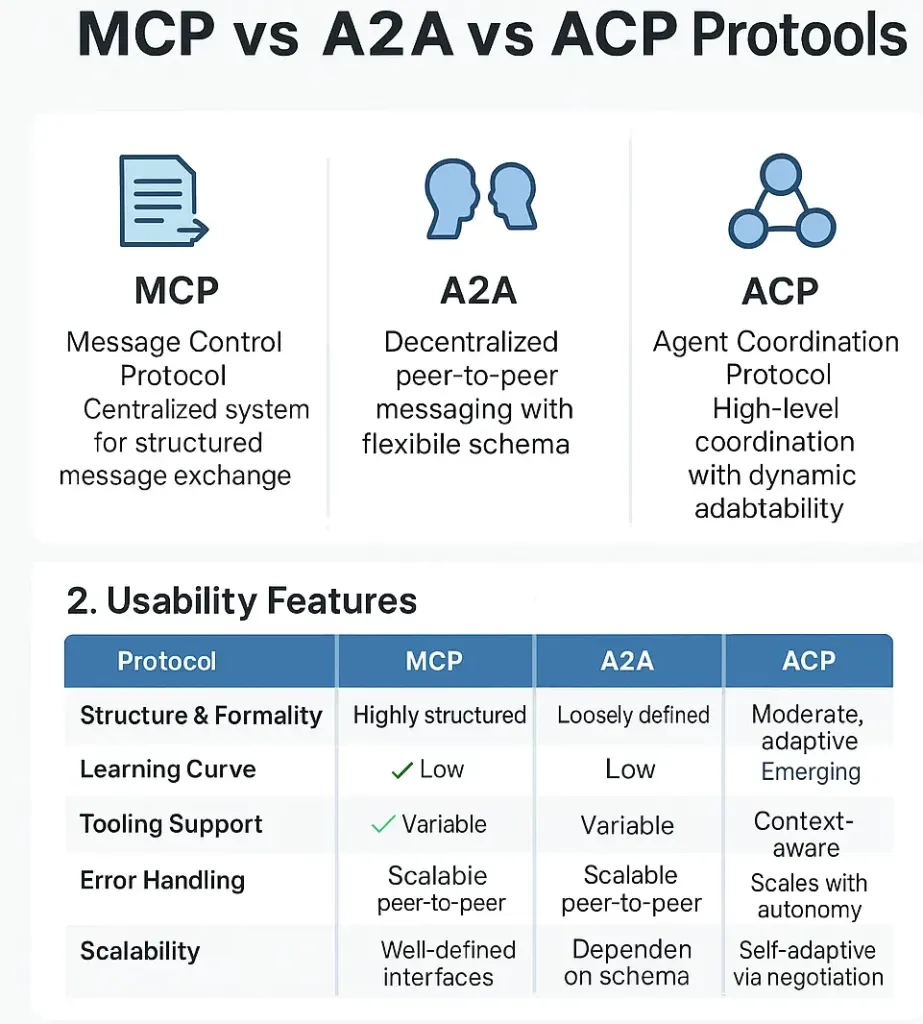
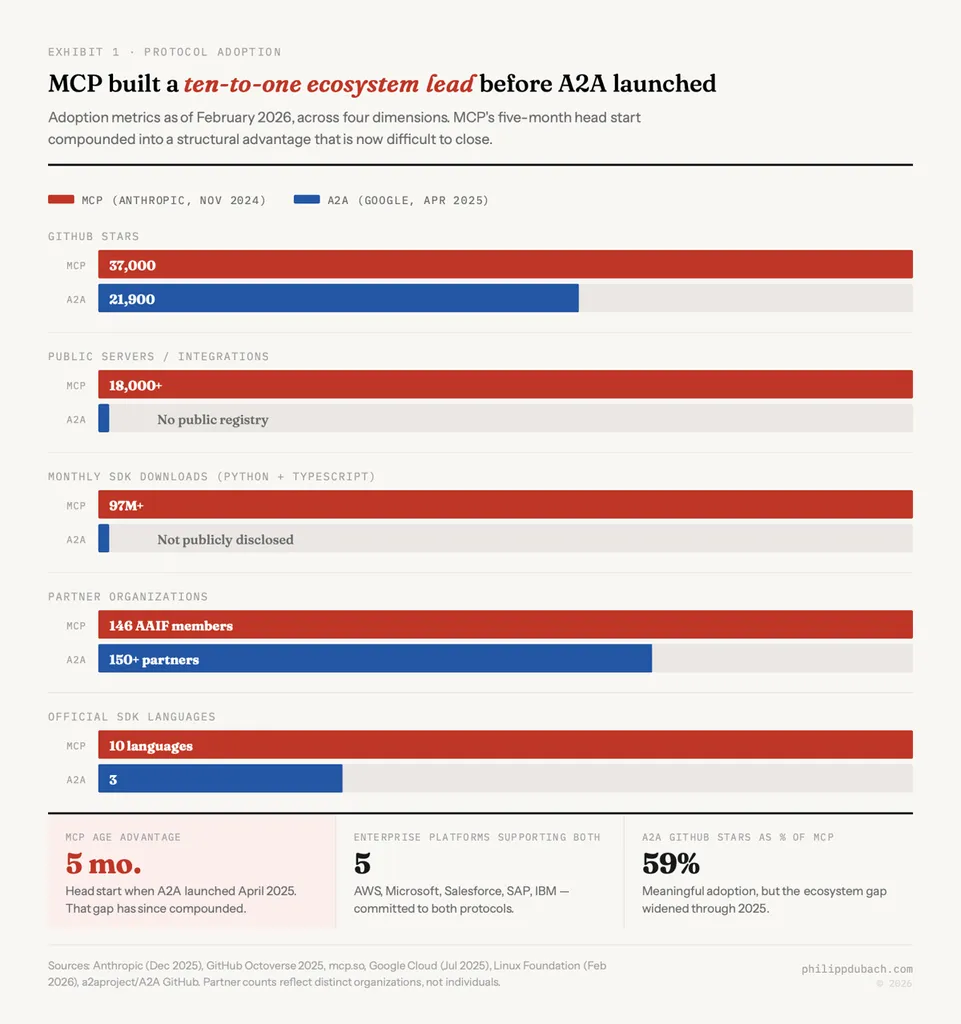
We are now moving past the stage where AI works alone and into an era where multiple AIs form teams. Here, we encounter another important concept: A2A (Agent-to-Agent).
Clearly distinguishing between MCP and A2A is the key to designing future AI agents.
- MCP (Model Context Protocol): The 'language' through which AI communicates with the external world (databases, APIs, file systems). It defines "What can I do?"
- A2A (Agent-to-Agent): The 'grammar' through which AI agents exchange information and collaborate. It defines "How will we work together?"
For example, if a user commands, "Plan my trip to Jeju Island tomorrow," the 'Travel Planning Agent' retrieves information from airline and hotel APIs via MCP (the role of MCP), while simultaneously negotiating information with a 'Weather Agent' or a 'Budget Management Agent' (the role of A2A).
Ultimately, the future AI ecosystem will be completed by grasping tools through MCP and holding hands with colleagues through A2A. As Kakao Ventures' analysis suggests, AI is now evolving beyond being a simple tool user into a "collaborative member."
Conclusion: Which path should we take?

As we have seen, the statement "MCP is dead" is half true and half false.
The 'passive MCP interface' that merely passes APIs to the model will certainly become obsolete. This is because it increases the model's cognitive load, is vulnerable to security threats, and is inefficient in terms of cost. However, the essential value of MCP in providing standardized connection and discovery remains valid, and it will instead survive in more sophisticated forms within enterprise-grade environments.
The future direction of AI development is clear:
- Do not stop at simple Tool Calling; instead, consider Skill-centric design that incorporates business logic.
- Build a Control Plane that ensures security and visibility to control AI behavior.
- Prepare for multi-agent collaboration systems via A2A protocols to overcome the limitations of single agents.
Rather than being swept away by technological hype and rushing to change tools, ask yourself first which layer the system you are building should reside in. Infrastructure should follow protocols, but intelligence should be abstracted into skills.
Is your AI project currently stuck in the simple 'tool connection' stage, or is it evolving into a true 'skill-based agent'? Let us know your thoughts in the comments!
References
- Is MCP Dead? Why the Debate Is Asking the Wrong Question · workato.com
- MCP is Dead; Long Live MCP! - Charles Chen (@chrlschn) · chrlschn.dev
- MCP에 이어 A2A, 이제 AI도 조립해서 쓴다 - 카카오벤처스 · kakao.vc
- A2A vs MCP - 이게 뭔데.. 쉽게 설명해줄게 : r/LLMDevs - Reddit · reddit.com
- "MCP는 끝났다" 혹은 "실패한 함정이다"라는 자극적인 주장 · blog.naver.com