
"I've optimized everything with JavaScript, so why is this heavy 3D engine stuttering in the browser?"
This is a question that makes any frontend developer building high-performance web applications want to grab their head in frustration. When attempting to implement image processing, complex physics calculations, or real-time 3D graphics, we constantly hit the massive wall of JavaScript's execution speed.
As of 2026, we no longer try to solve this problem merely through "code dieting." Instead, the web paradigm itself is shifting. We have entered the era of hybrid rendering architectures powered by WebAssembly (Wasm).
Why is JavaScript alone not enough?
The JavaScript we use every day is a truly wonderful language. It is flexible, possesses a vast ecosystem, and is optimized for constructing UIs. However, the problem lies in the "weight of computation."
JavaScript utilizes interpreter and JIT (Just-In-Time) compilation methods. While it undergoes an optimization process before execution, its inherent limitations become apparent in compute-intensive tasks that must push the CPU to its limits. It is like asking a passenger car (JS) to drive the route intended for a racing car (Wasm).
Specifically, the web of 2026 has moved beyond simply displaying information. Within the web browser, Photoshop-level image editing occurs, and massive 3D terrain data like Google Earth must be rendered in real-time. Relying solely on JavaScript's event loop and Garbage Collection (GC) for these tasks is too costly. If computations run too long, the main thread gets blocked, and users feel the "stuttering" and leave the page.
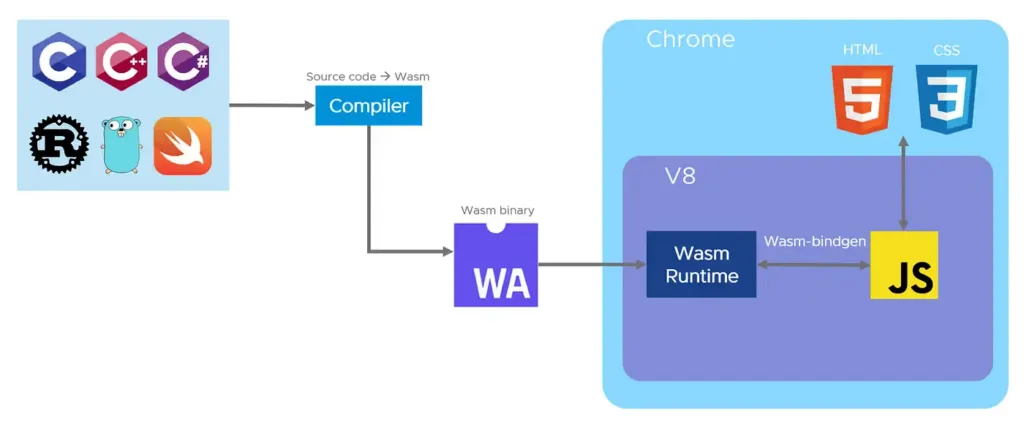
The Key to the Solution: WebAssembly (Wasm), a Powerful Ally
This is where WebAssembly enters as the relief pitcher. One of the most common misconceptions is the question: "Will Wasm replace JavaScript?" To give you the conclusion upfront: absolutely not.
Wasm is not a replacement for JavaScript; it is its most powerful complement. While JavaScript handles UI logic and user interaction, Wasm takes on the "heavy lifting" that requires extreme CPU usage. We call this a hybrid rendering architecture.
The power of this approach is evident in real-world examples. Figma, hailed as a revolution in design tools, has long been using a C++ engine compiled to Wasm. Thanks to this, it provides an experience on the web that is as smooth as a native app. Even more impressive is the recent web version of Photoshop. When processing 4K images, code written in Rust and compiled to Wasm shows performance that is 7 to 8 times faster than JavaScript. When utilizing SIMD (Single Instruction, Multiple Data) technology, this gap widens even further.
Because Wasm operates as low-level bytecode, it drastically reduces the time the browser spends interpreting code. As a result, it can achieve speeds from 1.5 to 20 times faster than JavaScript for complex computational tasks.
The New Standard of 2026: Beyond the Browser to Infrastructure
The domain of Wasm has now expanded beyond the confines of the browser. As of 2026, Wasm has established itself as a core technology for serverless computing and Edge infrastructure.
Consider traditional Docker containers. To spin up a single container, you must prepare the OS environment, leading to a delay known as a "Cold Start." This usually takes hundreds of milliseconds (ms) to several seconds. But Wasm is different. It is so lightweight that it can execute in less than 1 millisecond.
What does this difference mean? Companies can now utilize server resources much more densely. In fact, companies like Carl Zeiss AG have adopted Wasm-based pipelines to reduce infrastructure costs by 60%. They can now host 50 times more applications on a single node than they could with containers.
Furthermore, the completion of WASI (WebAssembly System Interface) has made the dream of "Write Once, Run Anywhere" a reality by allowing Wasm to access the file system and networks. Developers no longer need to worry about specific OSs or architectures; they can target both clients and servers with a single Wasm module.
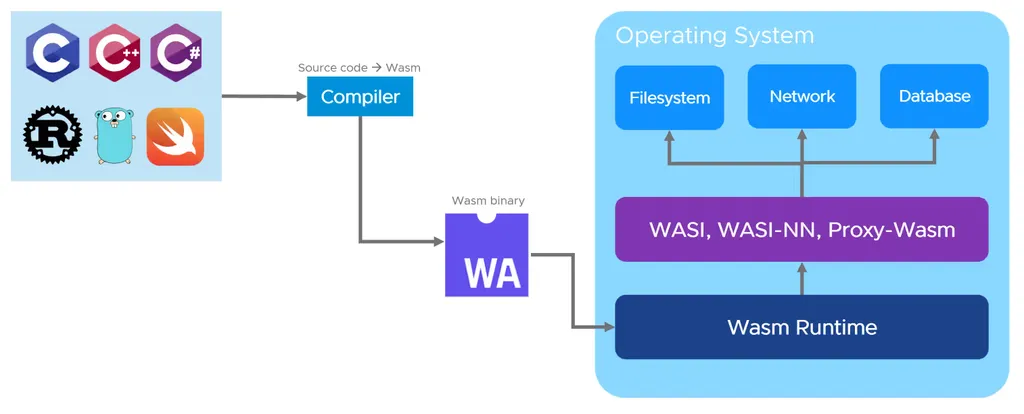
Practical Guide: Getting Started with Rust and Wasm
So, how can we get our hands on this powerful tool? The most recommended combination today is undoubtedly Rust and WebAssembly.
Rust is evaluated as the most optimized language for compiling to Wasm because it guarantees memory safety while delivering performance comparable to C/C++. While it has a steep learning curve, the benefits gained once mastered are overwhelming.
I propose a step-by-step strategy for building a successful hybrid architecture.
Step 1: Identify Problem Areas
You don't need to move all your logic to Wasm. Doing so would actually decrease development productivity. Keep logic that handles user click events or API calls in JavaScript. Instead, target the following areas:
- Filtering and sorting large datasets
- Real-time processing of images, video, and audio
- Physics engines or 3D graphics computations
- Encryption and complex mathematical calculations
Step 2: Set Up the Rust Environment and Compile
Using a tool called wasm-pack, you can easily create Rust code that works like an npm package.
- Set up the Rust environment via
rustup. - Install
wasm-pack. - Define the interface for exchanging data with JavaScript using the
#[wasm_bindgen]attribute. - Generate the optimized
.wasmbinary and the JavaScript wrapper that calls it using thewasm-pack buildcommand.
Step 3: Hybrid Integration
Import the generated Wasm module into your existing JavaScript project (React, Vue, Next.js, etc.). You can use it just like a regular library via import. Design a structure where heavy computations are passed to the Wasm module functions, and only the resulting values are received by JavaScript to be rendered on the screen.
A note of caution: When passing data between Wasm and JavaScript, "copying" costs occur. Passing small amounts of data too frequently can actually degrade performance. You need a design that passes large chunks of data at once or optimizes memory sharing.
Summary and Recommendations

Today, we have explored a new horizon in web development.
- Wasm is not a replacement for JS, but a powerful partner dedicated to CPU-intensive tasks.
- It has evolved beyond the browser to become core infrastructure for serverless and edge computing.
- The combination with Rust is currently the most powerful and secure methodology for performance optimization.
The standard for web development is shifting from "how beautiful a UI can be made" to "how smoothly complex computations can be handled." If you feel a performance bottleneck in your project, do not hesitate to pull out the Wasm "cheat key."
What is the "heavy task" in your project that you feel should be moved to Wasm right now? Tell us about your struggles in the comments!
References
- bookmarks/web.md at master - GitHub · github.com
- WASI 표준화로 가능하게 되는 것들 - 한컴테크 · tech.hancom.com
- WebAssembly(WASM) & WASI 2024 : 크로스플랫폼의 미래 - 한컴테크 · tech.hancom.com
- Rust를 WebAssembly로 컴파일하기 - 웹어셈블리 - MDN Web Docs · developer.mozilla.org
- Rust & Wasm (안전하고 빠른 웹 개발) · reddit.com
- 러스트로 만나는 WebAssembly 톺아보기: 개념부터 예제까지 · techblog.samsung.com