
"Can I also achieve great success starting from a small room like that person?"
If you are currently sitting in front of a laptop in a cramped studio apartment or a dormitory desk, this question is not merely a vague dream. In 2026, we live in an era where we can conduct business on a global stage without physical capital or massive offices.
Today, through two contrasting success stories that have recently heated up online communities, I intend to delve into the essential strategies of how one can create immense wealth from a very small space. Is it simple luck, or a meticulously calculated design?
From 0 to $1 Million: Nick's Strategy of Turning 'Luck' into 'Opportunity'

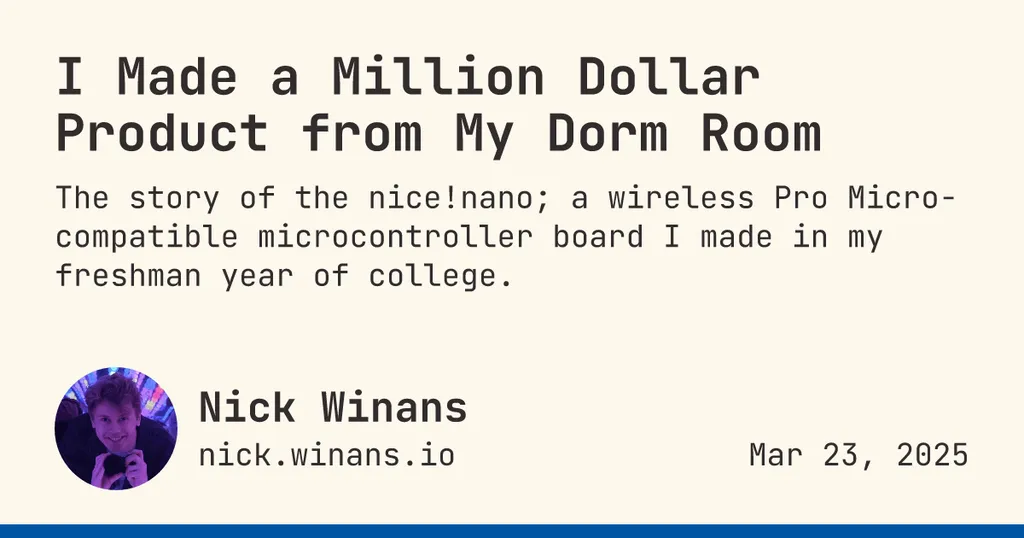
The story of Nick, which recently became a hot topic on Hacker News, is like something out of a movie. He designed a wireless microcontroller board called nice!nano in his college dormitory, and with this single small component, he generated $1 million in annual revenue.
Many say his success was due to the situational luck of the 'COVID-19 pandemic.' It was a time when people were confined to their homes and immersed in hobbies like keyboard customizing. However, Nick's true strength lay in his execution capability to seize that 'luck' when it arrived.
He accurately identified the fatal flaws of existing products: the latency occurring during wireless connections and short battery life. He didn't just stop at a resolution to "make a good product"; in just one weekend, he designed the circuit diagrams using KiCad and various open-source resources.
The key point we must note here is his community building strategy. After posting the product on Reddit, Nick did not simply wait. He immediately directed interested people to a Discord community.
- Feedback Loop: He communicated with users from the prototype stage to refine the product.
- Concentration of Demand: He gathered thousands of potential buyers within the community, putting them in a 'ready to purchase' state.
- Maintaining Momentum: As soon as the Group Buy ended, he immediately listed the product on an e-commerce store so that the purchasing flow would not be interrupted.
Nick's case shows how powerful it is to quickly solve existing discomforts by aligning them with community needs, rather than inventing a perfect, brand-new idea.
A $100 Million Exit and Seclusion: Philosophy After Success

While Nick's story focuses on 'technical execution,' the story of Harvard graduate Uoshma Garg speaks of 'scale-up and philosophy.' She surprised the world by selling her startup 'Ooshma,' which started in a dormitory, for approximately $120 million (about 160 billion KRW).
Garg's success was strictly data-driven. In mid-2024, she introduced marketing techniques that accurately read market demands, leading to an explosive expansion of her user base. This was not merely luck, but a strategic result of injecting appropriate capital and technology at the right timing for growth.
However, her path becomes even more peculiar and interesting from here. Immediately after finalizing the massive sale of over $100 million, she blocked all media interviews and retreated to a quiet island in Hawaii.
This feels like a kind of resistance against the 'obsession with continuous growth' that modern entrepreneurs experience. We are often taught that upon succeeding, we must run larger companies or become famous figures. However, Garg left the message that "the definition of success is not an end, but a new beginning," and walked out of the fierce competition of capitalism.
The two cases pose different questions to us. Will you grow together with a community and solve technical problems like Nick, or will you achieve economic freedom through overwhelming scale-up and practice your own philosophy like Garg?
3 Realistic Pieces of Advice for You Starting in a Small Room
Now, let's bring this from someone else's story to your own. The economic environment of 2026 still provides opportunities where individual creativity can overwhelm massive capital. For you, who is trying to start from a dormitory or a small studio, I suggest the following strategies.
1. Don't look for a "Problem"; look for "Discomfort"
Nick did not struggle to create something entirely new that the world had never seen. He simply solved the specific discomfort that existing wireless keyboard users felt: "The battery drains too fast!" Instead of a grand vision, start by solving the small irritations experienced by the people around you.
2. The Community is Your Most Powerful Asset
Don't wait until the product is perfect. Like Nick, you must talk to people through communities like Discord or Reddit from the early stages. Fans are not just customers who buy the product; they are colleagues who help build the product together. If a community is formed, the moment your product is released is practically already decided.
3. Define 'Success' for Yourself
Uoshma Garg's case gives us an important lesson. Money should not be the destination, but a means to live the life you desire. Is your goal to become a billionaire, or is it to live a free life? Your goals must be clear so that you do not lose your way after succeeding.
Of course, this process is accompanied by immense stress. Nick also suffered from PayPal's fund freezing issues during the group buy process, and Garg had to sever social ties after gaining immense wealth. Do not forget that success always comes with a corresponding cost.
Conclusion: Your Room is Already Large Enough

The commonality between Nick, who made 100 million, is not that they possessed special superpowers. They were simply ready to capture opportunities and connected those opportunities to the community and execution.
A small start does not necessarily lead to a small result. That small idea you are pondering right now could become a tool that changes the world for someone.
What is the 'small discomfort' you want to solve right now? And what is the very small action you can take today to achieve it?
Please share your small beginnings in the comments. We will be cheering you on!
References
- I made a million dollar product from my dorm room (2025) · news.ycombinator.com
- I Made a Million Dollar Product from My Dorm Room · nick.winans.io
- How he went from zero to millions out of a dorm room. Full ... · instagram.com
- From dorm room startup to 9-figure exit: Ooshma Garg's ... · linkedin.com