"Please, can't you just do it one step at a time instead of all at once?"
This was a monologue I found myself muttering recently while working on a coding task with an AI agent. No matter how smart a model is, if you throw a complex project at it, the context gets tangled, and it inevitably ends up spitting out nonsensical code or forgetting what it just said.
It was no different from a team leader barking, "Why is the result like this?" at a new recruit who was tasked with everything from planning and design to development and QA. In 2026, we shouldn't just be waiting for better models to emerge; we must live in an era where we contemplate how to bind those models into a "system" to make them move efficiently.
At the end of this contemplation, the tool I encountered is Harness. Today, I want to talk about this magical tool that goes beyond the limitations of a single AI agent to build your own "expert team."
Why is a Solo AI Limited?
We often believe that having a single high-performance model will solve everything. However, real-world projects are never simple. Even creating a single website requires numerous steps, including database design, API implementation, frontend work, and security reviews.
Entrusting all of this to a single model creates two major problems.
The first is "Context Overload." When too much information enters at once, the model loses its core focus and concentration wavers. It is like a student taking an exam where the scope is not just one textbook, but an entire library.
The second is a "Lack of Expertise." Geniuses who are good at everything are rare. When an agent specialized in a specific programming language, an agent specializing only in finding security vulnerabilities, and an agent reviewing code quality each divide the roles, the quality of the output increases exponentially.
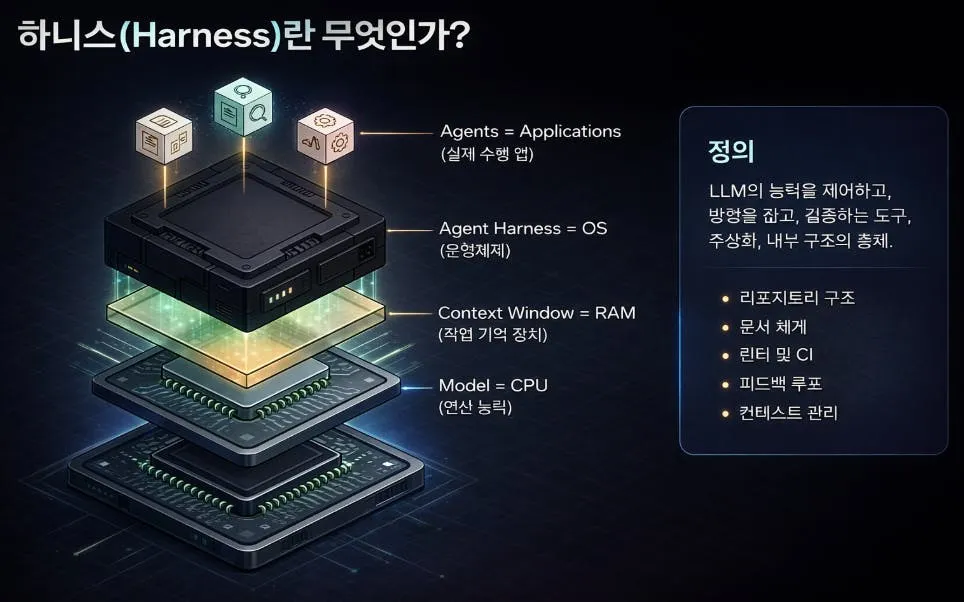
The development paradigm of 2026 is evolving beyond mere "Prompt Engineering"—writing good prompts—into "Harness Engineering," which involves designing the rules, tools, and skills surrounding the model.
Harness: Team Architecture Completed with a Single Command
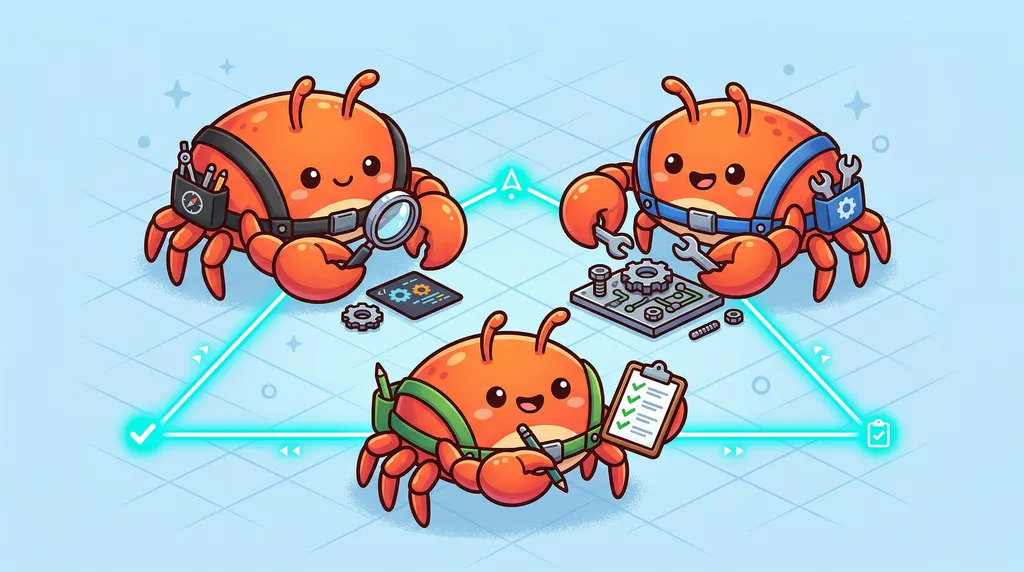
Harness appearing here is a 'Team Architecture Factory' that operates within the Claude Code environment. As the name suggests, it is a tool that designs the structure (Harness) in which agents can move.
The most amazing thing about this tool is that the user does not need to perform complex design themselves. Simply saying "Configure a harness" in natural language is enough. Then, Harness analyzes the user's project domain and automatically performs the following tasks:
- Domain Analysis: Identifies what the project intends to do.
- Team Design: Determines which roles (agents) are required.
- Agent Definition: Creates files containing the persona of each expert in the
.claude/agents/folder. - Skill Creation: Creates specialized tools (Skills) that each expert can use.
- Orchestration: Maps out the flow so that agents can exchange data and collaborate.
- Validation: Tests whether the design works properly.
This process is like a skilled operations manager assigning team members according to the nature of the project, providing them with the necessary tools, and writing the work manual.
What Kind of Team Will You Build? 6 Magical Patterns
Harness does not stop at merely creating a team; it provides 6 architectural patterns suited to different situations. Deciding which pattern to use based on the nature of the project is the core of 'Harness Engineering.'
- Pipeline: A does something, then B follows. Suitable for tasks with strong step-by-step dependencies.
- Fan-out/Fan-in: One task is analyzed simultaneously by multiple experts (Fan-out), and those results are then gathered back into one (Fan-in). Useful when multi-faceted reviews are needed, such as security or performance analysis.
- Expert Pool: Several experts are kept on standby, and the most suitable expert is called based on the nature of the question. This is great for domains where requirements change every time, like SNS copywriting.
- Producer-Reviewer: One person creates, and another person strictly reviews. This is the most powerful pattern when you need to maintain consistent quality in content.
- Supervisor: A central controller monitors the situation and distributes tasks in real-time. This is advantageous for large-scale projects with many unpredictable requests.
- Hierarchical Delegation: A tree structure where a manager assigns tasks to a deputy, and the deputy assigns them to a staff member. Used when the work units are deep, such as large-scale software development.
Just as the tools needed to drink water are different from those needed to cook, your project needs a "team structure" that fits perfectly.
Practical Application: 100 Prepared Workflows

You might ask, "I understand the theory, but is there anything I can actually use?"
Surprisingly, a project called 'Harness 100' exists on GitHub. This is a collection of 100 verified, practical agent team workflows.
The scope goes far beyond simply assisting with code writing.
- Content Creation: From writing YouTube scripts to publishing newsletters and managing SNS.
- Software Development: Building full-stack web apps, designing APIs, and even modernizing legacy code.
- Business: Market research, startup launch strategies, and writing investor reports.
- Legal and Education: Contract analysis, language tutoring, thesis advising, etc.
Users simply need to copy the desired workflow folder into their project directory. It is as if a well-organized 'expert team' is joining your project.
Of course, there is a caveat. If you add too many rules, the agents may become confused. You must not forget the principle: "Achieve maximum effect with minimal rules."
Closing: It is Time to Design 'Systems', Not Just 'Models'

So far, we have looked at how Harness overcomes the limitations of AI agents and elevates us from mere 'prompt inputters' to 'system designers.'
To summarize, Harness is a tool that automates the entire process from domain analysis to team design, skill creation, and validation. Through this, we can go beyond the limits of a single AI and operate an expert group using the six architectural patterns.
Now, the ability to handle AI is shifting from "how well you ask questions" to "how efficiently you design collaboration systems." What kind of team do you want to build?
Are you currently struggling with AI alone and experiencing 'Context Overload'? Tell us in the comments what your dream AI team would look like!
Do you want to be a 'dictator' who orders everything from an AI agent, or a 'leader' who coordinates a team?
References
- Harness — Agent Team & Skill Architect for Claude Code · revfactory.github.io
- AI 한 명한테 다 시키지 마세요: Harness로 '나만의 전문가 팀' 구축하기 · contents.premium.naver.com
- Harness — Claude Code를 위한 팀 아키텍처 팩토리 - GitHub · github.com
- Yongsup Park - Facebook · facebook.com
- 하네스 엔지니어링 완벽 정리 — AI 코딩 에이전트 성능을 2배로 ... · gpters.org
- 하네스 만들어줘~ : 네이버 블로그 - Naver Blog · blog.naver.com
- Harness 100 — 실전 에이전트 팀 하네스 컬렉션 - GitHub · github.com