"Aren't I buying at the top if I buy now?"
This is the most frequently heard question in the community whenever Ethereum's price fluctuates recently. The market is gripped by fear, and news headlines are constantly filled with reports of funds flowing out of ETFs; however, Bitmine—led by Wall Street heavyweight Tom Lee—is instead aggressively sweeping up Ethereum.
Buying when others are selling is theoretically simple, but in practice, it is one of the hardest things to do. Today, we will dig into the massive blueprint hidden behind why Bitmine, which has transformed into the world's largest Ethereum holder, and its leader Tom Lee, are making a bet on Ethereum that borders on "all-in" at this specific moment.
A Giant's Movement: Turning Fear into Opportunity

Every investor has heard the maxim: "Buy the fear and sell the greed." However, practicing this maxim requires exceptional insight. In 2026, the market is experiencing extreme volatility, with Ethereum prices dropping below $2,200 due to rising oil prices and macroeconomic uncertainty.
While most retail investors are contemplating stop-loss orders, Bitmine purchased approximately $157 million worth of additional Ethereum last week alone. This move goes beyond simply "buying because it's cheap." Tom Lee has defined the current bear market as the "final stage of the mini crypto winter." In other words, he is confident that we have entered the coldest period just before the winter ends and spring arrives.
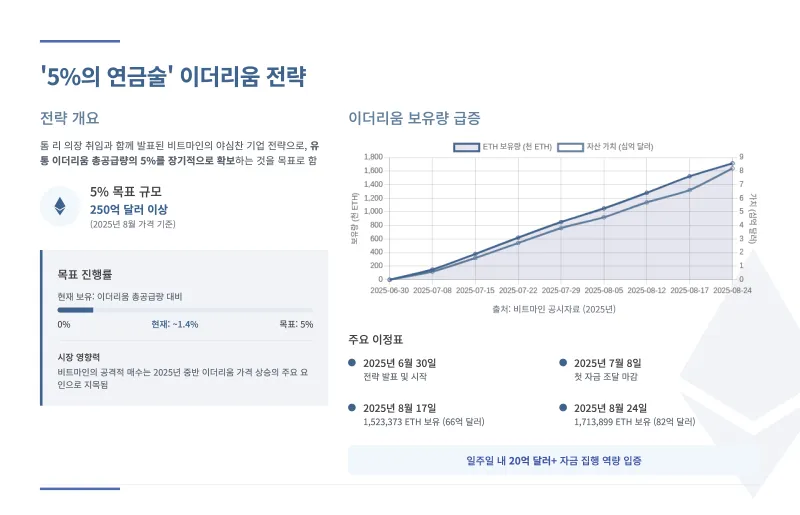
What we must pay attention to here is the scale of Bitmine. Their current Ethereum holdings amount to approximately 5.28 million ETH, a staggering figure representing about 4.37% of the total circulating supply. Just as Michael Saylor's MicroStrategy proved with Bitcoin, Tom Lee is also attempting to completely overhaul his company's financial structure through Ethereum.
Why Ethereum and Not Bitcoin?

Many may find this puzzling. "If Bitcoin is digital gold, why is he so obsessed with Ethereum?" Tom Lee's answer is clear: if Bitcoin is a means of storing value, then Ethereum is the "foundation upon which Wall Street will be rebuilt."
Tom Lee views Ethereum as the protagonist of a "super cycle" that will drive economic changes over the next 10 to 15 years. It is not merely about holding a single coin, but the belief that the global financial system will ride atop the Ethereum network, which enables smart contracts. Looking at trends such as the prospect of stablecoin approval through the White House's Genius Act or the SEC's Project Crypto, Ethereum is not just an asset, but "digital financial infrastructure" itself.
In particular, the attractiveness of Bitmine stock is maximized here. Bitmine does not simply keep its held Ethereum in a vault. It utilizes approximately two-thirds of its holdings for staking, generating hundreds of millions of dollars in annual revenue.
The continuous increase in the amount of Ethereum held per share provides an immense compounding effect for Bitmine investors. In fact, cases where the amount held per share has increased nearly tenfold since the time of acquisition suggest that holding Bitmine stock can yield higher returns than investing directly in Ethereum.
The Flip Side of the Downturn: Supply-Demand Imbalance and Institutional Calculation
However, it is not all rosy prospects. As with all investments, aggressive buying inherently carries risk. In fact, Bitmine has endured painful periods where its stock price dropped 70% from its peak, recording on-book losses of over $1.3 billion during periods of sharp Ethereum price declines.
At this point, we must analyze Tom Lee's strategy from two different perspectives.
First is the macro correlation. Tom Lee pointed to rising oil prices as the main culprit for the recent decline in Ethereum's price. His analysis, which suggests that the inverse correlation between oil and Ethereum has reached a historical high, emphasizes that the current decline is a temporary pressure caused by external economic factors rather than an issue with Ethereum's fundamentals.
Second is the supply-demand imbalance. Currently, the market is showing negative signals simultaneously: capital outflows from ETFs and an increase in exchange deposits. While a typical perspective reads this as a "sell signal," for massive institutions like Bitmine, it is read as a "zone where sufficient supply has been secured." While individuals throw their holdings away in fear, institutions are absorbing that volume to solidify the market bottom.
Of course, there are things to be cautious about. The strategy of a company holding cryptocurrency as a treasury asset is a double-edged sword that can shake the company's intrinsic value during periods of extreme volatility. The sight of other companies like ETHZilla selling assets to recover losses serves as a reminder that we must conduct risk management in parallel.
Tom Lee's Advice for 2030 Investors: Strategy, Not Speculation

Tom Lee recently delivered an important message to the 2030 generation. He stated that information regarding "which coin will skyrocket" is merely speculation, and that rational asset allocation based on data and strategy is the key.
What he emphasizes is the ability to understand market cycles. Much like his prediction that Bitcoin will break through its all-time high early next year, the market always fluctuates between overreaction and underreaction. Tom Lee's actions are closer to those of a strategist finding the point with the highest Risk-Reward Ratio within a massive flow, rather than a "fortune teller" simply trying to guess prices.
He advises caution against reckless risk-taking. Understanding the technical value and staking yields of Ethereum and contemplating how to integrate them into one's portfolio is the Wall Street-style method of investing.
Conclusion: What Should We Prepare For?
Bitmine's actions pose a clear question to us: "Are you an individual swayed by market noise, or a strategist who reads the massive flow?"
Ultimately, the core of the strategy shown by Tom Lee and Bitmine can be summarized into three points:
- Contrarian buying that views the bear market as the "end of the mini crypto winter."
- A long-term perspective that views Ethereum not just as an asset, but as "financial infrastructure."
- Maximizing "cash flow generation" and the compounding effect through staking.
Of course, the market can be shaken by unexpected variables at any time. However, if you understand the direction in which massive capital is moving and why they chose that direction, today's volatility will be an opportunity for study rather than a source of fear.
How do you view the current Ethereum price correction? Do you see it as an opportunity like Tom Lee, or do you still feel it is a dangerous zone?
Please share your thoughts in the comments!
References
- [한국어, 1편] 톰 리, 세계 최대 이더리움 보유기업 비트마인의 의장이 ... · youtube.com
- 이더리움 뉴스: Bitmine(BMNR), 톰 리가 이더 가격 조정을 유가 상승과 ... · coindesk.com
- 비트마인 톰리 - 이더리움 대규모로 매입 후, 최근 이더리움 가격 급락 ... · contents.premium.naver.com
- 비트마인, 이더리움 올들어 최대 매입…톰리 "미니 크립토겨울 최종단계" · news.einfomax.co.kr
- f. 톰리 비트마인 이사회 의장 ▶️ 2030 코인,주식 투자자들에게 월가 ... · instagram.com
- 톰 리 "비트코인, 내년 1월 말까지 사상최고가 재돌파 가능" · bloomingbit.io
- 비트마인 이머전 테크놀로지스, 이더리움 416만개 보유..총자산 140 ... · choicestock.co.kr
- 톰 리의 비트마인, 하락장 공포에도 이더리움 매수하는 이유는? · kr.beincrypto.com