Have you ever asked an AI to "make me a cool landing page"? The result is probably predictable. A purple gradient seen everywhere, cliché glassmorphism, and three centered card sections... We call this 'Slop.' It functions, but it's a design without a soul.
But now, there is a way to break free from those boring patterns. It is Taste-Skill. Rather than simply teaching AI agents how to write code, this framework is an Anti-Slop Frontend Framework that implants human 'Taste' to enable the design of high-level UI/UX.
How to Wake Up the AI's 'Design Brain': Why Existing AI Coding Fails
The problem we face isn't a lack of AI coding ability. AI can already write code with perfect syntax. The real problem lies in 'Design Decision-making.'
Currently, most LLMs (Large Language Models) are designed to produce the answer with the highest probability. In design, the 'most probable answer' ultimately means the most common and average design—in other words, 'Slop.' AI doesn't design creatively; it merely replicates the 'average UI patterns' that appear most frequently in its training data.
Taste-Skill digs into exactly this point. This project has designed a 'thought process' that the AI must undergo before writing code. Instead of the AI simply spitting out code, it forces the AI to first reason through and decide upon design principles.
To achieve this, Taste-Skill introduces three core 'Adjustment Dials':
- VARIANCE: Determines how original and unconventional the design will be.
- MOTION: Controls the intensity of animations and the nature of movement.
- DENSITY: Determines how tightly elements are placed on the screen or how much the beauty of white space is emphasized.
Through these dials, the AI can perform strategic design, such as lowering the density when creating a 'minimalist' style or maximizing variance when creating a 'Brutalist' style.
Beyond Simple Code Generation: The Diverse Skill Sets of Taste-Skill
Taste-Skill is not just a single command. It is a collection of various 'Agent Skills' that can be selected based on the user's purpose. Much like equipping skills to a game character, you can install and use them as needed.
Upgraded to v2 (experimental version), this framework provides the following powerful features:
1. Coding Skills for Implementation (Code Output)
design-taste-frontend(v2): The most core skill, which reasons through design language on its own and generates code with a strict structure.redesign-existing-projects: Diagnoses the UI of existing projects and completely transforms the layout and hierarchy.- Specialized Style Skills: You can change the AI's personality to match your desired mood, from a very calm and sophisticated
soft-skill, to a cleanminimalist-skill, and even a radical and rawbrutalist-skill.
2. Image Skills for Visual Guides (Image Generation)
An interesting point is that this framework doesn't just do coding. By using the imagegen-frontend-web or brandkit skills, the AI first draws high-quality compositions of web/mobile screens as images.
These images act like blueprints. If you feed the generated images back into tools like ChatGPT or Claude, the AI implements the actual code based on that visual guide. This completes a workflow of "Seeing with eyes, and coding with hands."
Practical Application: How to Introduce It to Your Development Environment
This tool requires no complex setup. It can be installed very easily through a CLI (Command Line Interface) familiar to developers.
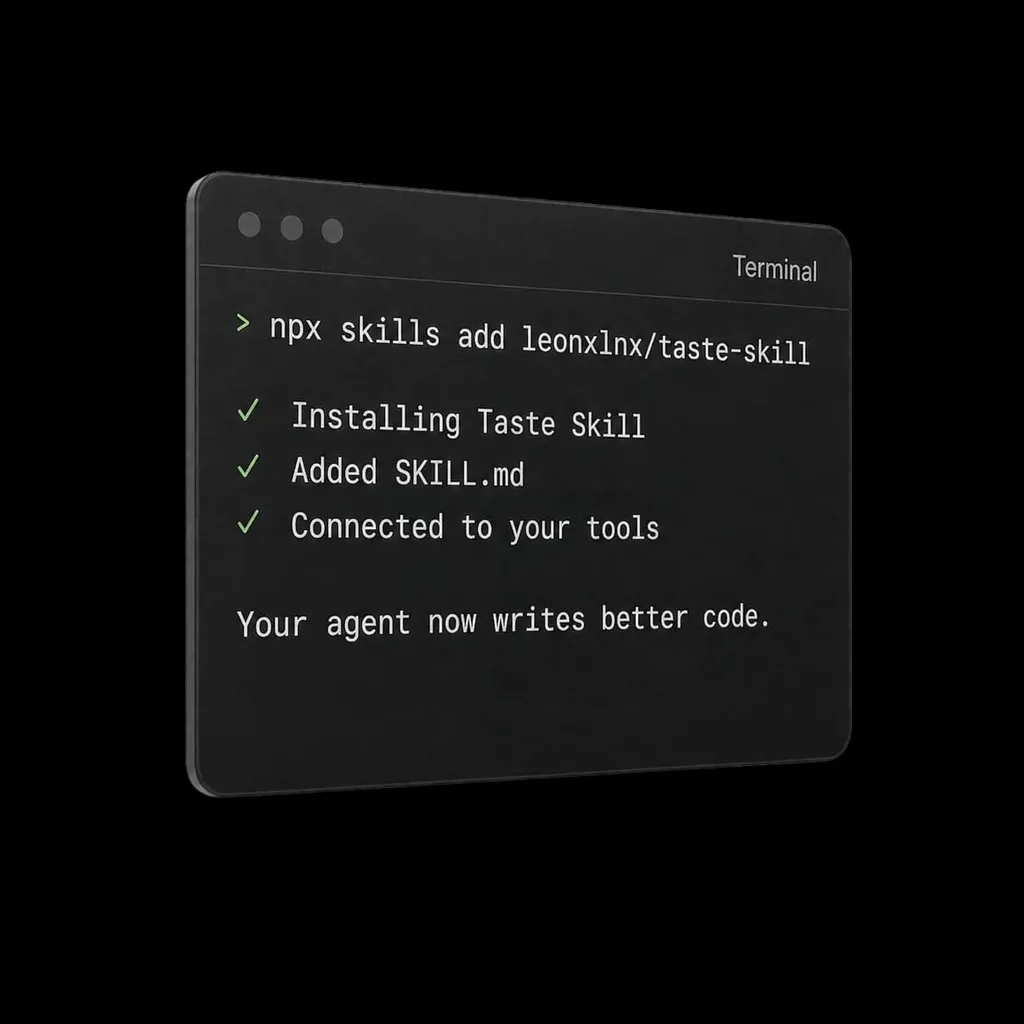
If you want to grant 'Taste' to an AI right now, simply open your terminal and enter the following command:
npx skills add https://github.com/Leonxlnx/taste-skill --skill "design-taste-frontend"If you want to install only a specific skill, you can use the --skill flag. If you are not familiar with the CLI environment, you can simply copy the contents of SKILL.md from the repository and paste it directly into a ChatGPT or Claude chat window.
As an extra tip, if the AI keeps using weird purple gradients or cliché layouts when producing results, try emphasizing Taste-Skill's core principle: 'Anti-Default Discipline.' Just specifying, "Don't use the AI purple, Inter font, and Slate-900 combination!" will change the quality of the output.
Conclusion: A New Standard for AI-Human Collaboration

Taste-Skill is not just a tool for making 'pretty code.' It is a massive experiment and answer to how AI can understand human sensibility and aesthetic standards, and how it can translate them into digital results.
Ultimately, future frontend development will shift from a battle of "how to write code" to a battle of "what kind of taste to grant the AI." Taste-Skill stands at the forefront of that change, helping AI become a 'creative partner' rather than a 'boring replicator.'
Why not try gifting your AI agent some great taste? Instead of a cliché website, try creating an interface that is pleasing to the eye.
What are the characteristics of the 'most boring AI design' in your opinion? Please share your experiences in the comments!
References
- Taste-Skill - gives your AI good taste ... · github.com
- Taste Skill | The Anti-Slop Frontend Framework for AI Agents · tasteskill.dev
- Frontend Solved with images-taste skill? : r/codex · reddit.com
- Leon Lin Leonxlnx · github.com
- Leonxlnx/taste-skill · github.com