Have you ever sighed while looking at the monthly CRM subscription invoice? Or have you felt frustrated by the "Data Lock-in" phenomenon, where your company's precious customer data is handed over entirely to a specific software vendor, making it impossible to even modify it the way you want?
As a business grows, customer data becomes massive and requirements become more demanding. However, existing giant CRM solutions are as solid and complex as massive fortress walls, often requiring enormous cost and time just to reflect a single small change we desire.
Today, we will take a deep dive into Twenty, an innovative alternative that has emerged for IT decision-makers, developers, and startup leaders dreaming of efficient operations who are feeling this thirst.
Why do existing CRMs make our lives difficult?
The problem we face is not simply a matter of "cost." The root cause lies in the structural design of the existing CRM market.
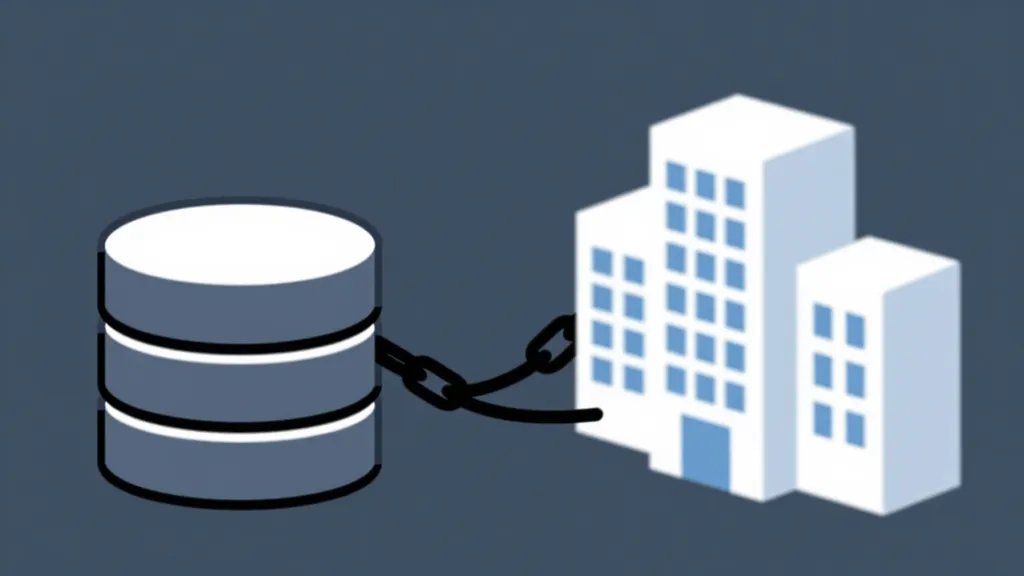
The first cause is "Vendor Lock-in." Powerful solutions like Salesforce or HubSpot are designed so that users cannot escape their ecosystem. Moving data incurs massive switching costs, which ultimately forces companies to maintain subscriptions even against unreasonable price hikes, much like being forced to eat something bitter because there is no other choice.
The second is "Rigid Structure." Modern business changes at the speed of light. Yesterday's sales process might not fit today. However, traditional CRMs are built to move only within a fixed framework, making it extremely difficult to reflect our business's unique workflow. It is like needing a custom-tailored suit but having to buy clothes from a ready-to-wear store.
Lastly, there is the issue of "Data Sovereignty." While cloud-based SaaS models are convenient, they instill anxiety because you must rely entirely on external servers for your company's core asset: customer data. In sectors like finance or healthcare, where security is life or death, this becomes the biggest obstacle.
Twenty emerges as a problem solver: What makes it different?
To directly tackle these chronic problems, Twenty has emerged. As of 2026, this project has moved beyond being merely a "cheap and good open-source" solution to establishing itself as the #1 Open Source CRM for modern teams.
Twenty's core philosophy is clear: "To return complete control of customer relationship management to the enterprise." To achieve this, Twenty takes three innovative approaches.
1. 'Code-as-CRM' for Developers
The most surprising aspect is that the way the CRM is built and deployed is identical to a modern software development stack. With a single npx create-twenty-app command, you can scaffold an app, and using TypeScript, you can define Objects, Fields, and Views as code.
For example, if you want to create a 'Deal' object specialized for your business, instead of just finishing with a few clicks, you can clearly define it as a TypeScript type and immediately deploy it using the npx twenty app:publish command. This means the CRM can be version-controlled and managed just like a "software product."
2. Capturing the User Experience of Notion and Airtable
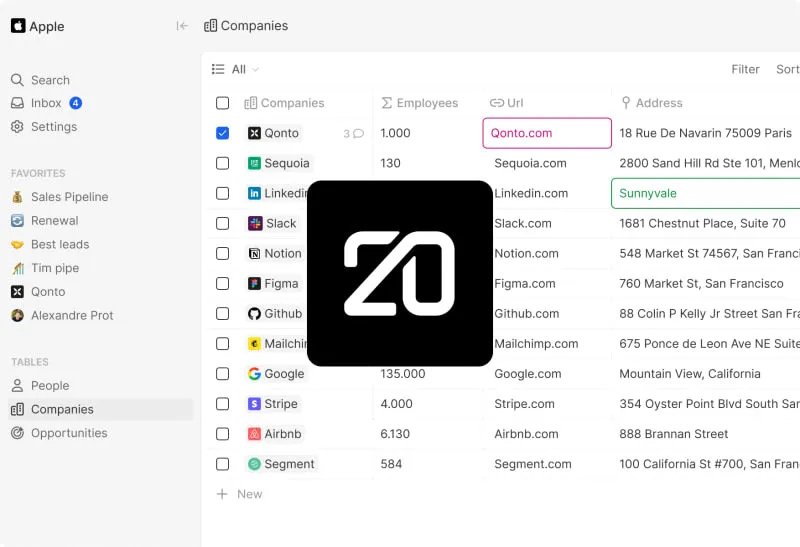
As impressive as its technical excellence is, the UX (User Experience) is equally stunning. For users tired of the clunky and complex interfaces of existing CRMs, Twenty provides an intuitive and sophisticated UI similar to Notion or Airtable.
Managing a sales pipeline or adding custom fields is as seamless as using a note-taking app. This is a powerful weapon that allows not only technical teams but also field sales teams to adapt to the CRM quickly.
3. Self-hosting to protect Data Sovereignty
While you can create a workspace in just one minute via the cloud version (twenty.com), Twenty also fully supports Self-hosting using Docker Compose to meet corporate security requirements.
If you install it directly on your own infrastructure, the data remains entirely under your control. Notably, there are no limits on the number of data rows when self-hosting. This provides a level of freedom that is on a different dimension from existing SaaS, where subscription fees skyrocket as data grows.
3 ways to use Twenty smartly
Twenty can be utilized through three paths depending on the user's technical proficiency and business situation.
The first is the 'Cloud Version', which is the fastest route. It is optimal for startups or small teams that do not want to worry about infrastructure management or server configuration. You can start working immediately just by signing up at twenty.com, and it is always updated to the latest version.
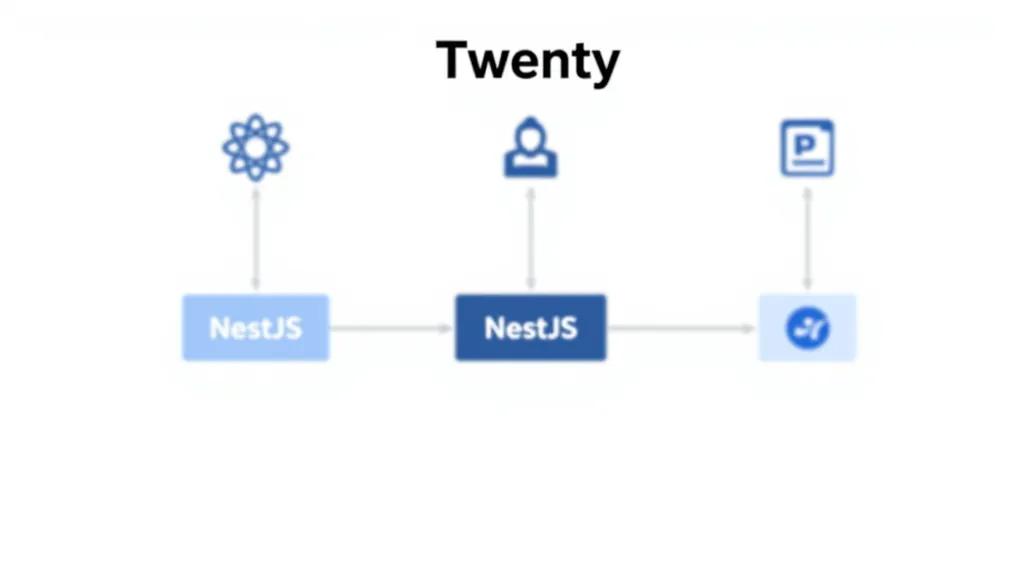
The second is the development-centric 'App Build' method. This is used when business logic is complex and the CRM needs to be integrated as a core system of the company rather than just a tool. Since it is based on a robust technical stack of React and NestJS, it can be organically connected to existing development stacks.
The third is 'Self-hosting', which maximizes security and cost reduction. This is recommended for companies where data security is the top priority or mid-sized companies that want to maximize cost-efficiency while managing large-scale data. By building it directly on your own server, you can secure 100% data sovereignty.
Of course, there are things to be careful about. Due to its open-source nature, UI performance degradation may occur when loading very large amounts of data in the browser all at once. This is a technical issue in the rendering process rather than a database limitation, and the development team is actively working to fix it. Additionally, keep in mind that functions essential in certain business environments, such as KakaoTalk integration, may require separate API integration.
The process of moving data is not scary
The biggest concern when adopting a new CRM is, of course, the question: "How do I move my existing data?" Twenty has designed this process very systematically.
- CSV Import: Suitable for standard data migration. It supports up to 10,000 records per file and allows you to use Excel formats as they are.
- API Import: If you need to move large-scale data of tens of thousands of records or more, the API method is recommended. It is powerful for large-scale migrations as there is no limit on the number of records.
One tip for maintaining data integrity is to follow the data upload order. For example, 'Company' information must be registered first so that you can link the 'People' information belonging to that company. If you follow this order, the process of moving existing data to Twenty will proceed very smoothly.
Now, take back control of your CRM

As we have seen, Twenty is not simply a cheap clone of Salesforce. It is a modern business infrastructure born from the belief that the owner of the data should be the 'enterprise,' not the provider.
To summarize:
- Cost and Lock-in issues: Achieve both data sovereignty and cost reduction through open source and self-hosting.
- Flexibility and Scalability: Build a custom CRM perfectly suited to your business through objects and fields defined as code.
- User Experience: Inherits the sensibility of modern productivity tools (Notion, Airtable, etc.), making it easy for anyone to use.
If you have been hesitating to use a CRM due to expensive subscription fees and complex settings, it is now time to seriously consider a new option called Twenty. Your business deserves to be more free and flexible.
Which do you currently struggle with most: CRM cost issues or data management issues? Tell us your concerns in the comments!
References
- Twenty | #1 Open Source CRM · twenty.com
- Twenty: Open Source CRM - Y Combinator · ycombinator.com
- What is Twenty? - Twenty · twentyhq-twenty.mintlify.app
- Twenty: 모던 오픈소스 CRM 구축 : r/webdev - Reddit · reddit.com
- Twenty라는 오픈소스 CRM 들어봤어? Salesforce나 HubSpot 같은 거 ... · threads.com
- 데이터 마이그레이션 - Twenty Documentation · docs.twenty.com