"AI is smart, but why does it feel so disconnected from my actual work data and tools?"
Have you ever felt this kind of frustration in the middle of your workday? Even if you extract a brilliant draft while chatting with Claude, the process of moving that content to Slack, organizing it in Notion, and creating Jira tickets remains "manual labor" for you. Since the AI doesn't understand the context of your work, the "context switching" cost—explaining the situation every single time—is also quite significant.
As of 2026, we expect AI to go beyond simple answer generation and become deeply integrated into practical work processes. Anthropic's recently unveiled Knowledge Work Plugins strike exactly at this point, elevating AI from a simple "consultant" to a "Coworker."
Today, we will dive deep into why these plugins are revolutionary and what practical differences they make compared to traditional ways of using AI.
Current Limitations: AI that is smart but has no 'hands or feet'
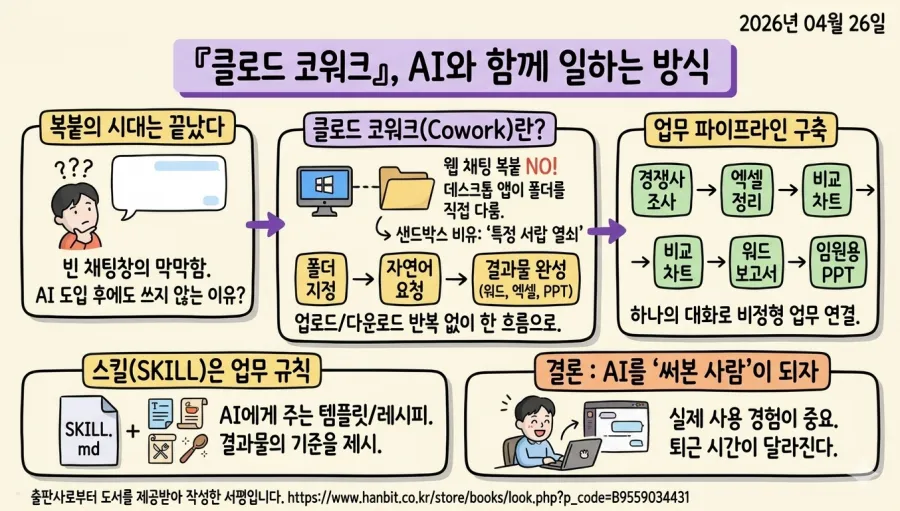
The ways we have used AI so far can be largely divided into two patterns.
The first is 'Simple Chatting.' This is the method of asking a question and receiving an answer. The biggest problem with this approach is 'data fragmentation.' Claude doesn't know your company's recent sales performance, nor does it know what conversations your team has had on Slack. Consequently, users must repeat the "grunt work" of copying and pasting information.
The second is 'API-integrated Automation.' This involves building workflows using tools like Zapier. While very powerful, the setup is complex, and there is little room for "intelligence" to intervene. In other words, it follows the rule "If A happens, do B" very well, but it fails at points requiring high-level intellectual judgment, such as "Analyze this data and write a strategic report."
Ultimately, we have been torn between 'AI that has high intelligence but no hands or feet' and 'automation that has fast hands and feet but no brain.'
Comparison of Alternatives: General AI Usage vs. Anthropic Knowledge Work Plugins
Now, let's compare specifically how this new ecosystem from Anthropic differs from existing methods.
1. General Purpose AI
The most popular method. While excellent at general knowledge, it is ignorant of your company's specific terminology or unique workflows.
- Pros: Ready to use immediately without special setup, very high accessibility.
- Cons: Must provide context (situational explanation) every time, cannot interact directly with external tools.
2. Traditional Automation
Rule-based automation.
- Pros: Perfectly performs repetitive, simple tasks (such as moving data).
- Cons: Difficult to respond to exceptional situations, inapplicable to complex tasks requiring 'judgment' (e.g., contract review, strategic planning).
3. Knowledge Work Plugins (The New Paradigm)
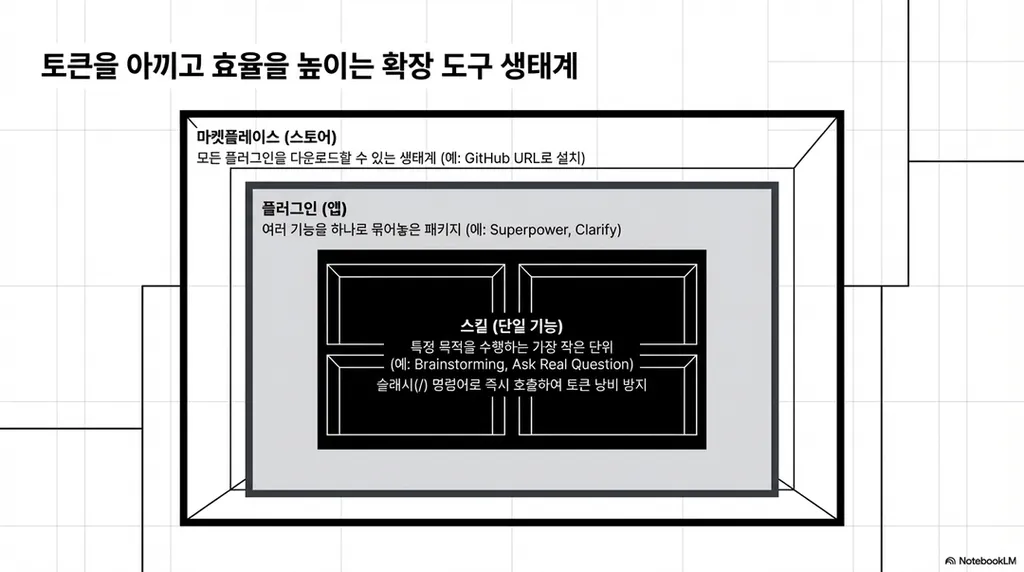
The plugin method unveiled this time is an 'Intelligent Agent' model that combines the advantages of the previous two methods. The 11 specialized job plugins do not just provide simple commands; they package skills, connectors (MCP), and sub-agents required for specific roles into a single package.
| Comparison Item | General Purpose AI | Traditional Automation | Knowledge Work Plugins |
|---|---|---|---|
| Work Context Understanding | Low (requires explanation every time) | Very Low (follows only rules) | Very High (possesses dedicated memory) |
| Tool Integration | None (copy/paste) | High (within set rules) | Very High (real-time connection via MCP) |
| Intellectual Judgment | High | Low | Very High (equipped with job-specific skills) |
| Primary Users | Anyone | IT/Operations Experts | Knowledge Workers (PM, Sales, Eng, etc.) |
Revolutionary Changes Experienced by Job Roles
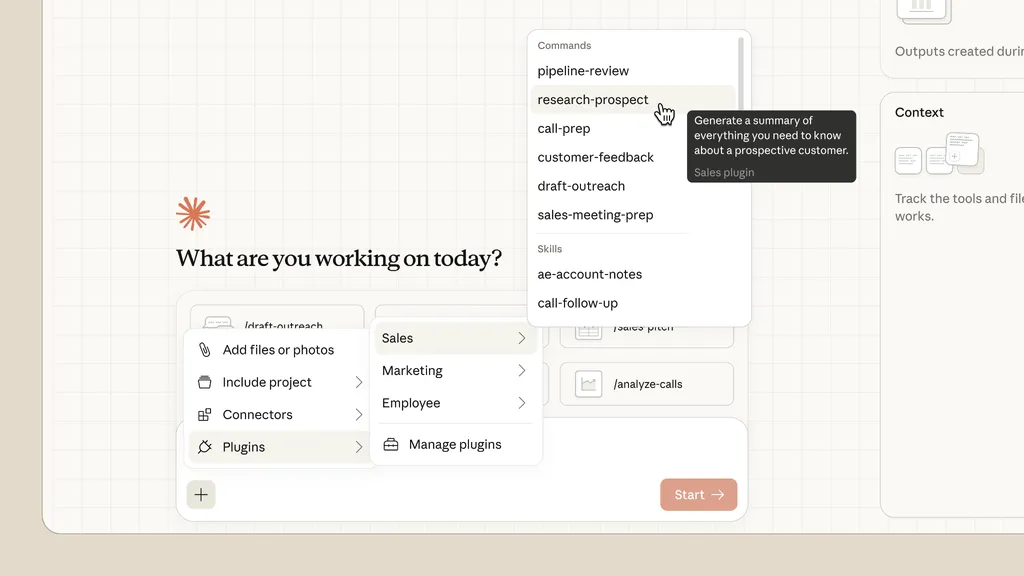
To say these plugins are simply "more convenient" is an understatement. Their true value is revealed when you see the "way of thinking" they employ in real-world operations.
The Productivity Plugin is like hiring a new employee. Through files like TASKS.md or CLAUDE.md, it learns our team's working methods and internal terminology. Thanks to this, a single phrase like "Organize this in our team's style" carries full context.
The Sales Plugin is the ultimate partner for a sales representative. With a single /sales:call-prep command, it generates a 'customized dossier' that integrates the meeting counterpart's history, latest news, and CRM data. Research that used to take an hour before meeting a client is finished in just a few seconds.
The Engineering Plugin targets the 'documentation work' that developers hate most. When an incident occurs, executing /engineering:incident-response structures the situation by timeline and even drafts a Postmortem. This allows developers to focus solely on code and problem-solving.
Beyond this, Product Management (PM) assists in building roadmaps using the RICE framework, Legal reviews risk factors in contracts, and Data experts perform everything from writing SQL queries to visualization without context switching.
Of course, it is not perfect. Challenges regarding security and accessibility remain. Since all connectors are linked via the cloud, they may conflict with a company's internal security policies (such as firewalls). Furthermore, caution is required to only install plugins from trusted sources. This is a common issue of 'responsibility and authority' that we will face in the era of AI agents.
Conclusion: We must now learn 'how to collaborate with AI,' not just 'how to use AI'
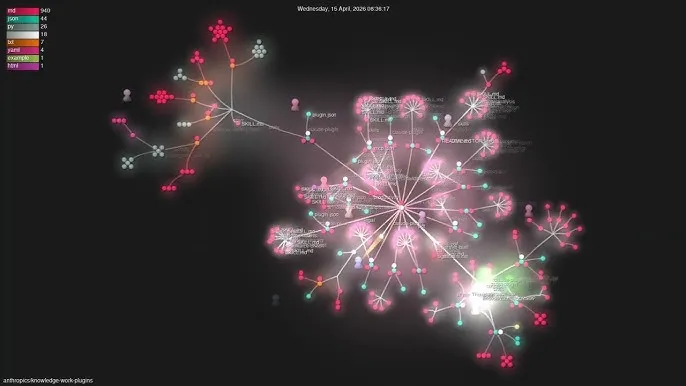
In conclusion, Anthropic's Knowledge Work Plugins are a decisive trigger that transforms AI from a simple tool into a coworker.
The core of this technology lies in 'the packaging of expertise.' Beyond just being good at conversation, each plugin already knows the data used by specific roles (HubSpot, Slack, Jira, etc.) and the decision-making frameworks used by those roles (MoSCoW, RICE, etc.).
To summarize:
- Limitations of existing AI: Inefficiency caused by data fragmentation and repetitive context explanation.
- Innovation of Plugins: Providing job-specific specialized skills, tool integration (MCP), and memory systems in a package.
- Practical Value: Reducing the time for high-level intellectual tasks—such as documentation, data analysis, and sales preparation—by more than 40%.
We have moved past the stage of wondering "What should I ask the AI?" and have entered an era where we must consider "How can I design my work workflow into a plugin format that the AI can understand?" The fact that Anthropic has released these as open source means an era has opened where we can all directly customize our own 'digital colleagues.'
What is the first 'tedious task' you want to delegate to an AI colleague? Please share your thoughts in the comments!
What do you think? How could these plugins change your specific job role?
References
- anthropics/knowledge-work-plugins · github.com
- knowledge-work-plugins Marketplace - Claude Code Plugins · claudepluginhub.com
- Use plugins in Claude Cowork | Claude Help Center · support.claude.com
- Anthropic Adds Plugins to Claude Cowork · reworked.co
- Knowledge Work Plugins: 지식 근로자를 위한, Claude ... · discuss.pytorch.kr
- Anthropic이 Claude Cowork 에 법률,영업,마케팅,데이터 ... · threads.com