
Right after the alarm rings and we open our eyes, we often blame ourselves for lacking willpower when we grope for our smartphones in the dark and open Instagram or YouTube. However, this behavior is less about personal weakness and more closely resembles an automatic response triggered by the brain’s reward circuit. The key point is that changing your morning habits does not require eliminating the smartphone entirely or removing it from the bedroom. British psychologist Dr. Sandra Wheatley explains that the object of addiction is not specific apps, but the 'instant gratification' itself 1. Therefore, you can keep holding your phone and simply change the type of reward by leaving a single line in a memo app instead of endlessly refreshing. Writing and handwriting provide a 'slow achievement' that accumulates step by step at the tip of your fingers rather than offering immediate stimulation, guiding the morning’s state of arousal toward a steadier direction.
The Brain Upon Waking and the Trap of Immediate Rewards
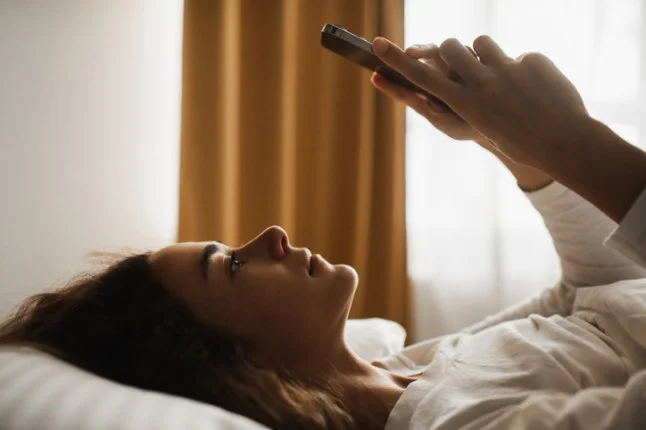
When we wake up in the morning, the brain gradually transitions from the slow brainwaves (delta waves) of sleep. Emily MacDonald, a doctoral researcher in neuroscience, argues that the brain should naturally transition from delta waves during sleep to alpha waves in a relaxed state, and then to beta waves in a waking state, but looking at a smartphone immediately upon waking bypasses this buffer stage and jumps directly to a high state of arousal (beta) 1. While MacDonald’s explanation is a personal perspective and does not directly cite results from large-scale clinical trials, this analogy suggests that morning habits can affect not just the waste of time, but the brain's tension levels themselves. Switching directly from a sleepy state to an external information-processing mode can trigger a stress response before one has had the chance to secure mental space for thought.
A larger reason why this behavior repeats lies in the brain’s reward system, specifically the dopamine circuit. Anna Lembke, a professor of psychiatry at Stanford University, explained that repeated exposure to digital stimuli causes the brain to adapt by reducing dopamine receptors, making it less sensitive to stimulation 2. If this adaptation persists, users fall into a 'dopamine deficit state,' experiencing depression, anxiety, or cravings for stimulation 2. At this point, we turn on media not to check news we are curious about, but as an act closer to seeking immediate reward to relieve that unpleasant sense of lack. Reaching for the phone in the morning is essentially an unconscious attempt to temporarily soften the lowered arousal and uncomfortable feelings accumulated overnight through the rapid changes on the screen, rather than checking news.
The 'Slow Achievement' Provided by Handwriting and Writing

There is no need to throw away the smartphone to change your habits. Dr. Wheatley recommends replacing the habit of liking Instagram photos with behaviors that are equally accessible but offer a different nature of reward, such as 'reading news on the phone' or 'writing a diary in a memo app' 1. The core idea is to maintain the accessibility of touching the screen with your fingers, while focusing on controllable activities instead of an unpredictable flood of stimuli.
Handwriting or journaling a single line on paper can yield deeper effects in this context. According to a case of expressive writing research introduced in 2019, participants who wrote honestly about their emotions for 15 to 20 minutes a day showed better physical and mental health indicators than those who wrote on neutral topics 3. What is important here is not the technical skill of writing neatly, but the fact that the 'focus' itself of staying with a single emotion and sentence for 15 to 20 minutes helps reduce anxiety and organize mental confusion.
The act of writing by hand physically induces this kind of focus. Handcrafts such as calligraphy or knitting reduce the pressure to produce good results and allow one to experience dopamine secretion and a state of immersion (flow) from the process itself 4. When you open a short transcription notebook in the morning, the brain does not have to urgently jump to the next stimulus. Instead of immediate feedback, the sense of small achievement filled by completing sentences character by character at the tip of your fingers can create a crack in the immediate reward loop created by social media.
Three-Step Practice for a Morning Routine

To apply this principle to your morning situation, small steps are needed rather than grand resolutions. The initial stages among the alternatives proposed by Dr. Sandra Wheatley are as follows:
- Changing the Role of the Screen: Even if you pick up your phone, read the news instead of scrolling through the Instagram feed, or write a 'one-line description of this morning’s mood' in a memo app. The screen becomes a tool for recording your state rather than an object for infinite scrolling 1.
- Reviewing Yesterday’s Line: Re-read the single line of emotion you wrote in the memo app yesterday this morning. This replaces checking social media notifications and changes the start of the day from external noise to checking your emotional flow 1.
- Expanding to Paper: Once you are somewhat accustomed, put down the phone and transcribe short sentences or journal in a paper notebook. If it is difficult to completely cut off digital devices from the start, setting a timer to check apps for only 5 to 10 minutes is also a method 1.
Turning on the phone first in the morning is not due to weak willpower, but an automatic response of a brain conditioned by immediate rewards. However, as Dr. Sandra Wheatley advises, if you look for the problem in the 'type of reward' rather than the 'phone,' the answer becomes clear. The moment we hold the smartphone but write a single line of emotion in a memo app instead of Instagram, we can change the chain of immediate stimulation to a route of 'slow focus and achievement.' The first five minutes of the morning can serve as an important starting point that designs a new day.
References
- ↩
- How to finally break free from your smartphone addiction | BBC Science Focus Magazine · sciencefocus.com↩
- How Writing Can Improve Your Mental Health · rtor.org↩
- The Mental Health Benefits of Art Are for Everyone · bebrainfit.com↩