30-Minute Bodyweight Workouts: The Key to Fatigue Recovery Lies in 'Intensity Control'
For office workers who are mentally and physically exhausted after work and find it burdensome to visit the gym, a 30-minute bodyweight workout routine based on 'low intensity and high frequency' that can be practiced at home without any special equipment, along with sustainable mental management strategies, is gaining attention. The core concept is not to force a perfect 30-minute workout every day, but rather to consistently meet the total weekly activity volume and ensure sustainability 1.
Exercises such as squats and push-ups, which use one's own body weight as resistance without heavy gym equipment, are also sufficient strength training 1. International health organizations such as the WHO, CDC, and NHS recommend that adults engage in at least 150 minutes of moderate-intensity physical activity and strength training on at least two days per week 123. These recommended durations do not require adhering to a fixed 30-minute daily block; breaking them into increments of 10 to 30 minutes can provide significant benefits for preventing cardiovascular disease and increasing basal metabolic rate 123.
In particular, for beginners who find exercising difficult, it is advisable to use the 'talk test' (whether conversation is possible) as a practical benchmark to gauge if their activity intensity is appropriate. Activities falling under low to moderate intensity should allow for conversation, even if breathing becomes slightly faster than usual 13. Conversely, if one is so out of breath that it is difficult to continue speaking, the intensity of that activity is considered too high for beginners, so speed should be adjusted or difficulty lowered 13. At moderate intensity, one can speak but find it difficult to sing, while at high intensity, one needs to take a breath immediately after speaking a few words 3.
Step-by-Step 30-Minute Routine for Beginners
A 30-minute workout routine that can be started with just one mat, even without special equipment, can be clearly divided into three stages: '5 minutes warm-up + 20 minutes strength training + 5 minutes cool-down' 12. Each movement should start with 1 to 2 sets of 8 to 12 repetitions, and it is perfectly fine to initially cut this number in half 1.
First, during the 5-minute warm-up, gently move the joints using exercises like shoulder rolls or marching in place without using momentum to gradually raise body temperature 12. In the subsequent 20-minute strength training section, alternate between four basic bodyweight movements, combining aerobic elements by resting for 30 seconds to 1 minute with marching in place between each movement 1.
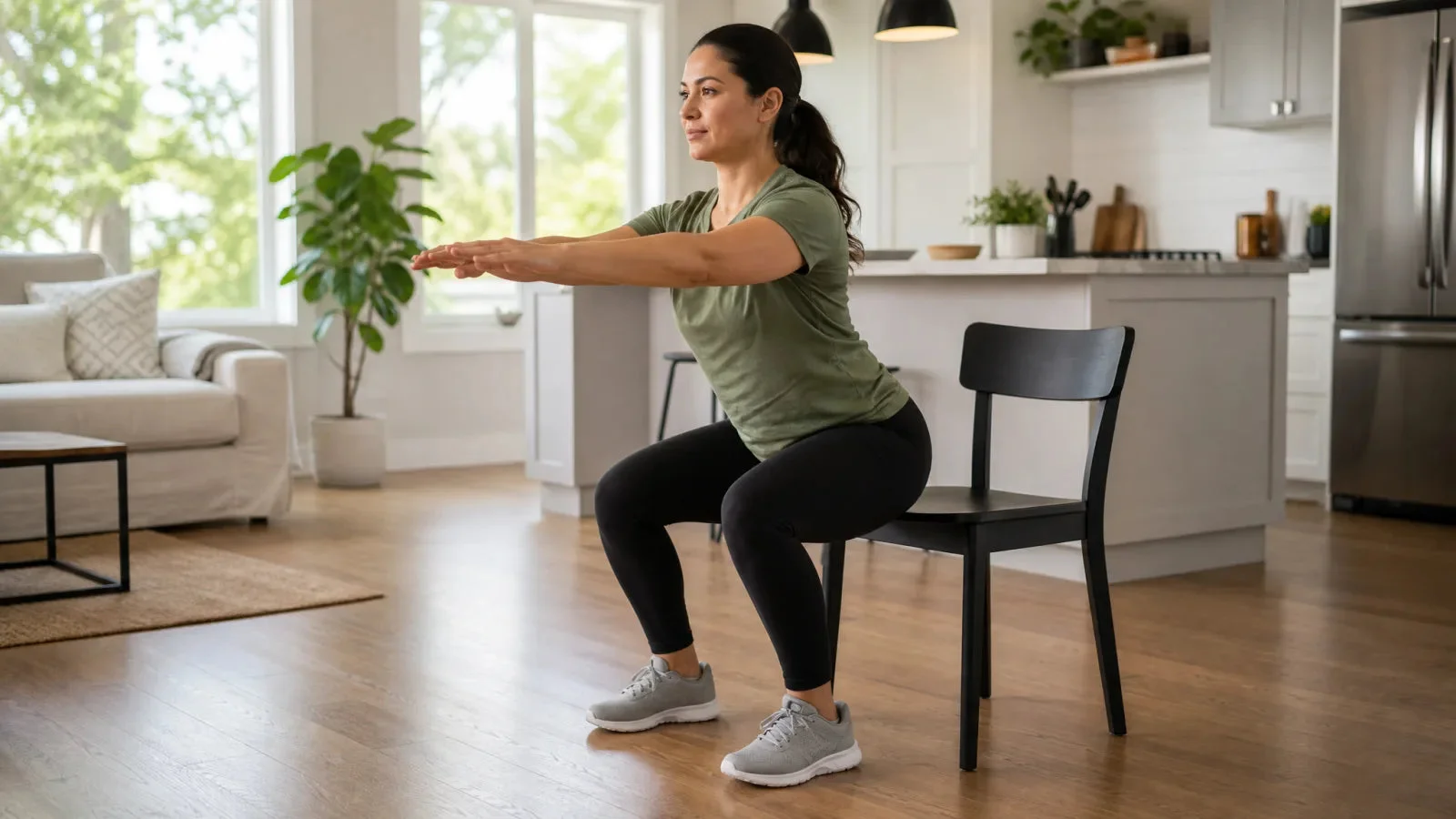
- Chair Squats: Repeatedly sit down and stand up using a chair as a reference, engaging the glutes and lower body muscles. Perform the movement to the point where no knee pain occurs 1.
- Wall Push-ups: If doing push-ups on the floor is too demanding, lower the difficulty by pushing the body away while leaning against a wall to train the upper body muscles 1.
- Glute Bridges: This involves lying down and lifting the hips, which is effective for activating the gluteal (butt) muscles of office workers who sit at a desk all day 1.
- Bird-Dogs: This exercise involves extending opposite arms and legs alternately while in a prone position; it is a safe core exercise that builds trunk stability as a safe alternative to high-intensity plank exercises 1.
In the final 5-minute cool-down stage, cool down the body temperature with light walking and stretch only to the point of no pain to relax the body 1. This routine is characterized as low-impact, with no jumping or strenuous movements, which minimizes stress on the knees and joints while stimulating the whole body 4. Additionally, to avoid injury and accumulated fatigue, increase only one variable—time, intensity, or frequency—slightly each day 3.
Lowering Exercise Execution Barriers through 'Environment Design'

It takes an average of 66 days for a new exercise habit to become automatic in the brain. Within that period, the initial phase of four weeks (approximately 26 days) post-exercise is considered the most critical for forming new neural pathways 5. To successfully navigate this period, it is essential to focus on 'daily repetition' and 'sustainable intensity' rather than attempting excessive strength gains 15.
Relying solely on willpower often leads to collapse due to post-work fatigue, making it essential to pre-design the home environment to physically lower the barriers to exercise execution. Setting up the environment, such as laying out workout clothes before leaving work or keeping a yoga mat spread on the living room floor at all times, reduces 'decision fatigue' caused by having to decide whether or not to exercise each time. Such environment design is effective in reducing exercise execution barriers by more than 30% 5.
Furthermore, setting a 'work end notification' or a 'specific location upon arriving home' as an exercise trigger (signal) can induce the brain to automatically engage in the behavior. Building an immediate reward system, such as drinking a protein smoothie after a workout or logging the activity with apps like Strava to stimulate dopamine, is also a good method to enhance sustainability 5. Using a calendar to simply mark the days exercised and visually confirming progress also serves as a small reward 1.
'Alternative Routines' for When Overtime and Fatigue Persist

In office life, there are inevitably days when it is difficult to secure the originally planned 30 minutes due to frequent overtime or sudden fatigue. If one completely gives up exercising because the plan fell apart, the brain's exercise signals may cease, interrupting habit formation. It is recommended to flexibly perform a '10-minute alternative routine' even if the full 30 minutes cannot be achieved, to maintain regular exercise signals in the brain 15.
On days exhausted by overtime, it is important to repeat even ultra-low-intensity activities, such as 5 minutes of very low-intensity stretching or 10 minutes of light stair climbing 5. Even if habits loosen during weeks 5 to 8 or a slump arrives, adjusting intensity to maintain the routine at least 1 to 2 times per week without stopping completely can lead to noticeable physical and mental changes after eight weeks 5.
Finally, while high-intensity interval training (HIIT) is advantageous for meeting aerobic goals when time is limited, it can strain the knees and heart, so it is safer to introduce it once a week only after becoming sufficiently accustomed to basic exercises 3. Additionally, check individual reactions to see if post-work exercise interferes with sleep, and avoid strenuous exercise immediately after meals 1. Refraining from caffeine and food two hours before bedtime, and reducing smartphone use one hour before falling asleep, helps improve sleep quality and recovery 3.
Ultimately, the success of low-intensity, high-frequency home training depends on 'consistent weekly activity volume' rather than daily workout amounts. Just as severe muscle soreness should not be used as an indicator of exercise effectiveness, escaping perfectionism and repeating the simple action of spreading out a mat becomes the most reliable fatigue recovery tool and physical fitness management method in an office worker's daily life 15.
References
- 퇴근 후 30분 맨몸 직장인 홈트 루틴 및 무너지지 않는 멘탈 관리법 - jjonghub · jjonghub.com↩
- 직장인 체력 증진을 위한 15분 홈트 루틴: 운동 초보가 일주일 만에 몸을 바꾸는 법 - 메디셜 공식 .... · blog.meditial.co.kr↩
- 쉽게 지치지 않는 체력 만드는 실전 가이드 - 어머넷 블로그 · blog.eomeo.net↩
- 1편/20분 저강도 인터벌트레이닝 전신운동/Low Impact Interval Training · youtube.com↩
- 퇴근 후 운동 습관, 직장인 3가지 핵심 원칙으로 8주 안에 만드는 법 » Home · dnrlifestory.com↩