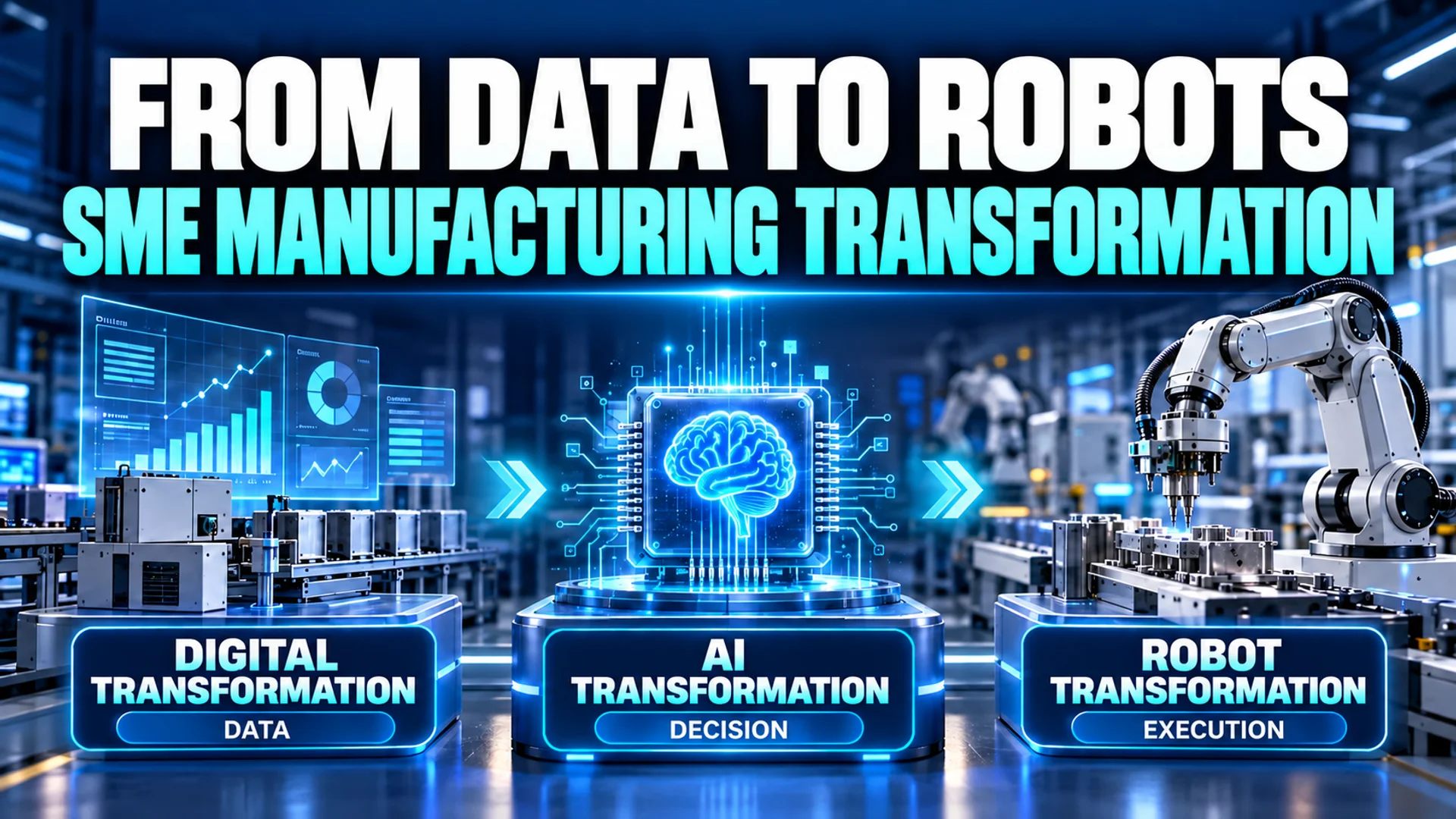
The Ministry of SMEs and Startups has unveiled a new blueprint to fundamentally transform the production methods of small and medium-sized manufacturing enterprises. At the 16th State Policy Coordination Meeting held on October 29, 2026, at the Chong Kun Dang factory in Cheonan, South Chungcheong Province, the ministry announced its 'Strategy for Expanding Physical AI in Small and Medium-sized Manufacturing' 123. The core of this strategy lies in building a 'Physical AI' ecosystem where systems independently perceive and act upon the physical world by connecting data accumulated through digital transformation (DX) with artificial intelligence transformation (AX) and robotics transformation (RX), moving beyond the mere automation level of individual equipment 123.
The government has set an ambitious plan to invest over 5 trillion won by 2030 to increase the number of digitally transformed companies to 30,000 and those adopting AI to 6,000 123. A particularly noteworthy aspect is that manufacturing data has been defined as a 'strategic asset,' opening new pathways for it to be utilized in support programs without imposing cash burdens. In this article, we will carefully unravel the key contents of the announcement, including the structure of the Ministry of SMEs and Startups' 3X strategy, the virtuous cycle system for manufacturing data, robot demonstration plans, and the talent development program intended to lead the field.
3X Strategy: Connecting AI and Robotics Through Data
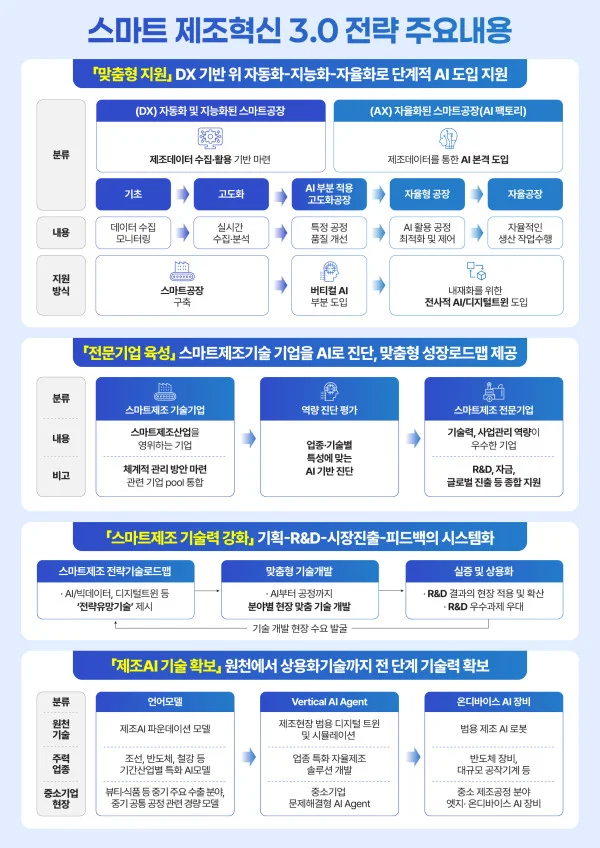
The backbone of this policy is the 3X strategy. It is a structure that links and merges data secured through DX with AX and RX 12. Physical AI is not merely generative AI that finds answers within a screen. It refers to technology that perceives and judges the real world to act physically, and the Ministry of SMEs and Startups plans to cultivate small and medium-sized manufacturing sites as key demonstration grounds for Physical AI 2.
| Category | Current Level | 2030 Target | Remarks |
|---|---|---|---|
| DX Rate (Number of Companies) | 30% | 50% (approx. 30,000 companies) | Expansion of digital transformation foundation |
| AI Adoption Rate (Number of Companies) | 1% (approx. 600 companies) | 10% (6,000 companies) | Full-scale field application of AI |
| Manufacturing Robot Deployment | - | Approx. 1,000 companies | Support for hazardous processes and automation |
| Smart Manufacturing Specialists | - | 500 companies | Cultivation of technology supply ecosystem |
To achieve these figures, the government is pushing forward with four major strategies and 12 key tasks 1. It provides phased support for DX and AX based on corporate capacity and concentrates manufacturing innovation support on companies in new growth sectors such as new security, pharmaceutical biotech, climate tech, and K-consumer goods 12. This policy can be interpreted as a design intended to create a virtuous cycle where companies do not merely collect data but use that data to allow AI to solve process problems, which in turn improves the performance of robotic equipment.
'In-Kind Recognition' of Manufacturing Data: An Experiment to Reduce Cash Burdens
For small and medium-sized manufacturing enterprises, AI adoption is directly tied to high initial cost barriers. The Ministry of SMEs and Startups aims to break through this issue with an approach called 'data assetization.' The most notable institutional change in this strategy is the introduction of data valuation. When companies participate in government support programs, they provide manufacturing datasets, which are evaluated and recognized as in-kind contributions to offset cash burden requirements 123. This acknowledges that manufacturing data can become an alternative resource for policy support funds, moving beyond merely being buried records within the company.
The government plans to establish this data valuation model and guidelines within this year and pilot them starting with the 'Autonomous Factory Construction Project' next year, expanding them in stages 3.
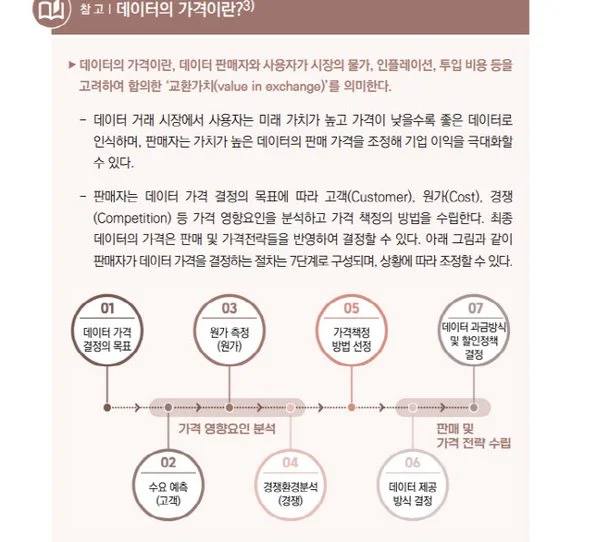
The platform managing data flows is also being significantly strengthened. The existing AI Manufacturing Platform (KAMP) will be upgraded to 'Manufacturing AI 24' 12. Manufacturing AI 24 will serve as a hub to build a 'virtuous cycle system for manufacturing data (flywheel)' that goes beyond a simple data repository, covering everything from data collection and standardization to AI model development and field re-application 12. In other words, it institutionalizes a structure where an AI model created with data from Factory A improves productivity at Factory B, and the new data generated in the process further refines the AI.
Field-Specific AI Robots: 'Smart Robo Factory' and 'Everyone's AI Factory Manager'
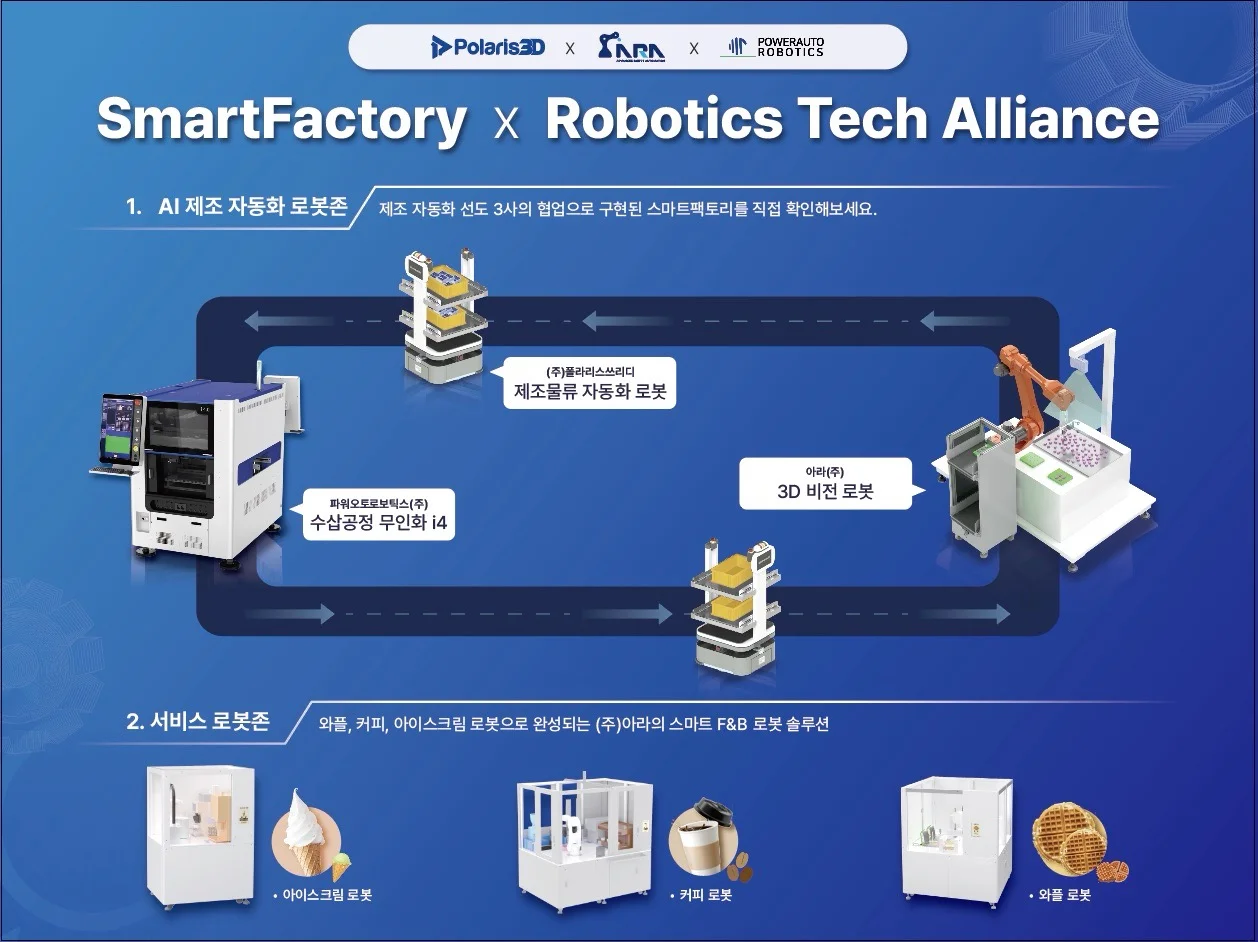
Manufacturing robots represent the frontline where AI meets the physical world. The Ministry of SMEs and Startups is pushing for demonstrations that apply AI trained on the know-how of skilled workers to manual processes in export-driven industries with high labor dependency, such as K-Food and K-Beauty, and to introduce AI robots and safety devices in hazardous or harmful processes like casting and mold-making to reduce exposure to high heat and dust 3.
The ministry also revealed a plan to integrate these process-specific verification models into a single factory, evolving into a tentatively named 'Smart Robo Factory' where AI, robots, and data are fully connected 3. Starting in 2028, the creation of a dedicated program for the widespread adoption of humanoid robots is also under consideration 3.
Inter-ministerial cooperation frameworks have also become more refined. National AI core technologies developed by the Ministry of Science and ICT, such as 'Everyone's AI Factory Manager,' will be directly linked to the Ministry of SMEs and Startups' smart factory dissemination system 124.
graph LR
    A[과기정통부<br>피지컬 AI 원천기술 및 인프라] -->|연계 확산| B(중기부<br>스마트공장 보급 및 현장 실증)
    B -->|데이터 환류| C[제조AI 24<br>데이터 표준화 및 모델 고도화]
    C -->|가치 평가| D[기업 지원사업<br>현물 인정]
For instance, while the Ministry of Science and ICT develops core technologies for robots and equipment, the Ministry of SMEs and Startups supports smart factory construction and demonstrations to ensure these technologies operate on actual production lines 4. The goal is to redesign fragmented ministerial projects around corporate demand to reduce the cost and labor burdens, which are the biggest obstacles to adopting advanced technologies 4.
500 Manufacturing AX Specialists: A Talent Pipeline Built with KIST and Others
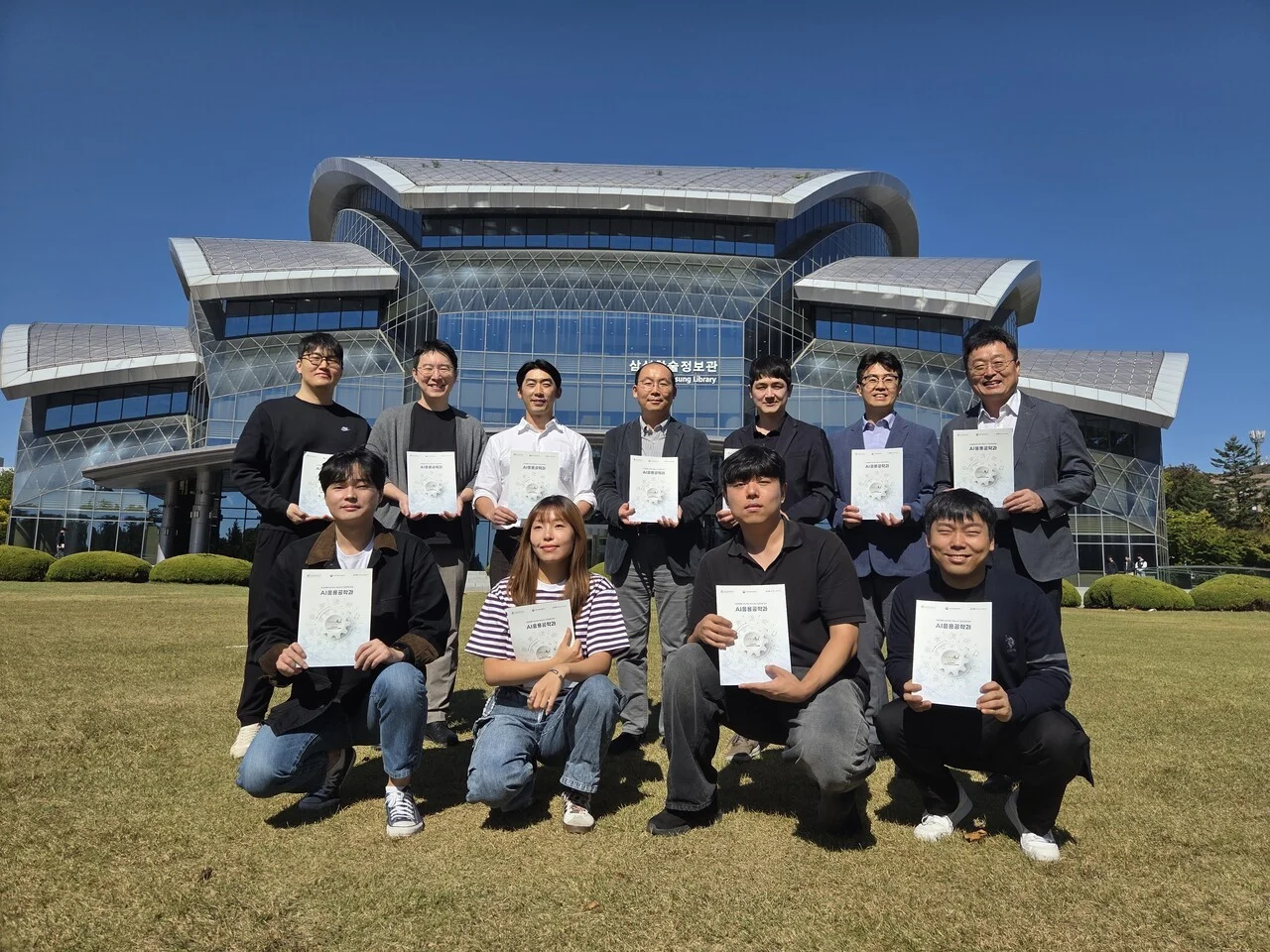
No matter how excellent the AI systems and robots are, they are ineffective without the 'people' who can handle them and adjust them to fit the field. The labor shortage in small and medium-sized manufacturing sites is the most critical variable determining the success or failure of the policy. The Ministry of SMEs and Startups has finalized plans to cultivate 500 manufacturing AX specialists in collaboration with four major science and technology universities, including KAIST 53.
- Manufacturing AI Fellow Program: Scheduled to launch in 2027 in cooperation with four major science and technology universities, this program will cultivate a total of 500 specialists 53.
- Practical Workforce Training: The scale of training will be significantly expanded from 600 people this year to approximately 1,600 by 2027 53.
- AI-Specialized Contract Departments: The number of departments, currently 10 as of 2026, will be increased to 30 by 2030 5.
Upon completion of these educational programs, participants will be awarded a Manufacturing AX micro-degree, with direct linkage to employment at small and medium-sized enterprises to ensure rapid influx into the industry 5. Additionally, a 'Manufacturing AI Education Center' will be established within this year to provide practical, hands-on training to 10,000 current workers annually 5. To expand the talent ecosystem on the technology supply side, smart manufacturing specialist companies will also be increased from a pilot designation of 100 companies in 2026 to 500 companies by 2030, laying the groundwork for full-cycle support and overseas expansion 123.
Administrative and Financial Support to Increase Policy Effectiveness
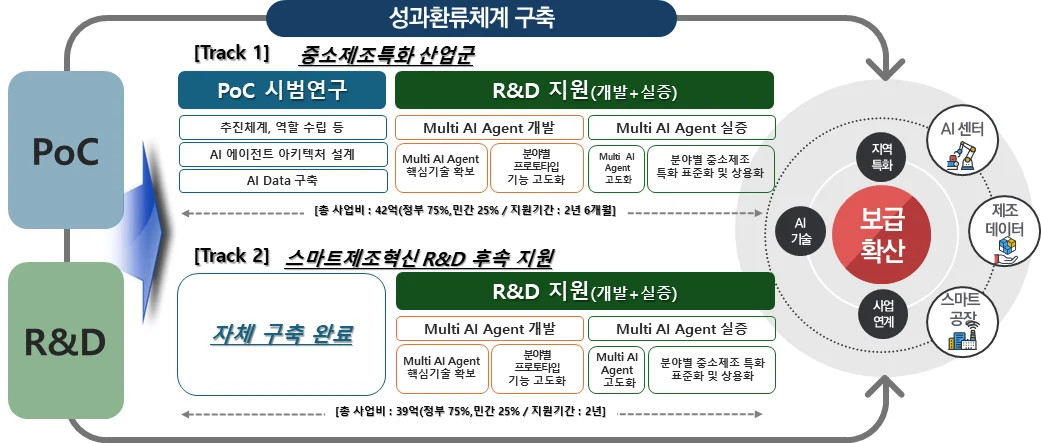
To facilitate on-the-ground changes, the thresholds for policies are being significantly lowered. The introduction of an 'AI Agent' as an AI-based corporate support service is a representative example 1. In the past, considerable administrative effort was required to write business proposals for complex government support programs and match companies with appropriate technology suppliers. The AI Agent, trained on accumulated support program data, is designed to directly assist with company matching and business proposal writing 1.
Furthermore, a dedicated fund worth 2 trillion won is being established for local corporate development and technology R&D, alongside support for GPU leasing and cloud infrastructure, which are essential for AI model development 1. This financial and infrastructure package can serve as a practical foothold for small and medium-sized manufacturing companies, who often lack the capacity for fundraising or building their own infrastructure, to join the 3X strategy.
The policy's goal is clear. The Ministry of SMEs and Startups' strategy of linking data, AI, and robotics aims to fundamentally transform the production methods of small and medium-sized manufacturing enterprises and serve as a key driving force for propelling South Korea into a leading nation in Physical AI. Industry attention is focused on whether this announcement will serve as a turning point, breaking away from the past inertia of relying solely on aging factory equipment and human craftsmanship, and transitioning to a new manufacturing ecosystem where data becomes productivity.
References
- "중기, 피지컬 AI 주체로"…2030년까지 5조 투자 :: 공감언론 뉴시스 · newsis.com↩
- 중기부, 2030년까지 제조 中企 6000곳에 AI 도입…5조원 이상 투입 · biz.chosun.com↩
- 위험공정에 AI 로봇 도입...중기부, 2030년까지 '중소 제조혁신' 5조 이상... · newspim.com↩
- [보도자료] 중기부-과기정통부, 피지컬 AI로 중소제조 현장의 미래를 연다 - 중소기업 기술마켓 AI .... · aihub.techmarket.kr↩
- KAIST 등 4대 과기원서 제조AI 500명 키운다…중기부, 5년 인력정책 재편 - 산학뉴스 · sanhaknews.kr↩