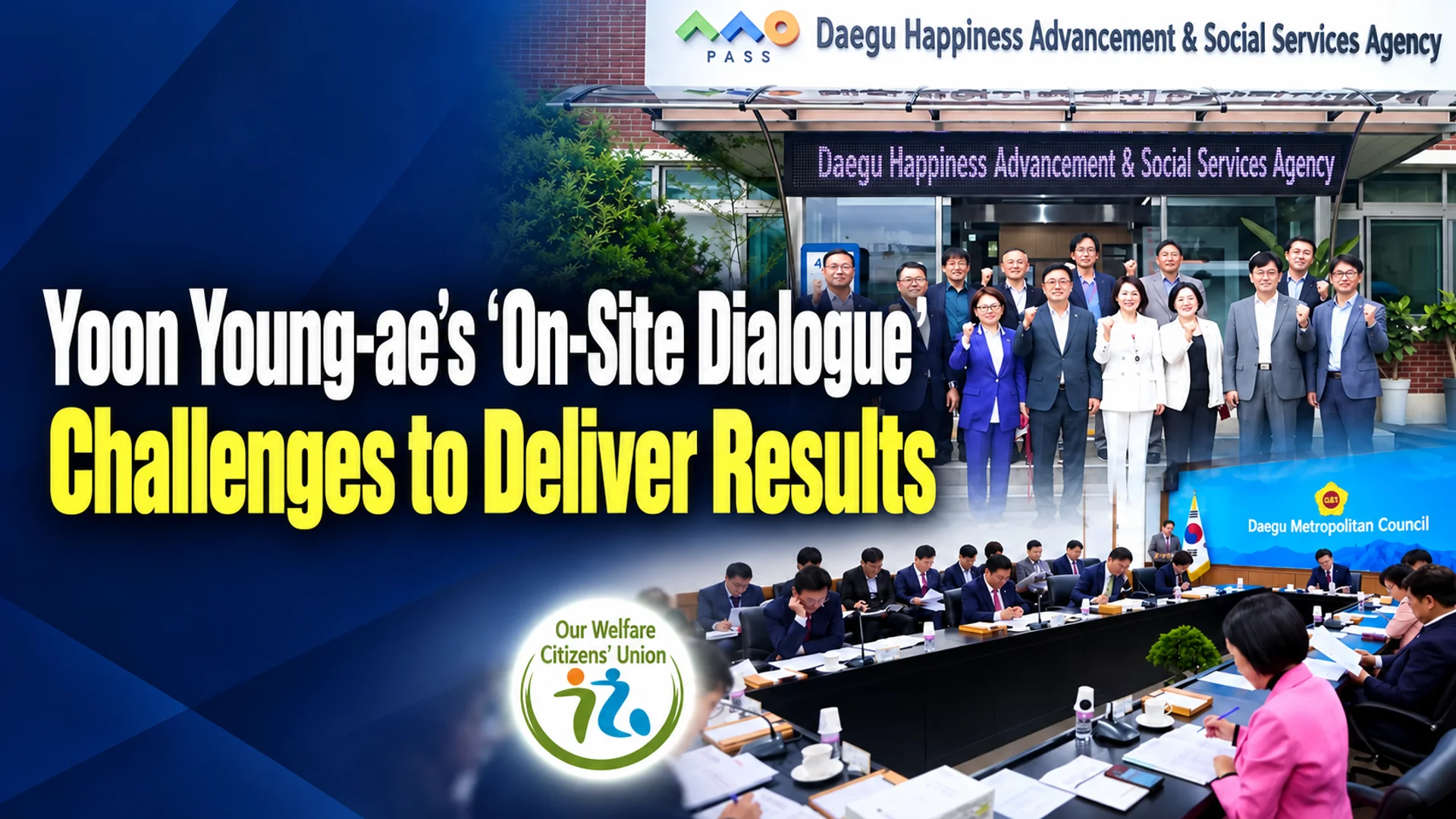
Shinim (newly appointed) Yoon Young-ae, the new president of the Daegu Metropolitan City Happiness Promotion and Social Services Institute (hereinafter referred to as Daegu Happiness Promotion Institute), officially took office after receiving her appointment certificate from Daegu Mayor Chu Kyung-ho on October 28, 2026 1, 2, 3. On her first day, President Yoon forwent a formal inauguration ceremony, instead conducting departmental reviews of key issues and meeting with staff, signaling a practical start to her duties 1, 3. In her inaugural statement, she identified "on-site communication," which involves listening to the voices of citizens and field workers while avoiding formalistic desk administration, and strengthening "citizen-centric, tangible services" as core tasks 1, 2, 3.
President Yoon's vision reflects the current state of Daegu's social service ecosystem and indicates how she will respond to demands for verification and innovation raised immediately after her appointment. This article analyzes the potential impact on the institution of her appointment, given her career spanning both welfare administration and local politics, and examines the specific challenges the field is demanding be addressed.
Opening Statement Focused on On-Site Practical Administration
In her inauguration speech, President Yoon clarified that "the institution's highest mission is to provide customized social services that citizens can practically experience in their daily lives" 1, 2, 3. This is interpreted as a declaration of intent to shift away from the past model of unilaterally providing services predetermined by policy suppliers and toward a "citizen-centered" paradigm that carefully discerns individual citizens' needs 1.
Notably, her actions immediately following the appointment are significant. President Yoon chose internal departmental issue reviews and sequential visits to major affiliated facilities instead of a flashy inauguration ceremony 1, 2, 3. This appears to be a practical implementation of her commitment to communicative administration, aiming to avoid formalistic desk administration and directly hear the voices of citizens and field workers 1, 2, 3.
Furthermore, she views the internal health of the organization as directly linked to the quality of external services. President Yoon emphasized, "We will do our utmost to foster a healthy organizational culture where employees can work with pride, ensuring that this energy translates into high-quality services for citizens" 1, 2, 3. This suggests the president recognizes the need for internal innovation to address the structural problems of the social service sector, where an increasing number of workers are leaving the welfare field due to severe job burnout.
Career Spanning Welfare Administration and Local Politics
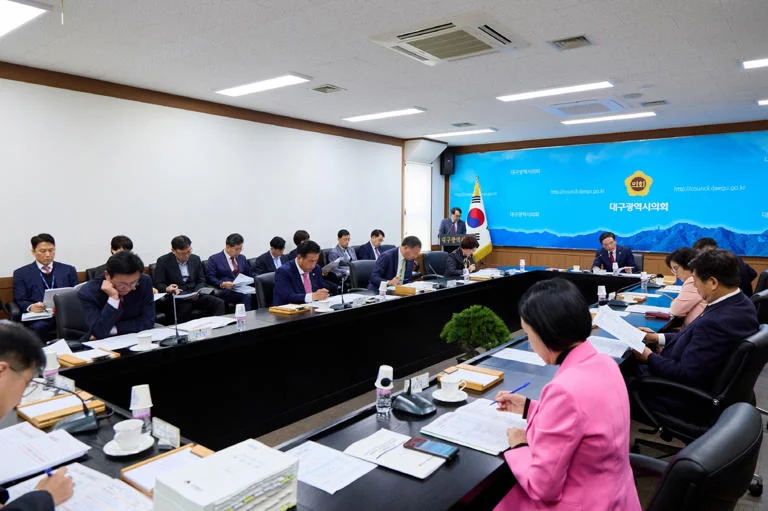
To understand the keyword "on-site" emphasized by President Yoon, it is necessary to examine her background. President Yoon is a scholar who holds a Ph.D. in social welfare and a practitioner who concluded her civil service career on the front lines of welfare administration, serving as Head of the Welfare Support Division and Head of the Resident Living Department at Daegu Nam-gu Office 4, 1, 2, 3. Subsequently, she served as a member of the 8th and 9th Daegu Metropolitan City Council, demonstrating understanding of city administration overall and performing functions of policy formulation and oversight 4, 1, 2, 3.
This background has led to divided interpretations: some view it as possessing dual perspectives—administration that understands the pains of the field and politics that observes city administration—while others raise questions of verification regarding the gap between her stated perspectives and her actual activity history in specific fields during her legislative tenure.
| Category | President Yoon Young-ae's Profile and Career |
|---|---|
| Education | Ph.D. in Social Welfare, Master's in Public Administration 4, 1, 2, 3 |
| Administrative Career | Served as Head of Welfare Support Division and Head of Resident Living Department at Daegu Nam-gu Office 4, 1, 2, 3 |
| Legislative Career | Member of the 8th and 9th Daegu Metropolitan City Council, Chair of the Planning and Administration Committee 4, 1, 2, 3 |
| City Council Standing Committees | 8th term: Planning and Administration Committee / 9th term first half: Construction and Transportation Committee, second half: Planning and Administration Committee 4 |
The crux of the matter lies in whether this administrative and legislative experience can effectively resolve the chronic issues currently facing the Daegu Happiness Promotion Institute.
Civic Groups Raise Questions on Professional Verification and Reward Personnel Controversy

On October 29, the day after the inauguration, the civic group "Our Welfare Citizens' Union" issued a statement raising questions about President Yoon's appointment process and professionalism 4. The group cited the lack of a "history of serving on welfare-related standing committees" during her tenure as a city council member 4.
During the 8th City Council, she served on the Planning and Administration Committee. During the 9th City Council, she was assigned to the Construction and Transportation Committee in the first half and the Planning and Administration Committee in the second half 4. Ultimately, during her eight years as a council member, there was no standing committee activity through which her expertise in the welfare sector could be verified. Consequently, the group expressed uncertainty as to whether the competency required for the president position was sufficiently verified and suspected the possibility of a politically motivated reward appointment 4.
Of course, President Yoon's career serving for a long period as head of welfare departments at Daegu Nam-gu Office is an undeniable administrative foundation. However, the criticism that she did not have her macro-level welfare policy vision and operational capabilities as the institution's head verified through her role as a city council member is acting as initial skepticism regarding whether the president's "on-site communication" vision will translate into concrete execution capability.
Bloated Organization, the Paradox of Consolidation Policy
The most urgent task facing the newly inaugurated president is stabilizing the organization internally. The Daegu Happiness Promotion Institute was launched under former Mayor Hong Joon-pyo by consolidating four institutions into one to improve operational efficiency and cut budgets 4.
However, with the recent transition to Mayor Chu Kyung-ho's administration, a policy to separate the organization back into three institutions has been foretold, significantly shaking the effectiveness of the consolidation policy itself 4. Synergy effects expected at launch are hard to find, and the organization has become bloated while the intent of consolidation is undermined by repeated mid-term resignations of heads, audit findings, controversies over presidential leadership, and entries into politics, drawing criticism 4.
Civic groups urge that for President Yoon's proposal to "foster a healthy organizational culture" to not remain mere slogans, the organization's role and identity must be clearly redefined amidst the confusion of consolidation and separation. They also advised clarifying the institution's role as the control tower for integrated care 4.
| Group's Concerns (Daegu Happiness Promotion Institute) | President's Inaugural Vision and Tasks |
|---|---|
| Policy confusion including re-separation after consolidation, and organizational bloating 4 | Rapid internal organizational restructuring and strengthening of practical administrative systems 1, 2, 3 |
| Controversies over presidential leadership and mid-term resignations of heads 4 | Enhancing employee pride and fostering a healthy organizational culture 1, 2, 3 |
Heewon Conversion Roadmap: To Avoid Ending as an Empty Promise
The issue of "Heewon," a social welfare facility under the Daegu Happiness Promotion Institute, is considered a benchmark for the public nature of Daegu's social services. The Daegu City government previously promised to convert Heewon from a simple residential facility into a "comprehensive welfare town" by 2030 4.
However, according to concerns raised by the group on October 29, clear execution plans or outlooks for this promise have yet to emerge 4. Even if the president calls for "customized social services" that citizens can experience in their daily lives in her inaugural speech, if regional long-standing challenges like the Heewon issue remain stuck in neutral without a concrete roadmap, policy credibility will inevitably decline significantly. Civic groups directly requested that the "Heewon conversion roadmap" be established as a core task by President Yoon and the Daegu City government 4.
Leadership Tested: Turning 'Slogans' into 'Results'
!['Leadership tested: Turning 'slogans' into 'results']](https://blog.inerit.dev/media/posts/7eed4e1e/section_6.webp)
Ultimately, President Yoon Young-ae's keywords of "on-site communication" and "organizational innovation" appear to be a result of accurately diagnosing the symptoms currently afflicting Daegu's social service ecosystem. These include the burnout and lack of communication felt by welfare field workers, administrative waste that citizens fail to perceive, and facility conversion challenges showing no signs of resolution.
However, regional society's gaze toward the new head is a mix of expectation and skepticism, as seen in the professionalism controversy raised by the Our Welfare Citizens' Union immediately after the inauguration or the confusion surrounding the existing consolidation policy. The group warned, "For the on-site communication and organizational culture innovation emphasized in President Yoon's inauguration speech to not remain mere slogans, she must prove her will and leadership through concrete vision and results" 4.
President Yoon starting her first schedule with field department reviews and visits to affiliated facilities may be a positive sign. Now, the crux lies in whether those visits remain formal inspections or translate into specific administrative results that citizens can comprehend, such as finalizing the Heewon conversion roadmap or establishing the role of the control tower for integrated care.
References
- ‘현장·체감복지’ 닻 올린 윤영애 대구행복진흥원장 취임 | 뉴데일리 · tk.newdaily.co.kr↩
- 윤영애 대구행복진흥원장 취임…“시민 체감형 복지 실현” - 더타임즈 실시간 뉴스 · thetimes.kr↩
- 대구행복진흥원, 윤영애 신임 원장 취임… 시민 체감형 복지 확대 시동 - 충청뉴스큐 · ccnewsq.com↩
- 대구행복진흥원장 임명에 시민단체 “전문성 검증 필요”…윤영애 원장, 조직 혁신 과제 직면-브.... · m.dk.breaknews.com↩