Have you ever thought about how science and technology policies around the world are decided, and what ripples those decisions cause in our daily lives?
When many people hear “OECD,” they think of complex reports or difficult economic indicators. However, it is more like a game board where national governments compete to create “rules.”
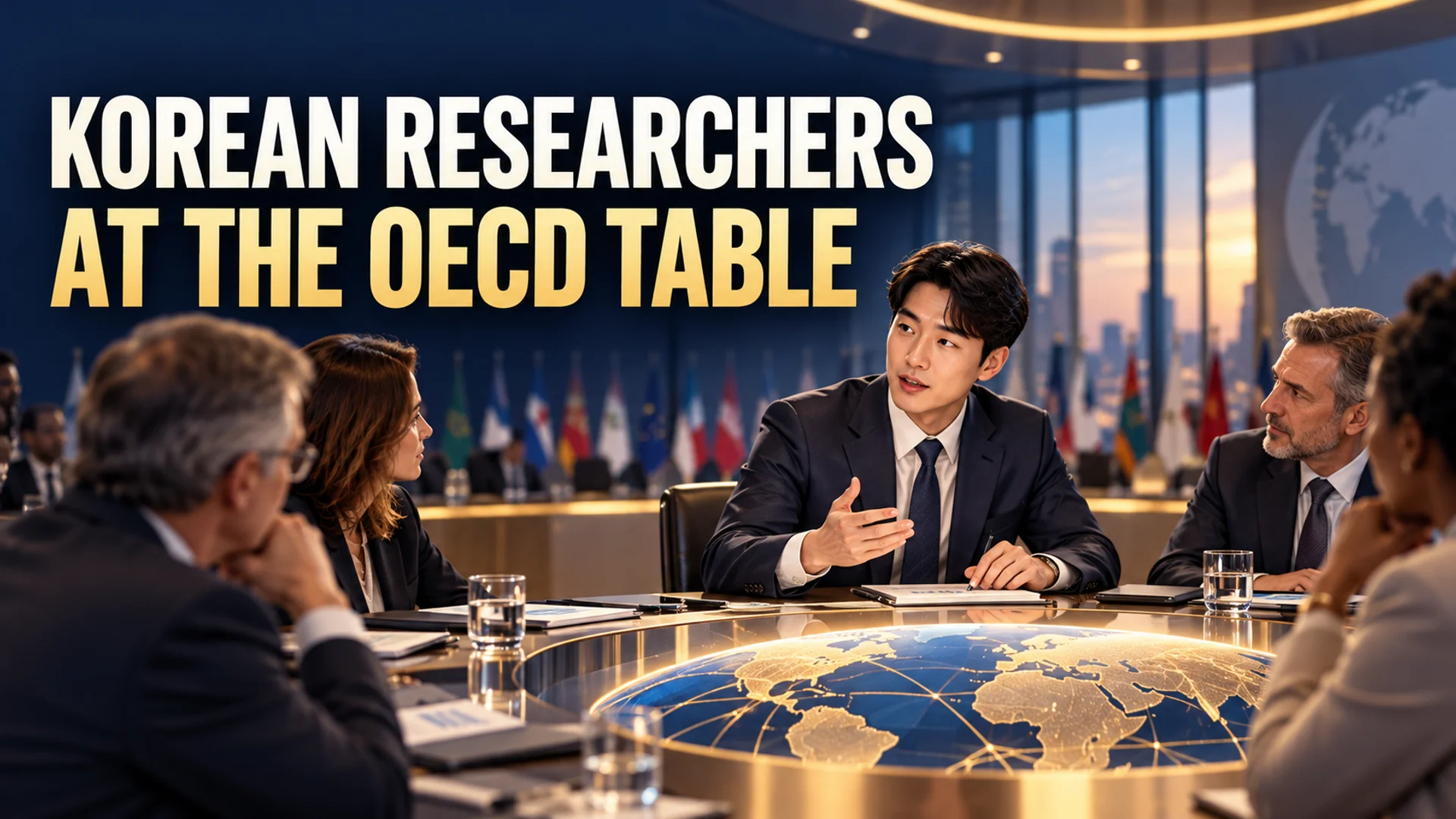
This week, welcome news arrived: the center of that board has shifted slightly closer to Korea. This is because Dr. Myung-wha Lee, Head of the Global Strategy Division at the Science and Technology Policy Research Institute (STEPI), was elected Vice-Chair of the OECD Committee on Science and Technology Policy (CSTP).
This is not just proud news about one Korean holding a key position. Let’s take a closer look at why this is news you should read, and how it will affect your pocket and your children’s future in the long run.
Evolution into a ‘Rule-Setter,’ Not Just an Honor
When hearing the news of Dr. Myung-wha Lee’s election as Vice-Chair of the OECD CSTP, the first word that came to mind was “promotion.”
Until now, Korea’s science and technology policy has primarily focused on “catching up.” The strategy was to analyze standards set by advanced nations, modify them to fit domestic situations, and then adopt them.
However, this election for Vice-Chair suggests that this paradigm is being fundamentally shaken. The CSTP is not merely a forum for sharing information but a core body that oversees policy coordination and direction-setting among member countries.
The position of Vice-Chair involves assisting the Chair and deeply participating in proceedings and major decision-making processes. This means that Korea has begun to pick up its pen and directly intervene in creating the “global standards” we have consumed until now.
Experts interpret this appointment not only as a victory for Dr. Myung-wha Lee’s personal capabilities but also as a result of the global strategic infrastructure STEPI has built.
Policy in the digital transformation era and innovation strategies for sustainable development have long since become global issues. This opens an opportunity for us to establish ourselves not merely as “observers” but as “rule-setters” in this field.
This can lead to an effect where, when domestic researchers or companies face regulatory barriers abroad, they are preemptively cleared through passages rather than merely reacting after the fact. As the flow of policy changes, it is time for our mindset to shift from “receivers” to “participants.”

Why Science and Technology Diplomacy, and Why Now?
As of 2026, we stand in the midst of a massive transition. In an era where Elon Musk decides to borrow $40 billion for AI infrastructure, it has become a global challenge that policy speed fails to keep up with technological speed.
This is precisely why international organizations like the OECD are becoming important again. It has become nearly impossible to solve issues such as global technical standards or data regulations through the efforts of individual nations alone.
The CSTP Vice-Chair role held by Dr. Myung-wha Lee serves as a coordinator to bridge this “speed gap.” This is also the backdrop for why her international joint research project experiences and policy forum leadership, accumulated while leading STEPI’s Global Strategy Division, have been recognized.
Interestingly, the process through which Korea’s science and technology policy gained recognition from the international community was not smooth. In the past, there was considerable criticism that Korea rested on its role as a “Fast Follower.”
However, this election can be seen as evidence that Korea’s policy capabilities as a “First Mover” have been recognized. This is also expected to have positive ripple effects on strengthening the global competitiveness of domestic think tanks.
It is obvious that science and technology diplomacy enhances national brand value, but more specific scenarios are needed for it to be connected to practical national interests.
For example, agendas such as AI ethical guidelines or carbon-neutral technology cooperation plans are discussed first at the CSTP table. If Korean perspectives are reflected here, our companies can reduce compliance costs for relevant regulations and gain an advantage when expanding overseas.
This is why “strengthening OECD-level science and technology policy cooperation systems,” led by Dr. Myung-wha Lee, must not remain a mere slogan. It is a time to check how closely your business management or research plans align with international standards.
How Does Policy Change Our Daily Lives Without Us Knowing?
Many people think of national policies as distant and abstract areas. However, subtle adjustments in science and technology policy have a surprisingly strong impact on your life.
The “innovation strategies for sustainable development” discussed at the OECD CSTP are ultimately directly linked to environmental regulations in our hometowns, energy bills, and job creation in new industries.
If Korea is marginalized in these discussions, we may face situations where we have to unconditionally accept regulatory standards set by other countries. This leads to cost increases, which can ultimately be passed on to consumer prices or tax burdens.
Conversely, if Korea is deeply involved in the policy-making process, like Dr. Myung-wha Lee, there is room to establish buffer devices suited to our circumstances or create favorable exception clauses.
In fact, in recent years, global technology cooperation plans have become a central axis of competition between nations. The reality is that the backbone industries of our economy, such as semiconductors, batteries, and biotechnology, are standing in the middle of international standard wars.
If Korea, as the Vice-Chair country of the OECD CSTP, leads key agendas, an environment will be created where domestic researchers and companies can proactively respond to international standards. This acts as a practical benefit by reducing risk management costs for businesses.
Furthermore, such policy credibility also leads to qualitative improvements in the domestic science and technology ecosystem. This is because expanding international networks means an increase in the influx of outstanding foreign research talent and opportunities for joint research.
When we commonly refer to “diplomacy,” we tend to think of it as the exclusive domain of politicians or diplomats. However, science and technology diplomacy is the frontline of economic warfare. As the flow of policy changes, a new specification—“global policy sense”—may become important for individual careers.
Shadows Behind Success: Issues to Resolve
Of course, this election does not solely mean unqualified “success.” Along with expectations, a cold and critical eye is also needed.
While the influence of the Vice-Chair position is immense, many hurdles must be overcome to translate that power into substantive results. Leadership in international organizations requires not just public speaking skills but highly sophisticated political ability to coordinate the interests of over 30 member countries.
A Western-centric policy inertia still strongly remains within the OECD. It remains to be seen how persuasive the “science and technology policy model leading from developing to developed nations” proposed by Asian countries, particularly Korea, will be.
Additionally, domestic challenges remain. Regardless of Dr. Myung-wha Lee’s capabilities, it is a separate issue whether Korea’s internal science and technology policy is as agile and flexible as international expectations.
If domestic policy is rigid, even if we lead good agendas on the international stage, we may be held back at the actual execution stage. This suggests that strengthening the capabilities of the domestic policy ecosystem must be a prerequisite.
Experts also evaluate this appointment as the “starting point” for participating in global governance. In other words, the true benchmark will be what policy outcomes are actually produced in the next two to three years.
Some critical views may dismiss this as “showcase diplomacy.” However, considering the practical capabilities and insights Dr. Myung-wha Lee has honed while leading the Global Strategy Division at STEPI, these concerns are likely unfounded.
The important thing is for Korea to secure a “permanent” seat in the OECD’s rule-setting process based on this opportunity. The remaining task is not to treat this as a one-time honor, but to turn it into a sustainable network.
Questions That Change Your Perspective
Ultimately, Dr. Myung-wha Lee’s election as Vice-Chair of the OECD CSTP is a signal that Korean science and technology has established itself as a major rule-setter in “global governance.”
This not only aims to improve the quality of domestic policy but also broadens the pathways for our companies and researchers to proactively respond to international standards.
We no longer need to face the waves of policy from the position of “followers.” We now occupy a position where we can adjust the direction of those waves to some extent.
Of course, this change will not immediately alter the numbers in your bank account. However, it provides very important insights for reading the flow of industries and occupations looking ahead 5 or 10 years.
Science and technology diplomacy is an invisible economic war. The fact that the Korean language will be prominently used on that frontline provides not just pride, but practical information.
Now, when you see the word “OECD” in news headlines, please do not just dismiss it as “a difficult international meeting is being held.” I recommend that you contemplate at least once how the regulations and policy trends contained therein will impact your workplace and business.
In which field do you expect Korean science and technology diplomacy to bear fruit first? And how do you see it connecting to your profession or area of interest?
References
- 이명화 STEPI 본부장, OECD 과학기술정책 혁신 주도 · dt.co.kr
- “세계 과학기술 정책결정 주도 ”…STEPI 이명화 본부장, OECD CSTP 부의장 선출 · biz.heraldcorp.com
- 이명화 STEPI 본부장, OECD 과학기술정책위 부의장 선출 · view.asiae.co.kr