"What will happen to me if my job is replaced by AI?"
As AI technology advances at a dazzling pace, this has become a worry that keeps many professionals awake at night. We have entered an era where simple tasks like coding, document writing, and data organization can be completed by AI such as Claude or ChatGPT in just a few seconds.
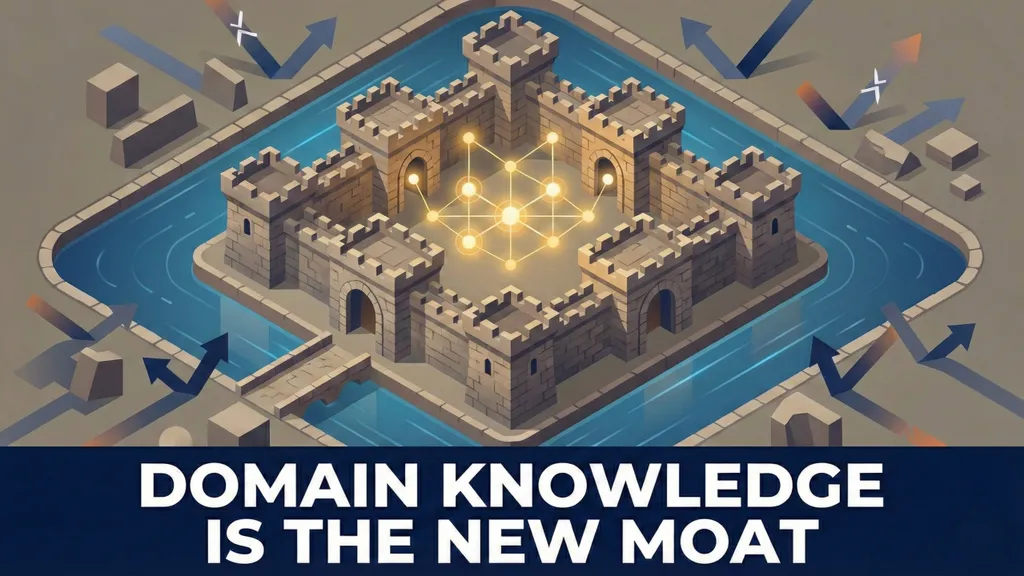
Let me get straight to the point. In the age of AI, what will determine your survival and create a powerful moat that no one can invade is not the AI technology itself, but your 'Domain Expertise'.
While technical skill stacks continue to change, the essence of the business problems to be solved and the industry context remain constant. The 'steering wheel' that decides where to drive the powerful engine called AI can only be held by experts who possess a deep understanding of that specific field.
Why 'AI Generalists' are in Danger: The Fear of Sherlocking
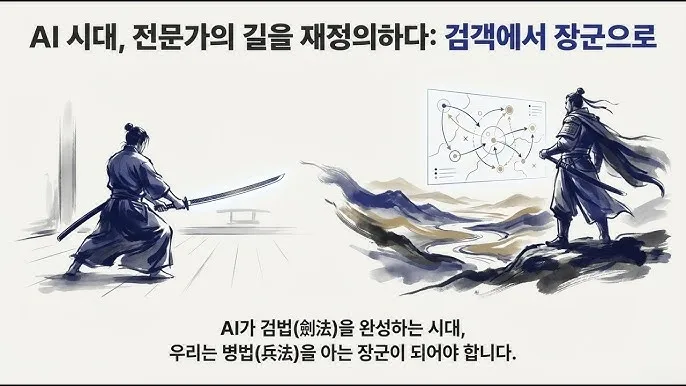
Many people believe that AI can do everything and strive to become 'AI Generalists.' They learn prompt engineering, master all sorts of AI tools, and say, "I am someone who handles AI well." But to be blunt, this is a very dangerous strategy.
This is because if the value you provide remains at the level of a 'document writing assistant' or a 'general coding assistant,' you will have to engage in a head-on battle with tech giants like OpenAI, Microsoft, and Google. These companies can absorb the features you created into their own services in just a single quarter. In the industry, this is called 'Sherlocking'.
Generalists usually rely on 'Explicit Knowledge' available on the internet—information found on the first page of Google search results or manuals organized in blogs. However, the information that actually makes money and determines the success or failure of a business is not recorded on the internet.
For example, suppose you are building a real estate AI service. A general AI would write excellent property descriptions, but true experts find immense difficulty in preparing the 'Disclosure Packet that complies with local municipal regulations'. This process involves complex regulations and notarization procedures, which is an area that requires a perfect understanding of the local legal context, rather than simple text generation.
This undocumented 'Tacit Knowledge' is the 'Dark Matter' of an industry that AI cannot easily mimic, and it is the true fortress you must build.
AI Operates on 'Domain', Not 'Vibe'
Recently, a new term called 'Vibe Coding' has emerged to describe AI producing results that just "feel right" enough. It is very useful when creating prototypes in low-risk environments. However, in domains like enterprise systems, medicine, or finance, where not even a sliver of error is permitted, 'vibe' alone is not enough.
Enterprise AI systems must do more than just be creative; they must adhere to strict governance and deterministic guardrails. This is where the fatal weakness of AI, 'Hallucination', occurs. When AI tells a plausible lie, the person who can immediately recognize and correct that it is wrong within a business context is not a brilliant programmer, but a Domain Expert with deep knowledge of that field.
As of 2026, we must move past the illusion that AI will solve everything. The role of the 'final approver'—the person who judges whether the AI's output aligns with business goals, complies with regulatory guidelines, and matches the actual psychological context of customers—has become even more crucial.
Ultimately, anyone can generate code, but the ability to judge what that code should perform and what impact that result will have in the real world becomes the new competitive advantage in the AI era.
The 'Skill-Opportunity Matrix' for Your Career Growth
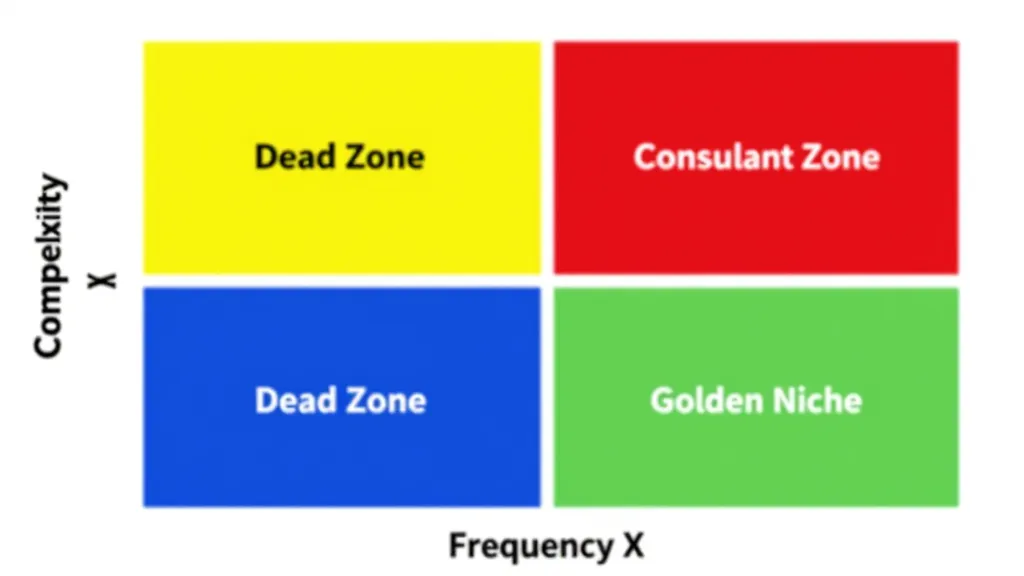
So, in which direction should we move? Vague advice like "just study hard" is not helpful. I recommend that you analyze your work based on the following two axes:
- Complexity: How much unsearchable specialized knowledge is required to perform the task?
- Frequency: How often does an expert perform this task?
By dividing the quadrants based on these two axes, the path we must take becomes clear.
- Low Complexity / High Frequency (Dead Zone): This is the area already automated for free by giant corporations. If you stay here, you are at high risk of being left behind.
- Low Complexity / Low Frequency (Irrelevant): An area that lacks sufficient volume to be commercialized or to build a career.
- High Complexity / Low Frequency (Consultant Zone): An area where data is scarce and difficult for AI to process, which is still handled by high-priced human experts.
- High Complexity / High Frequency (Golden Niche): This is the 'Golden Niche' you should target.
For example, think of tasks such as specialized legal document review, building code compliance inspections, or complex medical coding audits. It is too complex for Google or OpenAI to create features reflecting all these specificities, yet these are repetitive, painful tasks for experts every single day. If you combine your expertise with this area, AI will not be an enemy replacing you, but a powerful assistant that increases your productivity tenfold.
Conclusion: Towards the Synergy of AI Literacy and Domain Knowledge
Now, we must stop asking the unproductive question, "Will AI take my job?" Instead, we must contemplate, "How can I combine my domain knowledge with AI to create irreplaceable value?"
Remember. AI Literacy without domain expertise is career suicide, and domain expertise without AI literacy is corporate suicide.
The winners of the future will not be those who are good at handling technology itself, but 'Integrators' who use technology as a tool to amplify and verify their own deep knowledge. Identify immediately which areas of your work require 'tacit knowledge.' That is where your fortress will be built.
What are the 'secret rules' in your career that AI can never touch and only you know? Let us know your thoughts in the comments!
References
- Paul Hanson's Post - Domain expertise is the moat. · linkedin.com
- Domain Expertise vs AI: The New Moat in the AI Era · linkedin.com
- Your Domain is Your Moat—Why "AI Generalists" are Dying · leanpivot.ai
- Why your domain experience is the only moat that AI can't ... · itbrief.co.nz
- AI만으로는 부족한 이유: 도메인 전문성과 고급 AI 모델의 균형 · kr.linkedin.com
- AI 시대에 도메인 전문가가 되는 것이 가장 중요한 기술일까요? · kr.linkedin.com
- 도메인 전문가란 무엇인가? AI 시대에 대체 불가능한 존재가 ... · xn--design-hl6wo12cquiba7767a.com
- AI 시대, 도메인 전문가의 힘 · jejunews.com