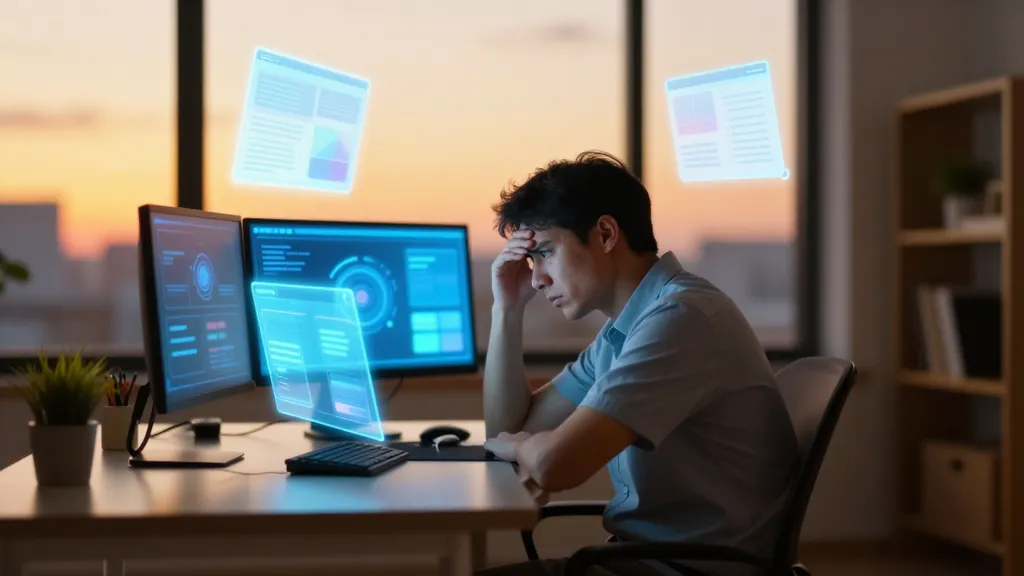
"I've finished work, so why do I still feel watched?"
Even though you've closed your laptop today, are you struggling to rest peacefully because of the ceaseless notifications and "that presence" that feels like it's checking your work efficiency in real-time? In 2026, remote work is no longer an option but a necessity, and at its core lies the "AI Assistant" helping us with our tasks.
Behind the sweet fruit of convenience lies a chilling sense of surveillance, as if someone is constantly watching you. Today, we delve deep into the two faces of AI-driven remote work, unfolding under the name of the "productivity revolution."
A Partner to Aid My Efficiency? Or a 24-Hour Monitor?
The vision we had when starting remote work was clear: to achieve peak performance by concentrating in our most comfortable spaces without the waste of commuting. However, the reality of 2026 is slightly different. Many companies are mandating the introduction of "AI Assistants" to maximize efficiency.
These AIs have gone beyond simply organizing schedules. They read facial expressions during video conferences, analyze typing speeds, and even monitor in real-time whether we deviate from work-related websites. Particularly in industries where security is paramount, such as call centers in the financial or public sectors, these AI-based monitoring systems are already deeply embedded.
Here, we must ask a fundamental question: Is this technology truly an "assistant" helping my work, or a "digital monitor" recording my every move?
This is the root cause of the psychological pressure felt by many remote workers. The continuous recording and monitoring performed under the pretext of increasing work efficiency erodes worker autonomy and causes chronic stress, feeling as though one is being whipped without a moment to breathe. Instead of the assurance of "doing well," the anxiety of "not getting caught" takes precedence.
Why We Can't Rest Even at Home: The Clash of Technology and Psychology
Then, why does remote work in 2026 feel more exhausting than traditional office work? The cause is not merely "all in your head." A combination of technological and psychological factors is at play.
First, there is the collapse of boundaries. With the disappearance of the physical "ritual" of commuting, our brains face great difficulty in switching between work mode and rest mode. Even after work ends, we unconsciously revert to work mode by looking at AI assistant notifications or the accumulation of work efficiency data.
Second, there is the increase in Virtual Fatigue. An environment where one must constantly be conscious of others' gaze through video conferencing consumes much higher cognitive energy than offline interactions. The pressure to read even the slightest changes in another person's expression causes extreme mental exhaustion that goes beyond mere "Zoom fatigue."
Third, there is the opacity of algorithms. The process of how AI evaluates my work performance or the criteria it uses to measure my efficiency is hidden like a "black box." When workers cannot find clear reasons for why they received a low score or why a task was judged as delayed, they feel distrust and helplessness toward the technology.
Ultimately, behind the productivity gains brought by AI technology, there are massive holes left by the lack of data privacy and psychological safety.
A 3-Step Roadmap to Catch Two Birds: Productivity and Human Rights
To solve this problem, we must not simply oppose the introduction of technology, nor should we choose unconditional acceptance. While technology can be neutral, the way it is applied depends on our choices. We propose a step-by-step solution necessary for a sustainable remote work culture.
Step 1: Establish Transparent Algorithms and Data Governance
The first priority must be ensuring the transparency of AI monitoring. Companies must clearly explain to workers what data the AI collects and what criteria it uses to measure performance. It is essential to implement "Explainable AI (XAI)" technology to provide a system capable of presenting the basis for its results. Furthermore, strict data governance must be established to ensure that collected data is not used for purposes other than its intended use (e.g., excessive surveillance or unfair personnel actions).
Step 2: Prepare Legal and Ethical Safeguards for Digital Rights Protection
Individual privacy is a fundamental right with constitutional value. Governments and policymakers must redefine labor standards in line with the pace of technological advancement. Following the spirit of a "Digital Bill of Rights," they must prohibit excessive data collection without worker consent and establish legal remedy procedures to prevent discrimination that may arise from AI decisions. It is time to mandate "Human Rights-by-Design" so that AI remains a tool to complement capabilities rather than a tool to replace or control humans.
Step 3: Guarantee the "Right to Disconnect" at the Organizational Level
A redesign of corporate culture itself is necessary. Systems should be put in place to institutionally guarantee digital detox periods, such as blocking AI notifications or pausing the use of digital devices after work hours. Instead of converting work efficiency into mere "numbers," companies must transition to a "human-centered management model" that considers the mental health and psychological state of workers.
Conclusion: Ultimately, Humans are the Masters of Technology
Remote work in 2026 presents us with a massive turning point. AI assistants have certainly revolutionized our work and created a wide stage for collaborating with global talent. However, for that stage not to become a prison that constrains us, we need the wisdom to prioritize human dignity over technological efficiency.
Ultimately, the key is social consensus. Companies, governments, and workers must raise their voices together so that AI becomes a partner that maximizes our potential rather than a surveillance tool that weakens worker autonomy. No matter how fast the pace of technology, the steering wheel that determines its direction must still be held by us humans.
What do you think about the current AI-based work environment? Is it a convenient assistant, or an uncomfortable monitor?
Please share your thoughts in the comments!
References
- 공공ㆍ금융 콜센터 AI 도입 현황과 문제점 노동조합의 과제 연구 · idr.jinbo.net
- 2026년 사이버 보안 위협 트렌드 전망 및 대응 | 인사이트리포트 · samsungsds.com
- 윤보성, 진회승 - 소프트웨어정책연구소 · spri.kr
- 인공지능 개발과 활용에서의 (AI) 인권 가이드라인 연구 최종보고서 ( ) · humanrights.go.kr
- 2024 개인정보 이슈 심층 분석 보고서 · privacy.go.kr
- 디지털 권리장전 해설서 · oecd-opsi.org
- 인공지능 전환과 노동법의 대응 과제 - 노동법률 · worklaw.co.kr
- 20. 재택근무와 심리적 변화: 원격 근무가 정신 건강과 생산성에 미치는 ... · blog.naver.com