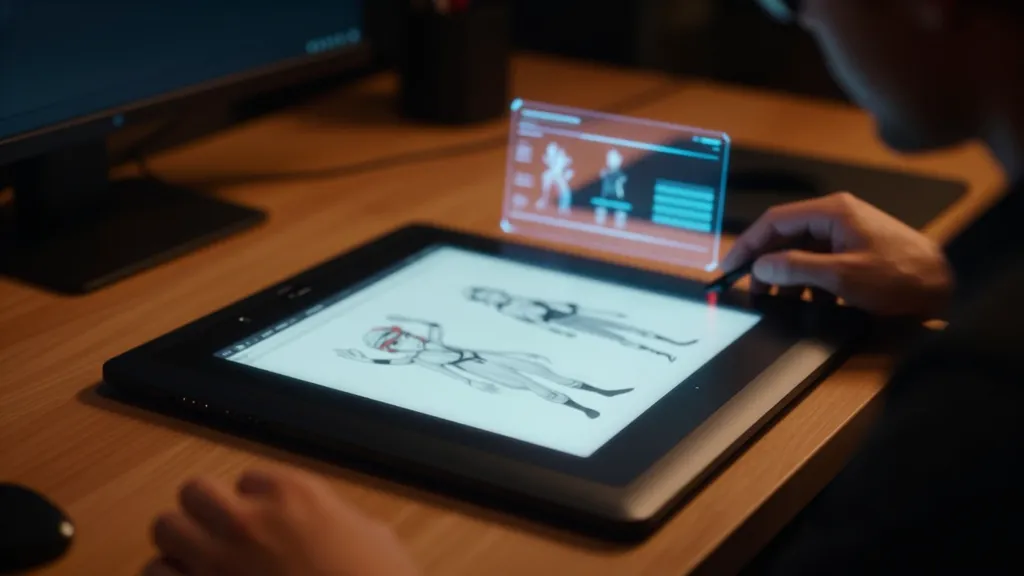
As of 2026, AI is no longer a novel technology but has become an essential 'tool' in the animation production field. However, paradoxically, as the speed at which AI drafts compositions and fills in backgrounds increases, the authority and value of the 'Animation Director,' who determines the quality of the final output, is becoming stronger than ever.
While anyone can use the skill of generating images simply by inputting prompts, what breathes life into that result as a 'work of art' is ultimately human aesthetic judgment and control. In today's post, we will take an in-depth look at the current state of the copyright wars brought about by AI technology and identify the talent that will survive within the changing industrial structure.
The Runaway Technology and the Clash of Copyright: Why Ghibli Protested Against OpenAI
The animation industry is currently in the midst of massive turbulence. The protest letters sent by the Japanese animation industry, including Studio Ghibli, to OpenAI (Sora 2) starting from late 2025, were not merely an emotional response. It was a survival strategy for the industry to establish a massive defensive line called 'creative ethics.'
There is a common misunderstanding: "Why is it a problem if AI learns from the drawings of existing artists?" The core issue lies in 'unauthorized learning.' Because the process of an AI model absorbing styles and compositions without the consent of creators while learning from hundreds of millions of images is no different from plundering a creator's soul in the name of data.
The global market is currently fighting fiercely to resolve this issue.
- USA: Legal battles are ongoing regarding how far AI learning will be permitted under the principle of 'Fair Use.'
- EU: Through the 'AI Act,' while acknowledging exceptions for data mining, they have specified the 'opt-out' right, allowing creators to refuse the use of their works for training.
- China: Taking a different path from the US, they are recognizing originality if human intellectual effort is involved.
Under this pressure, OpenAI is also seeking change by introducing an 'Opt-in' policy, where learning is only possible if the rights holder explicitly consents. In a situation where the speed of technology outpaces law and ethics, we have entered an era where creators must even possess legal knowledge to protect their own styles.
Who Owns AI-Generated Content? The New Boundary of Copyright
"AI-drawn pictures have no copyright?" This statement is half true and half false. According to the 2025 guidelines from the US Copyright Office (USCO), outputs generated 100% by AI without human intervention are considered to be in the 'public domain.' This means it is difficult to legally prevent anyone from using them.
However, the variable of 'human creative contribution' emerges here. If a human utilizes AI as a tool to select, arrange, and retouch the results to apply their own unique style, the story changes. At that point, it becomes a 'copyrightable work' that can be protected.
We can gain an important insight at this juncture. A 'prompt engineer' who simply commands, "AI, draw this," will find it difficult to hold copyright. However, a 'director' who critically reviews AI outputs and reconstructs them through their own aesthetic perspective can secure strong copyright. Ultimately, as technology advances, the core issue of copyright will be 'who holds the final control' rather than 'who issued the command.'
Vanishing Roles, Emerging Talent: The Rise of the 'Hybrid Creator'
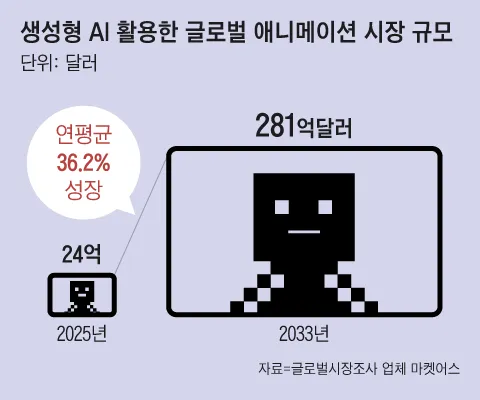
As the animation production process becomes ultra-fast due to AI, the occupational landscape is being completely reshaped. According to a 2026 research report by the Korea Creative Content Agency, many existing roles performing simple repetitive tasks are under threat of automation. At the same time, however, new fields such as 'AI-collaborative creators' and 'data-driven storytellers' are opening up.
The talent the industry now seeks is not simply 'someone who draws well.' It is 'hybrid talent' capable of combining technology and art.
- AI Literacy: The ability to handle AI tools proficiently to reduce task time.
- Critical Aesthetic Judgment: The ability to pick out and refine which of the numerous results spat out by AI is a 'masterpiece.'
- Adherence to Ethical Guidelines: The ability to exercise creativity within legal boundaries while avoiding copyright issues.
In the case of Japan, generative AI is already being extensively introduced into concept planning, storyboarding, background art, and even dubbing, forming a market of a record-breaking 13 trillion yen. Those who will win here are not those who fear AI, but the hybrid experts who handle AI like their own 'fingertips.'
Redefining the Role of the Animation Director: Why Their Value is Increasing
Then, why must we speak of the importance of the 'Animation Director' once again?
No matter how brilliantly AI draws backgrounds or creates smooth characters, it is nearly impossible for it to maintain the 'Tone & Manner' of the entire animation or to consistently lead the character's emotional arc. This is because AI merely predicts the next pixel based on statistical probability; it cannot understand or intentionally direct the subtle tremors caused by an emotion like 'sadness.'
The Animation Director of 2026 is not merely someone who traces lines.
- The final inspector (Curator) who filters AI outputs.
- The quality controller (Quality Controller) who catches AI errors (Artifacts).
- The artistic conductor (Conductor) who connects technology with human sensibility.
Ultimately, the role of the Animation Director in the AI era is evolving from 'the person who draws' to 'the person who decides.' While technology is responsible for productivity, humans are responsible for 'value' and 'direction'. In an era where production volume can increase infinitely, the insight of a single person who decides what is "good" becomes inevitably more precious.
Conclusion: How to Ride the Wave of Technology
The animation industry of 2026 is like a massive laboratory where chaos and innovation coexist. While copyright disputes and ethical debates are still ongoing, the unstoppable flow of technology is already creating new standards for creation.
To summarize what we have examined today:
- AI is reshaping the boundaries of copyright, and human creative contribution becomes the key to copyright protection.
- Not simple technicians, but talent with 'hybrid creativity' who can command AI as a tool will lead the market.
- As technology advances, the insight and decision-making power of the Animation Director, who controls the overall artistic completeness, becomes even more valuable.
Ultimately, the important question is not the fear of "Will AI take my job?" but rather, "How will I tame AI to be a tool that expands my artistic horizons?" This is because even if tools change, the intention and sensibility of the human using that tool will remain an irreplaceable value.
Between a perfect image drawn by AI and a clumsy drawing drawn by a human, which work moves your heart more? We are curious to hear your thoughts!
References
- 2026년 트렌드 AI 그림 저작권, 지금 몰라서 손해보는 해결 ... · wikidocs.net
- 지브리와 OpenAI, 그리고 'AI 윤리' 논쟁 일본 애니 업계가 ... - Instagram · instagram.com
- AI환경에서의 콘텐츠산업 인재양성 방향 및 차별화 방안 연구 · nsp.nanet.go.kr
- 이미지생성AI시대 애니메이션학과의 교과·비교과 운영 안 연구 · koreascience.kr
- 일본 콘텐츠 산업에서의 생성형 AI 활용 현황 및 트렌드 - 디자인DB · designdb.com