
South Korea's care policy in 2026 is signaling a fundamental shift in direction in the face of the overwhelming statistical reality of "one-person households." At the core is not merely a simple issue of poverty, but the loneliness and social isolation experienced by the middle-aged and elderly resulting from severed relationships.
1. The Gap Between Statistics and Reality, and the Structure of Loneliness One-person households registered on the resident registry number 10.27 million, accounting for 42.27% of the total, but those aggregated by actual residence stand at 8.24 million households (36.6%). The gap of 2.03 million people is due to the "household separation" procedure for housing subscription lotteries and tax benefits1.
In the daily lives of these massive "one-person households," eating alone (honbap) and drinking alone (honsul) are naturally integrated. It is clear that "the act of eating and drinking alone" has established itself as a cultural trend. However, the reality of loneliness shown by the statistics is not entirely romantic. According to the "2025 Statistics on Single-Person Households" published by Statistics Korea (the National Data Department), 48.9% of single-person households in 2024—nearly half—answered that they felt lonely2. In particular, 48.8% of single-person households among the middle-aged and elderly (ages 40–59) feel lonely, a figure 10.4 percentage points higher than that of multi-person households (38.4%)3.
A New Risk Group for Solitary Deaths: Middle-Aged Men, Between "Youth and the Elderly"
Solitary deaths are traditionally viewed as a problem affecting the elderly, but among the 3,924 deaths from solitude in 2024, those aged 50–69 accounted for 2,468 people (62.9%)1, 3. In particular, 81.7% of the deceased were male3, leaving middle-aged and elderly single-person households in a legal blind spot between youth and old age3.
"Economic poverty" is often cited as the primary cause of death by solitude, but the data does not support this. Only 41.4% of those who died by solitude were recipients of the Basic Livelihood Security Program4, and although the poverty rate for elderly women (45.0%) is higher than that for elderly men (32.6%), the absolute majority of those who died by solitude are male1. As workplace-centered social networks collapse with retirement, isolated "eating and drinking alone" emerges as an indicator of sustained isolation.
The First Discoverers Are Not Family: Reconstructing Physical Encounters
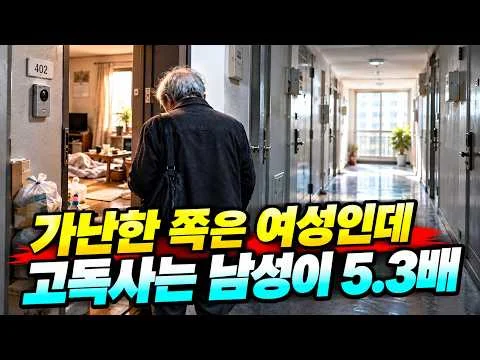
The reason preventive policies for solitary deaths are placing all emphasis on "physical welfare checks" is clear. In 2024, only 26.6% of those who died by solitude were discovered by family members, while housing management personnel, such as landlords and building managers, accounted for the highest proportion at 43.1%1. This means that the "frequency of physical encounters" is a more critical variable determining life or death than the density of relationships.
This connects to the question of how to incorporate the private act of "eating and drinking alone" into public safety zones, as it is necessary to detect subtle signs of disconnection even in spaces where people enjoy meals or drinks alone.
The Evolution of "Non-Contact Care": Technology-Based Networks

Local governments are densely constructing technical safety nets utilizing IoT and AI to identify disconnections in daily life.
- Suwon City's "Smart Care Plug": Connected to appliance plugs, it detects changes in power usage and light levels. If no signal is detected, AI automatically checks on the resident's well-being, and if there is no response, it immediately notifies the caseworker of a potential danger. Since May 2026, 200 units have been distributed and are operating in 44 administrative districts (dong)5.
- Osan City's "Together on, Smart on Service": It analyzes complex data in real time, including front door and refrigerator openings, mobile phone activity logs, and step counts. It was first introduced in Gyeonggi Province in September 20256.
- Daegu Se-gu's "AI Abnormal Sound Analysis": This district was the first in Daegu to introduce a method that analyzes abnormal sound sources, such as screams or impact noises occurring in isolated environments, to detect emergencies early7.
The adoption of technology provides a pathway to verify a "living signal" 24 hours a day, transcending the manpower limitations of caseworkers.
A Shift in Institutional Paradigms: From Solitary Death to Social Isolation

A major tectonic shift is occurring at the forefront of policy. The Ministry of Health and Welfare plans to fully revise the current "Act on the Prevention of and Management for Solitary Deaths" into the "Act on the Prevention of Social Isolation" by the second half of 2026, with implementation starting in 20278. This expands the policy target beyond simple at-risk groups for death to cover the broader spectrum of social isolation risks.
The government is currently operating a "Solitary Death Crisis Response System" that analyzes 27 types of crisis information, including alcohol use disorders and arrears. It investigated 80,000 people and identified 40,000 at-risk individuals in the first half of 2026 alone8. Incheon City is also transitioning to an integrated care system for returning to society using AI and IoT technologies, while Seoul City has built a new urban model for addressing loneliness that has garnered attention from foreign media (France 24)9, 10.
Conclusion: Infrastructure for Solidarity Toward a "Solitude" Without Loneliness
In 2026, society is redefining the loneliness inherent in the daily lives of one-person households as a structural societal issue. It is not possible to neglect the reality faced by 8.04 to 10.27 million households by treating it as simply "an era of eating and living well alone"2, 1. Now that single-person households have exceeded 10 million, society's infrastructure must be redesigned to prevent "isolation."
The connection where restaurants serving solo diners and bars catering to solo drinkers link with quiet apartments to check on each other's well-being would likely be a realistic solution to reduce the 43.1% of discoveries by "landlords and building managers" and alleviate the 48.8% "loneliness among the middle-aged and elderly." A dense network where technology detects signals, law expands the scope of targets, and neighbors verify existence will be the new infrastructure of mutual survival that enables a "solitude" free from isolation.
References
- 1인가구 1,027만 시대, 고독사 3,924명을 갈라놓은 건 가난이 아니었습니다 · youtube.com↩
- 2026 사회적 고립 통계 - 외로움과 모임의 역할 | 온모임 · onmoim20.connect-offline.com↩
- 중장년 1인가구의 외로움, 왜 청년도 노인도 아닌 사각지대에 있을까? | 요모조모 · yomojomo.kr↩
- '1인 가구'로 인한 고독사 사망자 증가 ··· 2024년 고독사 실태조사 · m.blog.naver.com↩
- 수원시 사물인터넷(IoT) 기반 ‘스마트돌봄플러그’ 사업 본격 추진한다 · newslink.kr↩
- 오산시, 경기도 최초 통합구성 고독사 방지 서비스 개시 - 뉴스링크 · newslink.kr↩
- ▢ 사업명 : 21-2. AI 활용 고독사 예방 및 스마트 돌봄 추진 · dgs.go.kr↩
- '사회적 고립 예방', 정책 대상 넓힌다|정책 바로보기 · youtube.com↩
- 인천시, 고독사 예방 넘어 ‘사회적 고립 예방’본격화 - 국민TV · kukmintv.tv↩
- [연재 기사-하] '이웃사촌의 부활', 일본·유럽의 고독사 방지 선진 사례에서 배우는 대안 · thenewsmedical.co.kr↩