
"Can I really leave work at 2 PM this Friday?"
As of May 2026, this is the question heating up group chats among South Korean office workers. The reason is that the "4.5-day work week"—a magical phenomenon where the entire Friday afternoon disappears while salaries remain the same—is becoming a reality, backed by unprecedented government support.
For some, it is the realization of a long-dreamed-of work-life balance; for others, it feels like an uncertain challenge that threatens corporate survival. Today, we will take a deep dive into the current state of this hot-button issue, the 4.5-day work week, and the choices our society must face.
1. The 'Dream of Friday Afternoons' Becomes Reality: Current Progress
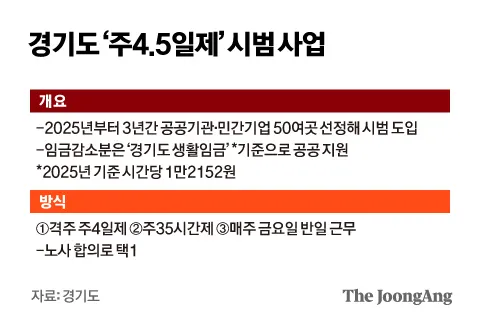
Change is happening even at this very moment. In 2026, the government is investing a staggering 32 billion KRW budget to promote the expansion of the 4.5-day work week. Rather than simply saying "take a rest," the government is directly providing subsidies of up to 800,000 KRW per person per month to help small and medium-sized enterprises (SMEs) reduce working hours without cutting wages.
In particular, 106 companies in the Gyeonggi province area are already realizing 'early Friday departures' by receiving these exceptional benefits. This is moving beyond simple welfare and establishing itself as a strategic choice for companies to retain talent.
However, not all companies can participate in this celebration. Currently, these benefits are targeted at SMEs and middle-market enterprises with fewer than 300 full-time employees, and above all, they must meet the strict condition of 'reducing working hours without wage cuts.' In essence, a sophisticated policy experiment is underway where the government takes on the burden of labor costs to improve the quality of life for workers.
2. At a Crossroads: Comparison of Three Models Surrounding the 4.5-Day Work Week
Not all 4.5-day work weeks look the same. Depending on the industry, size, and operating method of a company, the available models differ significantly. Let's compare the three representative models currently under discussion.
Model A: Standard 4.5-Day Week (Friday Afternoon Exit Type)
This is the most intuitive and popular model. Employees work as usual from Monday to Thursday, and on Friday, they either work only in the morning or leave at 2 PM.
- Pros: The sense of efficacy felt by employees is very high. Since time for self-development or family is guaranteed on Friday afternoons, job satisfaction and company loyalty soar.
- Cons: If working hours are reduced without a corresponding reduction in workload, the work density during weekday hours may become excessively high, potentially leading to burnout.
Model B: Compressed Work Week (4-Day Intensive Type)
This method involves cramming the 40-hour work week into 4 days. For example, working 10 hours every day from Monday to Thursday and taking Friday off completely.
- Pros: Since the entire Friday can be used as a holiday, it allows for a 'perfect 3-day weekend.' It is attractive to professions that involve frequent travel or long-distance movement.
- Cons: Working 10 hours a day is physically demanding. Furthermore, if partners or clients operate on a 5-day schedule, work gaps and communication disruptions emerge as serious issues.
Model C: Flexible Work Week (Autonomous Choice Type)
Preferred by IT companies and startups, this method allows employees to adjust their own hours as long as they adhere to "Core Time."
- Pros: It provides extreme autonomy tailored to individual lifestyles. It is most advantageous for building a productivity-oriented culture.
- Cons: From a manager's perspective, they may fall into the 'performance management dilemma' of how to evaluate employees who are not visible. Additionally, in professions where collaboration is crucial, matching schedules among members becomes very difficult.
| Category | Standard (Friday Afternoon Exit) | Compressed (4-Day Intensive) | Flexible (Autonomous Choice) |
|---|---|---|---|
| Perceived Rest | Medium (Friday afternoon) | High (Full Friday) | Very High (Autonomous) |
| Work Intensity | High (Requires focus) | Very High (Physical exhaustion) | Low (Autonomy-focused) |
| Suitable Industry | General office, Service | R&D, Professionals | IT, Startup, Design |
3. Stark Difference in Temperature: "Welcome" vs. "Concern"
Views between the business community and the labor sector are starkly divided regarding the introduction of this system. It is a situation akin to hot fire clashing with cold ice.

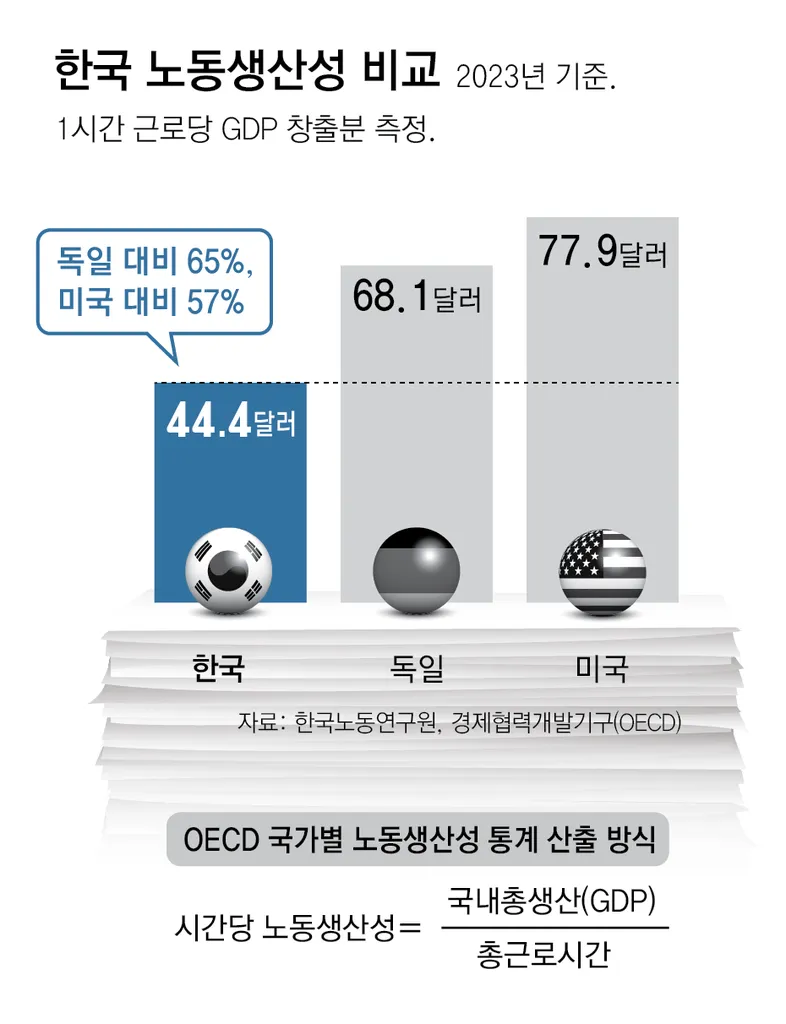
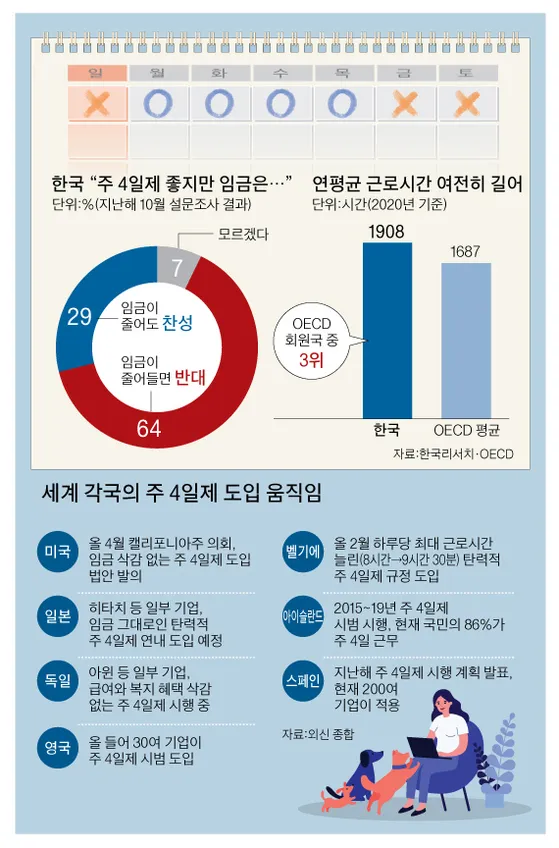
The voice of those welcoming it: "It is an opportunity for productivity innovation" Proponents point out that South Korea's working hours are much longer than the OECD average. They argue that sitting for long hours does not necessarily mean work is being done well. Looking at cases of leading companies like Samsung Electronics or SK Hynix, results show that when working hours are managed flexibly, employees' creativity and immersion actually increased. In other words, they argue that the 4.5-day work week should not be a reduction in labor hours, but a 'smart transition in the way we work.'
The voice of those concerned: "Corporate competitiveness will crumble" On the other hand, the business community is crying out. Particularly in industries like manufacturing or logistics, where facility utilization is vital, a reduction in working hours directly translates to decreased production and falling sales. Realistic warnings also arise, such as, "If we reduce only the hours while keeping wages the same, the burden of labor costs will eventually increase, leading to corporate bankruptcy." In fact, there have been cases, like the past example of Eduwill, where companies experienced turbulence and returned to a 5-day week after introducing the system without supporting productivity.
Furthermore, a variable that cannot be overlooked here is the massive wave of the 'abolition of the fixed overtime pay system (Comprehensive Wage System).' Currently, the government is attempting to prohibit the fixed overtime pay system in principle. If the 4.5-day work week and the abolition of the fixed overtime pay system coincide, the burden of overtime pay and labor costs that companies must bear could be greater than imagined.
4. Expert Advice: A 3-Step Strategy for Successful Settlement
In such a confusing situation, what path should companies choose? Simply following what others are doing is dangerous. Experts recommend a 'step-by-step approach' as follows.
First, 'Work Redesign' must come first. Reducing only time is not 'compressing work,' but 'creating work overload.' Unnecessary meetings, formal reporting procedures, and inefficient administrative processes must first be cleared through Digital Transformation (DX) or the introduction of AI. In other words, a 'systemic stamina' must be built first so that the same results can be achieved while working less.
Second, the organizational structure must be improved through 'result-oriented performance evaluation'. The era of questioning "what time did they arrive and what time did they leave" is over. For the 4.5-day work week to settle, a performance-based evaluation system centered on "what kind of results were produced" must be established. If the mindset of managers does not shift from 'surveillance' to 'trust and support,' this system is bound to fail.
Third, an 'industry-specific customized model' must be adopted. Applying the same standard to all companies is unfair. Companies should wear clothes that fit their own corporate DNA, such as IT companies choosing the flexible model, manufacturing choosing the rotating shift model, and service industries choosing a flexible model combined with AI automation.
Conclusion: Can We Catch Both Rabbits: Work-Life Balance and Productivity?

Ultimately, the 4.5-day work week is not just a simple 'expansion of rest,' but a massive question of 'how we will redefine the labor paradigm of our society.'
The government must refine support measures to ease the cost burden on companies, companies must find innovative ways of working to prevent productivity loss, and workers must prove their level of immersion equivalent to the reduced time. Only when these three wheels interlock and turn can the 4.5-day work week become a 'blessing' rather than a 'poisoned chalice.'
What do you think? Will the freedom of Friday afternoons become a source of vitality for our economy, or a burden that holds companies back?
How is your company or industry preparing for this change? Please share your opinions freely in the comments!
References
- 월급 그대로 '주 4.5일제' 진짜 시작됐다고? 직장인들의 평생 소원 ... · instagram.com
- “주4일제 하다가 포기했어요”...재계가 근로시간 단축 실험 그만둔 ... · mk.co.kr
- 주 4.5일제 도입, 더 이상 미룰 수 없는 과제다 - 오마이뉴스 · ohmynews.com
- 주 4.5일제 도입의 현실과 향후 법개정 과제 - 자유기업원 · cfe.org
- 인사담당자를 위한 주 4.5일 근무제 도입 매뉴얼(+ 주 4일제 사례) - 샤플 · shoplworks.com
- 주 4.5일제 근무 추진! 우리 회사에 맞는 모델은? 산업·기업 규모별 ... · biz.giftishow.com
- 주 4일제·4.5일제 도입, 정부와 기업의 선택인가 필수인가? - 모카클래스 · mochaclass.com
- 주 4.5일제 시행 및 포괄임금제 폐지? 기업 미칠 영향은 · daeryunlaw-comp.com