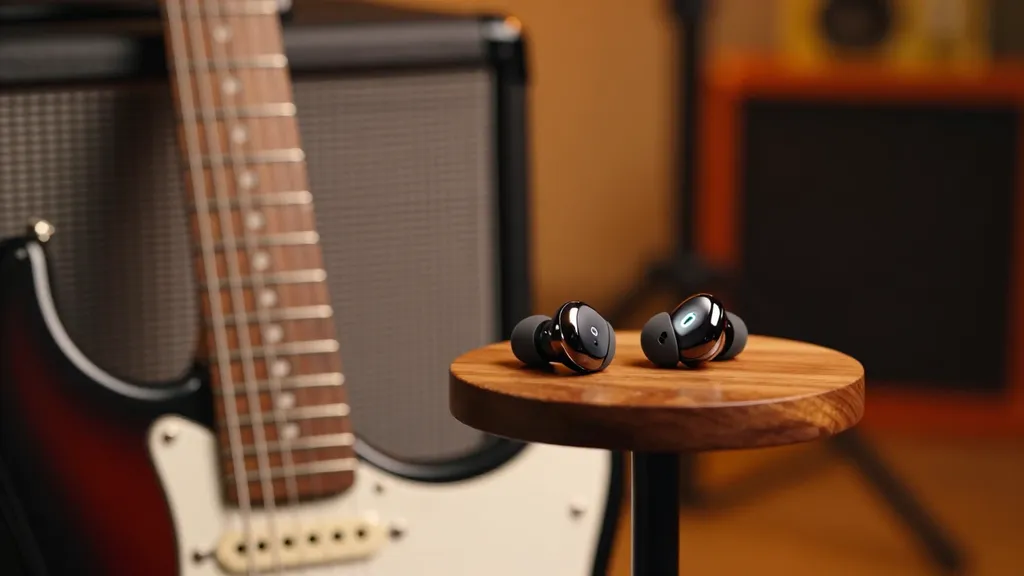
The sound of an amp breaking the silence of a practice room, and that subtle difference in tone felt when listening back to a track you just recorded. For a guitarist, sound is not just music; it is a detail directly linked to survival.
However, the moment we step out into the street, we face a harsh reality. The loud honking and the murmur of crowds instantly smear the resonance of that delicate guitar riff you heard in the studio just moments ago.
"Is there really no wireless earbud that can maintain studio resolution while perfectly erasing street noise?" To answer this question, we will thoroughly dissect the market-leading products of 2026 from a guitarist's perspective.
Why Wireless Earbuds Struggle to Become 'True IEMs'

Before we dive into the comparison, we must first correct some terminological confusion. Recently, marketing trends tend to label anything that goes in the ear as an 'IEM (In-Ear Monitor),' but from an audio engineering standpoint, this is a very dangerous approach.
A true IEM is a tool designed for performers to monitor their own instrument's sound in real-time at concert venues or studios. The most critical core factor here is 'latency.' No matter how much Bluetooth technology advances, a minute transmission delay is inevitable due to physical limitations.
It is practically impossible for a guitarist to perform picking without latency while wearing wireless earbuds. Therefore, the product we are looking for is not a 'wired IEM for studio monitoring,' but rather 'wireless earbuds that reproduce studio timbre as closely as possible while being convenient for daily use.' You must view products through this lens to avoid a failed purchase.
Comparative Analysis of Major Alternatives in the 2026 Wireless Earbud Market
The current market is divided into three main directions: premium lines aiming for overwhelming sound quality, all-rounders focusing on daily convenience and noise canceling, and budget-friendly models pursuing extreme cost-effectiveness.
1. The Pinnacle of Premium: Perfect Balance of Sound and Function
The first model to examine is the Galaxy Buds4 Pro, which is hard to resist for Galaxy users. Equipped with a 2-way speaker system combining an 11mm woofer and a 5.5mm tweeter, it captures everything from the low-end resonance of a guitar to its high-end shimmer quite excellently. In particular, the support for the UHQ codec shows an effort to provide resolution close to the original sound even in a wireless environment. However, the price point in the 300,000 KRW range is by no means light.
If you want to go all-in on 'musical emotion' rather than price, the Bose QC Ultra Earbuds (2nd Gen) or the Sony WF-1000XM5 are powerful alternatives. Bose is superb in its grand sub-bass and smooth high-end handling, resulting in less ear fatigue even when monitoring practice videos for long periods. On the other hand, Sony secures a wide dynamic range through LDAC support, making it advantageous for those who value instrument separation. However, Sony products have received feedback that the high frequencies are somewhat suppressed, which may cause mixed reviews among guitarists who prefer bright clean tones.
2. All-rounders and Outdoor: Convenience and Stability
For those who move around for practice or enjoy outdoor running, products with a slightly different form factor catch the eye. Open-ear products like the Shokz OpenFit Pro or Bose Ultra Open Earbuds are representative examples.
These products strive to deliver excellent sound without completely plugging the ear. The Shokz product, in particular, offers a very stable fit using nickel-titanium materials. However, due to the structural nature of not sealing the ear, the inability to expect the 'silence' provided by noise canceling in the middle of a noisy city can be a fatal drawback for a guitarist.
3. The Budget Revolution: Low-barrier Entry
If you are thinking, "I don't have much money to pour into guitar gear...", the QCY HT19 Melobuds or Xiaomi Air Pro 4 serve as excellent escapes. Specifically, the Xiaomi Air Pro 4 supports LDAC and aptX Lossless at a surprising price point in the 90,000 KRW range, showing 'hexagonal' performance that threatens products in the 200,000 KRW range. QCY also features powerful hybrid noise canceling reaching -56dB, allowing users to enjoy noise isolation at a low price. Of course, limitations in plastic texture and call quality clearly exist, but for 'music listening and practice assistance,' there is no better option.

Final Recommendations for Guitarists: Where is Your Environment?
Synthesizing vast amounts of data and actual user feedback, there is no 'single earbud' that fits everyone. Instead, the answer becomes clear based on your 'primary area of activity.'
Case 1. "I am a Galaxy user and want to cover both daily life and practice."
👉 Recommendation: Galaxy Buds4 Pro The safest choice. The separation of the 2-way driver, the convenience of the Galaxy ecosystem, and decent ANC performance present a 'standard' that a guitarist can use most reliably in daily life.
Case 2. "Sound quality is my top priority. I want to feel the texture of my instrument."
👉 Recommendation: Sony WF-1000XM5 or Cambridge Audio A100 If you want to extract maximum resolution despite being wireless, choose Sony; if you want deep sound infused with the tuning of a professional audio brand, choose Cambridge Audio. These go beyond simply hearing sound; they allow you to feel the texture of the music.
Case 3. "My budget is limited. As long as the sound is good, I'm fine."
👉 Recommendation: Xiaomi Air Pro 4 The king of cost-effectiveness. Thanks to high-resolution codec support, musical satisfaction is very high relative to its price. Highly recommended for beginners who want to experience high-quality wireless sound at a low cost.
Case 4. "My main purpose is actual monitoring work (mixing)."
👉 Recommendation: Wired IEM (PO FA19 or Stas Sonics U9) If you are planning to do mixing work with wireless earbuds, I will say this firmly: "Stop." Even with 2026 technology, wireless cannot become true monitoring gear. If you need to check the subtle tails of reverb or changes in EQ, choosing the aforementioned wired IEM models will be much better for your mental health and the quality of your work.
Conclusion: The Tool Only Supports Your Music
Ultimately, a good earbud is a tool that delivers the sound you want to hear as purely as possible without interference.
Your choice depends on whether you want the precision of a studio or whether you want to erase street noise and enjoy music comfortably. Regardless of which product you choose, what matters is how accurately that earbud delivers your guitar tone and musical taste without distortion.
I hope this guide helps you make the best choice for your precious ears.
What is the most important criterion for an earbud to you right now? Is it sound quality or noise canceling? Share your thoughts in the comments!
References
- 무선이어폰 추천 2026 1분기 결산 - YouTube · youtube.com
- [기즈모 베스트] 가격대별 최고의 무선이어폰 2026 - YouTube · youtube.com
- 고음질 블루투스 이어폰, 25년 가격대별 추천 : 네이버 블로그 · blog.naver.com
- 왜 모든 이어폰을 이제 "IEM"이라고 부르는 거죠? : r/audioengineering · reddit.com
- $100, $300, $500, $1000 이하 최고의 인이어 모니터 12가지 · soundbrenner.com