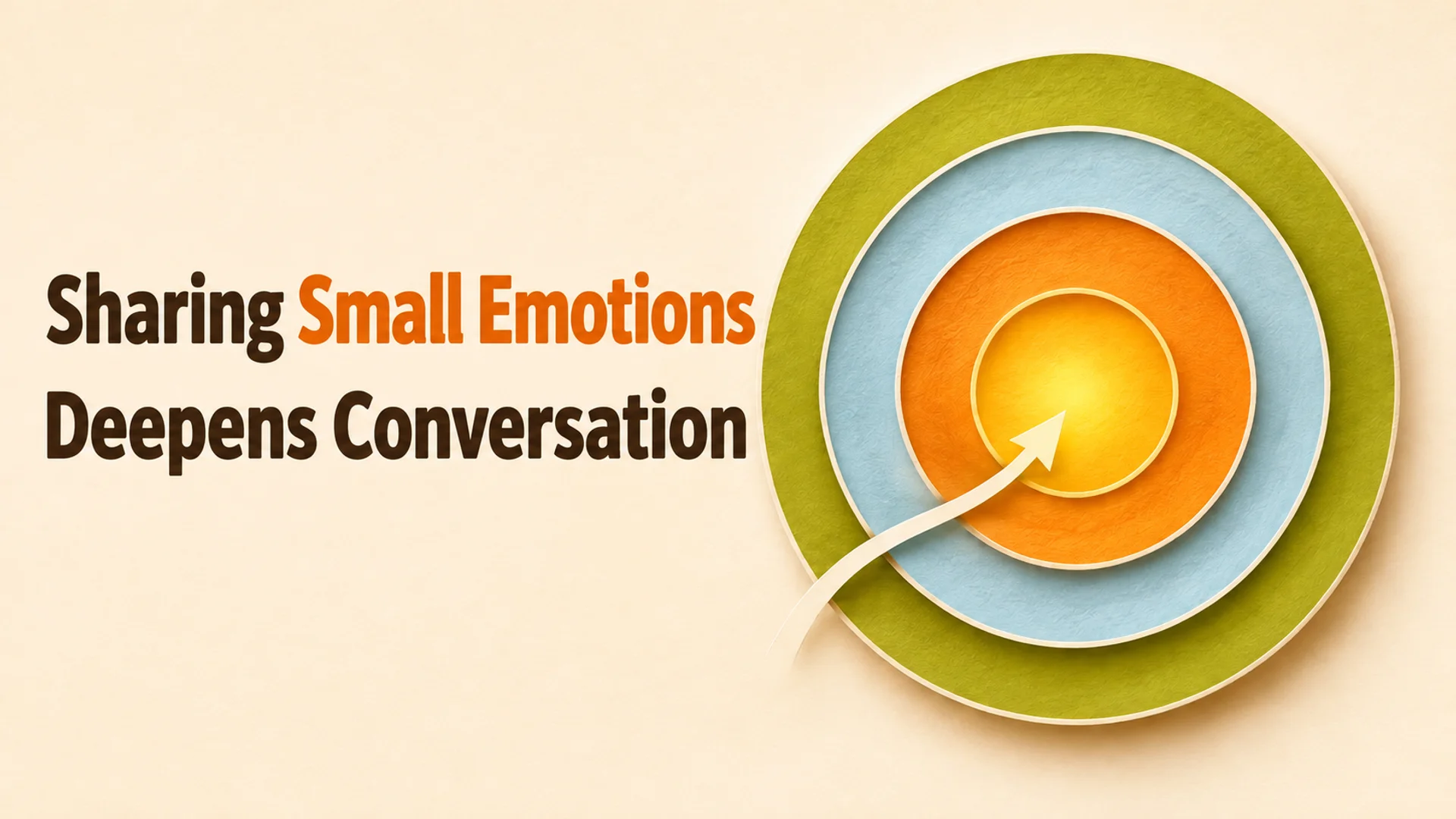
As a relationship grows, we naturally hope that the topics and depth of conversation will expand accordingly, but in reality, conversations often remain stuck at a similar level, causing frustration. Many people believe that asking deeper questions fosters intimacy, but from a psychological perspective, the key to advancing a relationship is not the difficulty of the questions. The core lies in the interaction between the "small emotions" I share first and the other person’s "attitude of responding at the same depth." According to research by Dr. Arthur Aron, featured on the Information Barista blog, relationships advance naturally when you share honest emotions matched to the stage the other person is currently at1.
How can we shift conversation topics to deepen the connection without awkwardness? The answer lies in "matching speeds" and "sharing emotions." Entering a stage that the other person is not yet ready for can create pressure, but revealing a small emotion first from the stage they are at—and opening one layer deeper when you receive a response—is the turning point for deeper conversation.
Why Conversations Stay Shallow: Speed Mismatches and Social Penetration
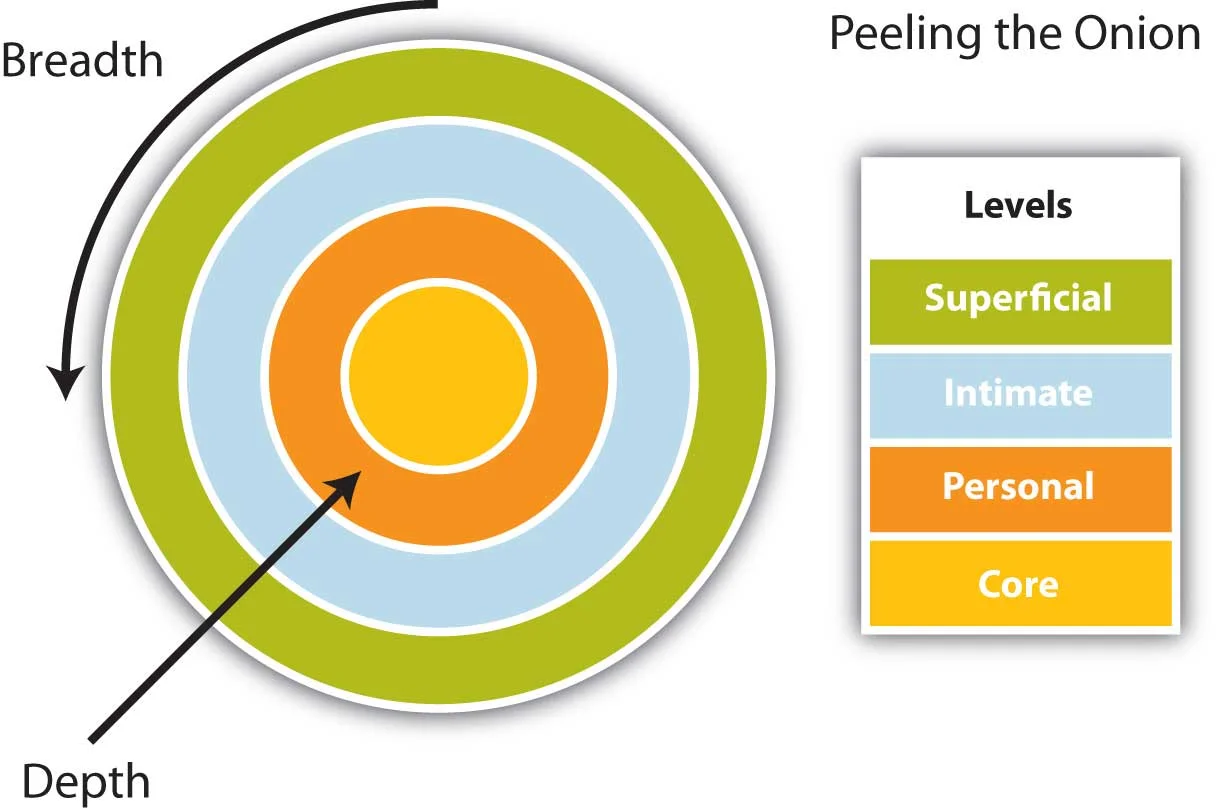
Human relationships are often compared to the layers of an onion. The "Social Penetration Theory" explains that genuine connections are formed by gradually revealing layers, from light daily topics to deep values, step by step2. To deepen a relationship, partners must gradually disclose their inner worlds, including light daily life, personal experiences, and the sharing of vulnerabilities and emotions.
Much of conversational failure stems from "speed mismatches," where one person jumps ahead to deep wounds or complex personal histories while the other remains at the lighter stages. For instance, an experiment conducted in 1997 by Dr. Arthur Aron’s research team at the State University of New York demonstrated that strangers formed deep intimacy by exchanging 36 questions over 45 minutes, engaging in gradual self-disclosure1.
Conversation stages can be understood in three levels1:
- Stage 1 (Light Preferences): Exchanging topics or values that carry no burden.
- Stage 2 (Personal Experiences): Sharing context or hopes related to one’s life.
- Stage 3 (Vulnerabilities and Emotions): Revealing weaknesses or honest emotions.
Conversations become awkward not because of the stages themselves, but due to a failure in pace control—jumping to Stage 3 while the other person wishes to remain at Stage 1.
Stages 1 and 2: Expanding from External Observations to Values

In the early stages of dating, start with "Stage 1 (Light Preferences)" where the other person can answer comfortably. According to resources compiled by Deokgye Editor, it is effective to discuss light interests that align with your level during a first date3. While these topics seem like simple information exchanges, they actually serve as pathways to understand the other person’s values.
The recommended flow for expanding conversation topics is as follows3:
- Light Interests: Hobbies, travel experiences, food preferences (indirectly gauging the other person’s comfort level or adventurousness).
- Mid-Stage Topics: School days, work (attitude), content, routines (understanding upbringing and values).
Specifically, when moving from Stage 1 to Stage 2, questions focused on the other person’s "attitude" feel natural. When discussing work, asking "Do you enjoy your work?" is more effective for understanding their attitude and values than asking "What is your salary?"3.
To maintain an interactive flow, it is important to maintain a "Questions 7 : Answers 3" golden ratio3. One-sided questioning feels like an interview, but adding follow-up questions like "So how was that?" after they finish answering naturally expands the conversation, allowing a smooth transition into Stage 2 topics such as school days or daily routines.
The Gateway to Stage 3: Diagnosing Readiness Through 'Test Exposure'

To enter "Stage 3," where emotions and vulnerabilities are shared, you need a procedure to check if the other person is ready for that pace. Sharing heavy feelings like "I think I’m experiencing burnout" from the start may impose excessive burden (over-disclosure) on the other person.
The YouTube channel 'Psychology Class for Sakes Sake' (Sokneun Semchigo Simri Susup) suggests a discernment procedure called "Test Exposure" for this purpose2. This involves offering a small mistake or light emotional fluctuation first, then observing the other person’s response pattern to decide whether to open up further.
For example, casually mention something like "I made a mistake in today’s meeting and felt my face getting hot," then observe which of the following three reactions occurs2:
- Self-Promotion: They interrupt your story to steal the topic with their own (narcissism in conversation).
- Light Consumption: They laugh off your mistake as gossip or use it as material for back-channel talk.
- Response at the Same Depth: They listen attentively, tuning into your emotions without judgment.
It is safe to open the next layer of your heart only when the other person responds with option 3. Through this process, you can determine if the other person is ready to respond to your emotions.
Mutual Pace Control: The Ping-Pong Principle and the Opening Domino Effect

The most important principle for deepening conversation is the "Ping-Pong Principle." Self-disclosure should not be a monologue performed alone but a process of exchange, like a table tennis game. If you share a Stage 2 level story, you should hold back from opening one more layer until the other person reciprocates at a Stage 2 level1.
Why is "speaking first" more important than "asking questions"? The reason lies in the psychological "Law of Reciprocity." When you confess an honest part of yourself or a small weakness first, the other person’s brain perceives it as "This person is trusting me by sharing this." This perception triggers an "Opening Domino Effect," encouraging the other person to voluntarily share their own stories1.
At the same time, the content of self-disclosure should be "emotions," not just "facts"1.
- Inappropriate Example: "I was scammed, so my bank account balance is zero." (A specific fact that might startle the other person.)
- Appropriate Example: "There was a time I was afraid of failing when I tried a new field." (An empathizable emotion.)
Both are honest shares, but only the latter invites the other person to add their own experience by thinking, "I felt that way too." Ultimately, the turning point for deeper conversation is not the moment you ask a harder question, but the interactive process of first sharing your small emotions in the language of the stage the other person is at, and peeling back one more layer of the onion only when you receive a "sincere response at the same depth." Maintaining this pace is the most reliable standard for advancing a relationship without awkwardness12.
References
- 7편: 호감을 부르는 자기개방: 패스트 프렌즈(Fast-Friends) 기법과 적정 선 · hanmogm.blogspot.com↩
- 자기 이야기를 안 하는 사람의 3가지 심리 | 속마음을 숨기는 진짜 이유 · youtube.com↩
- 첫 데이트 대화 주제 - 심리학 기반 7가지 자연스러운 대화 · deokgye.com↩